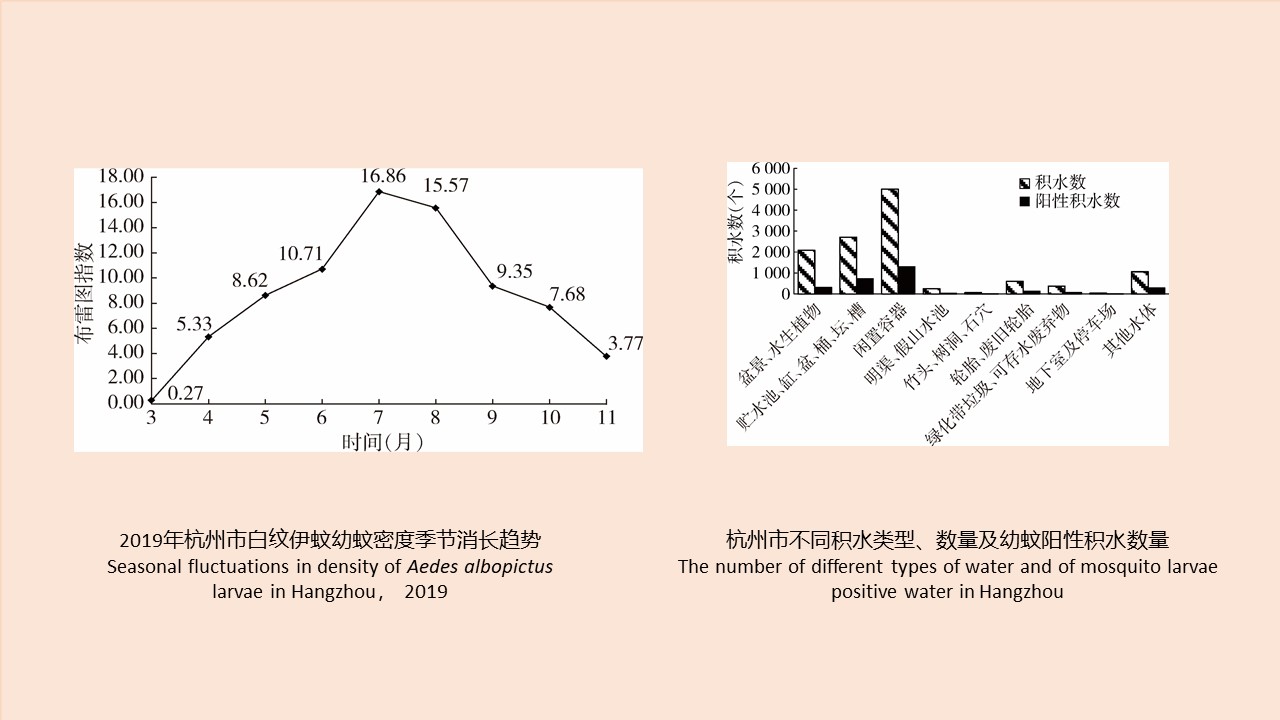
目的 了解杭州市2019年媒介蚊虫构成、种群密度及季节变化趋势,为蚊媒传染病防制提供参考依据。方法 2019年杭州市15个区(县、市)按照《全国病媒生物监测实施方案》和《浙江省病媒生物监测工作方案》开展监测,上城、下城、拱墅、江干和西湖区作为国家级监测点,余杭区和建德市作为省级监测点,其他各区作为常规监测点。成蚊监测时间为4-11月,幼蚊为3-11月;成蚊监测采用诱蚊灯法和双层叠帐法,双层叠帐法国家监测点2次/月,其他监测点1次/月;诱蚊灯法国家和省级监测点2次/月,常规监测点1次/月。幼蚊监测采用布雷图指数(BI)法,省级监测点2次/月,其他监测点1次/月。收集全市15个区(县、市)的蚊虫监测数据,应用Excel 2019软件对监测数据进行汇总分析,计算蚊密度、帐诱指数及BI。结果 2019年杭州市淡色(致倦)库蚊为主要蚊种,占总捕获数的76.88%,其次为骚扰阿蚊、白纹伊蚊、三带喙库蚊和中华按蚊;蚊虫总密度平均为3.09只/(灯·夜),季节消长呈单峰型,7月最高,为7.42只/(灯·夜),之后逐渐下降;不同生境中牲畜棚/养殖场的蚊密度最高,其次为城镇居民区,医院最低,为1.72只/(灯·夜)。帐诱指数平均为2.70只/(顶·h),7月最高,为5.69只/(顶·h),捕获蚊虫均为白纹伊蚊;不同环境类型间帐诱指数差异较大,以废旧物品处/工地最高,为4.32只/(顶·h)。BI值平均为8.84,其季节变化呈单峰模式,7月最高,为16.86,8月以后快速下降,其中6-8月均BI>10.00;阳性积水类型主要为盆景、水生植物,贮水池、缸、盆、桶以及闲置容器;其中闲置容器阳性数最多,为1 304个。结论 2019年杭州市主要优势蚊种为淡色(致倦)库蚊,蚊密度呈现明显的季节消长趋势,成蚊和幼蚊活动高峰均集中在6-10月,存在登革热等蚊媒传染病暴发流行风险。应依据蚊虫监测结果,结合本市当年气候特点,及早采取防蚊灭蚊措施,控制媒介蚊虫密度,防范相关蚊媒疾病的传播流行。
Objective To investigate the species composition, the mixed population density, and seasonal variation of vector mosquitoes in Hangzhou, Zhejiang province, China, 2019, and to provide a reference for the prevention and control of mosquito-borne diseases. Methods In 2019, 15 districts (counties or county-level cities) of Hangzhou carried out mosquito surveillance according to the "National Vector Surveillance Implementation Plan" and "Vector Surveillance Program in Zhejiang". The national surveillance sites included Shangcheng district, Xiacheng district, Gongshu district, Jianggan district, and Xihu district; The provincial surveillance sites included Yuhang district and Jiande city; the other districts were routine surveillance sites. Adult mosquitoes were monitored from April to November, and the larvae from March to November. Adult mosquitoes were monitored using the light trap method (twice a month at the national and provincial surveillance sites and once a month at the routine surveillance sites) and double mosquito net method (twice a month at the national surveillance sites and once a month at the other surveillance sites). Larval mosquitoes were monitored using the Breteau index (BI) method (twice a month at the provincial surveillance sites and once a month at the other surveillance sites). The monitoring data of the 15 districts (counties or county-level cities) were collected and analyzed using Excel 2019 software. The mosquito density, net trapping index, and BI were computed. Results In 2019, Culex pipiens pallens/quinquefasciatus was the main mosquito species, accounting for 76.88% of the total number of mosquitoes captured, followed by Armigeres subalbatus, Aedes albopictus, Cx. tritaeniorhynchus, and Anopheles sinensis. The density of mosquitoes in Hangzhou averaged 3.09 mosquitoes/light·night, with a single peak at 7.42 mosquitoes/light·night in July, after which the density decreased gradually. Among different habitats, livestock sheds/livestock farms had the highest mosquito density, followed by urban residential areas, and hospitals had the lowest density of 1.72 mosquitoes/light·night. The net trap index averaged 2.70 mosquitoes/net·h, and peaked in July at 5.69 mosquitoes/net·h. All mosquitoes captured with the net method were Ae. albopictus. The net trap index differed greatly between different habitats, with the highest index at waste and old goods location/construction sites, which was 4.32 mosquitoes/net·h. BI averaged 8.84, with a single peak at 16.86 in July. BI exceeded 10.00 from June to August, and rapidly declined after August. Positive waters mainly included miniascape, aquatic plants, water tanks, water vats, basins, barrels, and unused containers (the number of unused containers with positive water was 1 304, which was the greatest). Conclusion In 2019, the dominant mosquito species in Hangzhou was Cx. pipiens pallens/quinquefasciatus, and the density of mosquitoes showed clear seasonal fluctuations, with the peak of activities occurring between June and October for both adult and larval mosquitoes. The mosquito vector capacity might sustain mosquito-borne diseases transmission such as dengue. Mosquito control measures should be taken based on the surveillance results and local climate conditions, so as to control mosquito density and prevent the spread of mosquito borne diseases.
[1] 刘起勇. 新时代媒介生物传染病形势及防控对策[J]. 中国媒介生物学及控制杂志,2019,30(1):1-6,11. DOI:10.11853/j.issn.1003.8280.2019.01.001. Liu QY. Epidemic profile of vector-borne diseases and vector control strategies in the new era[J]. Chin J Vector Biol Control,2019,30(1):1-6,11. DOI:10.11853/j.issn.1003.8280.2019. 01.001.
[2] 刘起勇. 气候变化对中国媒介生物传染病的影响及应对:重大研究发现及未来研究建议[J]. 中国媒介生物学及控制杂志,2021,32(1):1-11. DOI:10.11853/j.issn.1003.8280.2021. 01.001. Liu QY. Impact of climate change on vector-borne diseases and related response strategies in China:major research findings and recommendations for future research[J]. Chin J Vector Biol Control,2021,32(1):1-11. DOI:10.11853/j.issn.1003.8280. 2021.01.001.
[3] 吴海霞,刘小波,刘起勇. 我国病媒生物防控现状及面临的问题[J]. 首都公共卫生,2018,12(1):4-6. DOI:10.16760/j.cnki.sdggws.2018.01.002. Wu HX,Liu XB,Liu QY. Current status and problem of vector prevention and control in China[J]. Capital J Public Health,2018,12(1):4-6. DOI:10.16760/j.cnki.sdggws.2018.01.002.
[4] 闫冬明,黄坤,赵春春,等. 常用蚊虫监测方法和技术研究进展[J]. 中国媒介生物学及控制杂志,2020,31(1):108-112. DOI:10.11853/j.issn.1003.8280.2020.01.023. Yan DM,Huang K,Zhao CC,et al. Research advances in common methods and techniques for mosquito surveillance[J]. Chin J Vector Biol Control,2020,31(1):108-112. DOI:10.11853/j.issn.1003.8280.2020.01.023
[5] 刘起勇,孟凤霞,樊景春. 中国重要病媒生物应急监测与控制[J]. 中国媒介生物学及控制杂志,2011,22(1):1-4. Liu QY,Meng FX,Fan JC. Vector surveillance and control in emergencies in China:proceedings and perspectives[J]. Chin J Vector Biol Control,2011,22(1):1-4.
[6] 刘起勇. 病媒生物监测预警研究进展[J]. 疾病监测,2018,33(2):123-128. DOI:10.3784/j.issn.1003-9961.2018.02.005. Liu QY. Research progress on the vector surveillance and early-warning[J]. Dis Surveill,2018,33(2):123-128. DOI:10.3784/j.issn.1003-9961.2018.02.005.
[7] 叶真,夏时畅. 病媒生物综合防制技术指南[M]. 杭州:浙江大学出版社,2012:18. Ye Z,Xia SC. Guidelines for comprehensive prevention and control of vector organisms[M]. Hangzhou:Zhejiang University Press,2012:18.
[8] 马勇建,付磊磊,张云兰,等. 2017-2018年滨州市蚊蝇种群结构及季节消长分析[J]. 现代预防医学,2019,46(17):3197-3200,3210. Ma YJ,Fu LL,Zhang YL,et al. Population structure and seasonal fluctuation of mosquitoes and flies of Binzhou,2017-2018[J]. Mod Prev Med,2019,46(17):3197-3200,3210.
[9] 周甜宇,顾敏华,张建军,等. 2008-2017年江阴市蚊虫监测分析[J]. 中华卫生杀虫药械,2019,25(5):432-436. DOI:10.19821/j.1671-2781.2019.05.011. Zhou TY,Gu MH,Zhang JJ,et al. Surveillance of mosquitoes from 2008 to 2017 in Jiangyin city[J]. Chin J Hyg Insect Equip,2019,25(5):432-436. DOI:10.19821/j.1671-2781. 2019.05.011.
[10] Govella NJ,Chaki PP,Mpangile JM,et al. Monitoring mosquitoes in urban Dar es Salaam:evaluation of resting boxes,window exit traps,CDC light traps,Ifakara tent traps and human landing catches[J]. Parasit Vectors,2011,4(1):40. DOI:10.1186/1756-3305-4-40.
[11] 高健荣,刘金华,刘戟环,等. CO2诱蚊器与紫外光诱蚊器效果对比[J]. 中华卫生杀虫药械,2015,21(4):375-377. DOI:10.19821/j.1671-2781.2015.04.016. Gao JR,Liu JH,Liu JH,et al. The effect comparison between CO2 mosquito trapping device and Uv mosquito trapping device[J]. Chin J Hyg Insect Equip,2015,21(4):375-377. DOI:10.19821/j.1671-2781.2015.04.016.
[12] 凌超,王韶华,武峥嵘,等. 两种成蚊监测法捕蚊效果的比较[J]. 医学动物防制,2020,36(3):294-295. DOI:10.7629/yxdwfz202003026. Ling C,Wang SH,Wu ZR,et al. Comparison of the effect of two adult mosquito monitoring methods in mosquito trapping[J]. J Med Pest Control,2020,36(3):294-295. DOI:10.7629/yxdwfz202003026.
[13] 李剑泉,沈佐锐,王丽英,等. 白纹伊蚊对光线与二氧化碳的行为反应[J]. 昆虫知识,2003,40(4):350-355. DOI:10.3969/j.issn.0452-8255.2003.04.015. Li JQ,Shen ZR,Wang LY,et al. Behavioral response of the mosquito Aedes albopictus to light beams and carbon dioxide[J]. Entomol Knowledge,2003,40(4):350-355. DOI:10.3969/j.issn.0452-8255.2003.04.015.
[14] 马德珍,明明,陆华. 光催化诱蚊灯与BG-trap捕蚊器诱蚊效果比较研究[J]. 中国媒介生物学及控制杂志,2020,31(6):685-689. DOI:10.11853/j.issn.1003.8280.2020.06.012. Ma DZ,Ming M,Lu H. Mosquito-trapping effect of photocatalysis mosquito lamp versus BG-trap mosquito lamp[J]. Chin J Vector Biol Control,2020,31(6):685-689. DOI:10.11853/j.issn.1003. 8280.2020.06.012.
[15] 韦凌娅,孔庆鑫,王慧敏. 双层叠帐法与BG-trap诱捕器法在登革热应急蚊媒监测中的捕蚊效果比较[J]. 中国媒介生物学及控制杂志,2019,30(1):65-68. DOI:10.11853/j.issn.1003. 8280.2019.01.014. Wei LY,Kong QX,Wang HM. Effectiveness of double mosquito net and BG-trap for emergency vector surveillance during dengue fever epidemics:a comparative study[J]. Chin J Vector Biol Control,2019,30(1):65-68. DOI:10.11853/j.issn.1003.8280. 2019.01.014.


