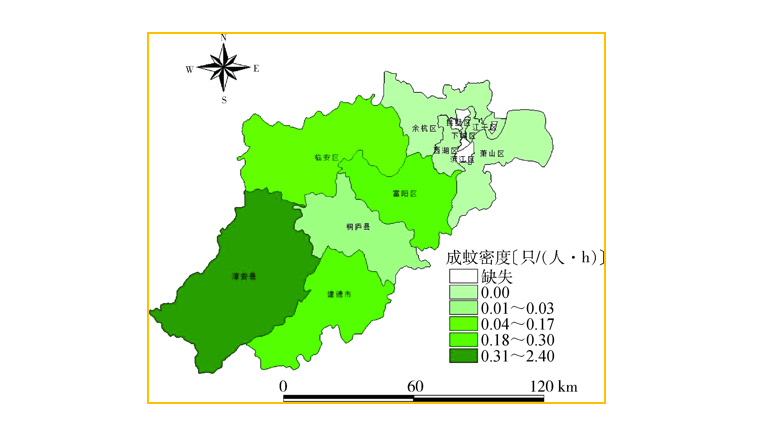
目的 了解杭州市消除疟疾后传疟媒介按蚊种群及密度现状,为消除疟疾后输入性疟疾再传播风险评估及输入性疟疾防控策略的制定提供依据。方法 2018-2019年选取杭州市10个区(县、市)为传疟媒介监测点,采用诱蚊灯法、人诱法、勺捕法分别进行传疟媒介成蚊种群及成蚊、幼蚊密度监测,同时收集2016-2020年杭州市间日疟确诊病例个案调查资料,对传疟媒介及疟疾疫情流行特征进行分析。结果 2018-2019年各监测点采用诱蚊灯法共捕获各类蚊虫1 686只,传疟媒介按蚊中仅发现中华按蚊(116只,占6.88%),主要分布于郊区和农村,城区未捕获;人诱法成蚊密度监测共捕获中华按蚊834只,7月下旬密度最高,其中郊区点为0.56只/(人·h),农村点为5.63只/(人·h),淳安县达到20.50只/(人·h);勺捕法幼蚊密度监测仅在稻田中捕获中华按蚊幼蚊373条,分布在淳安县、桐庐县和临安区,勺舀指数分别为0.70、0.05和0.02条/勺,7月下旬幼蚊密度最高(平均为0.54条/勺)。2016-2020年杭州市共确诊境外输入性间日疟病例12例,病例主要分布在余杭和西湖区;病例发病到确诊的时间平均为(7.08±8.24) d。结论 中华按蚊是杭州市持续存在、唯一的传疟媒介,主要分布在农村且有明显的季节性,境外输入性间日疟病例未及时发现仍存在再传播的风险。
Objective To investigate the population density of Anopheles vector of malaria after elimination of malaria in Hangzhou, China, and to provide a basis for risk assessment of imported malaria transmission and development of control strategy. Methods Ten districts, counties, or cities in Hangzhou were selected as malaria vector monitoring sites from 2018 to 2019. The density of adult (malaria vector) and larval mosquito populations were monitored by lamp-trapping, human-trapping, and dip survey methods. The data of confirmed cases of vivax malaria in Hangzhou from 2016 to 2020 were collected. The characteristics of malaria vector and epidemic were analyzed. Results A total of 1 686 mosquitoes were captured by lamp-trapping from 2018 to 2019. Of malaria vectors, only An. sinensis (116, 6.88%) was captured in the suburb and rural areas. A total of 834 An. sinensis adults were captured by human-trapping. The density was the highest in late July, which was 0.56 mosquitoe/person-hour in suburb areas and 5.63 mosquitoes/person-hour in rural areas (20.50 mosquitoes/person-hour in Chun'an county). Only 373 An. sinensis larvae were captured by dip survey in rice fields, with the density of 0.70, 0.05, and 0.02 larva/dip in Chun'an county, Tonglu county, and Lin'an district, respectively. The density of larvae was the highest in late July (0.54 larva/dip on average). From 2016 to 2020, 12 imported cases of vivax malaria were reported in Hangzhou, mainly in Yuhang district and Xihu district. The mean time from onset to diagnosis was (7.08±8.24) d. Conclusion An. sinensis is the only malaria vector consistently present in Hangzhou, which is mainly found in rural areas and varies significantly across seasons. Undetected imported cases of vivax malaria still pose a risk of transmission in Hangzhou.
[1] Vitoria M,Granich R,Gilks CF,et al. The global fight against HIV/AIDS,tuberculosis,and malaria:Current status and future perspectives[J]. Am J Clin Pathol,2009,131(6):844-848. DOI:10.1309/AJCP5XHDB1PNAEYT.
[2] 阮卫,潘金仁,张轩,等. 浙江省消除疟疾行动计划中期评估报告[J]. 中国热带医学,2016,16(4):354-358. DOI:10.13604/j.cnki.46-1064/r.2016.04.12.Ruan W,Pan JR,Zhang X,et al. Mid-term assessment report of Malaria Elimination Action Plan in Zhejiang[J]. China Trop Med,2016,16(4):354-358. DOI:10.13604/j.cnki.46-1064/r.2016.04.12.
[3] 金行一,朱素娟,徐卫民,等. 杭州市消除疟疾前后流行特征分析[J]. 预防医学,2018,30(7):676-679,684. DOI:10.19485/j.cnki.issn2096-5087.2018.07.007.Jin XY,Zhu SJ,Xu WM,et al. Epidemiological characteristics of malaria before and after the elimination in Hangzhou[J]. Prev Med,2018,30(7):676-679,684. DOI:10.19485/j.cnki.issn2096-5087.2018.07.007.
[4] 杨献青,方利洪,王卫强,等. 建德市疟疾流行病学特征分析[J]. 预防医学,2018,30(5):482-489. DOI:10.19485/j.cnki.issn2096-5087.2018.05.013.Yang XQ,Fang LH,Wang WQ,et al. Epidemiological characteristics of malaria in Jiande[J]. Prev Med,2018,30(5):482-489. DOI:10.19485/j.cnki.issn2096-5087.2018.05.013.
[5] 丰燕,阮卫,潘金仁,等. 浙江省2012-2017年传疟媒介监测结果分析[J]. 中国媒介生物学及控制杂志,2019,30(5):540-544. DOI:10.11853/j.issn.1003.8280.2019.05.014.Feng Y,Ruan W,Pan JR,et al. An analysis of surveillance results of malaria vectors in Zhejiang province,China,from 2012 to 2017[J]. Chin J Vector Biol Control,2019,30(5):540-544. DOI:10.11853/j.issn.1003.8280.2019.05.014.
[6] 浙江省农业厅农作物管理局. 浙江省水稻生产概况和特点[EB/OL]. (2006-03-28)[2021-03-31]. https://wenku.baidu.com/view/4ca436c8d5bbfd0a7956736b.html. Agricultural Administration Bureau of Zhejiang province. General situation and characteristics of rice production in Zhejiang province[EB/OL]. (2006-03-28)[2021-03-31]. https://wenku.baidu.com/view/4ca436c8d5bbfd0a7956736b.html.
[7] 李凯杰,尚晓鹏,皮琦,等. 湖北省主要传疟媒介按蚊生态习性及密度分析[J]. 国际医学寄生虫病杂志,2015,42(6):328-331. DOI:10.3760/cma.j.issn.1673-4122.2015.06.005.Li KJ,Shang XP,Pi Q,et al. Analysis on the density and ecological habit of the main malaria vector Anopheles in Hubei province[J]. Int J Med Parasit Dis,2015,42(6):328-331. DOI:10.3760/cma.j.issn.1673-4122.2015.06.005.
[8] 金行一,朱素娟,徐卫民,等. 2003-2013年杭州市境外输入性疟疾报告病例分析[J]. 中国预防医学杂志,2015,16(4):279-282. DOI:10.16506/j.1009-6639.2015.04.009.Jin XY,Zhu SJ,Xu WM,et al. Epidemiological analysis on imported malaria cases in Hangzhou from 2003 to 2013[J]. Chin Prev Med,2015,16(4):279-282. DOI:10.16506/j.1009-6639.2015.04.009.


