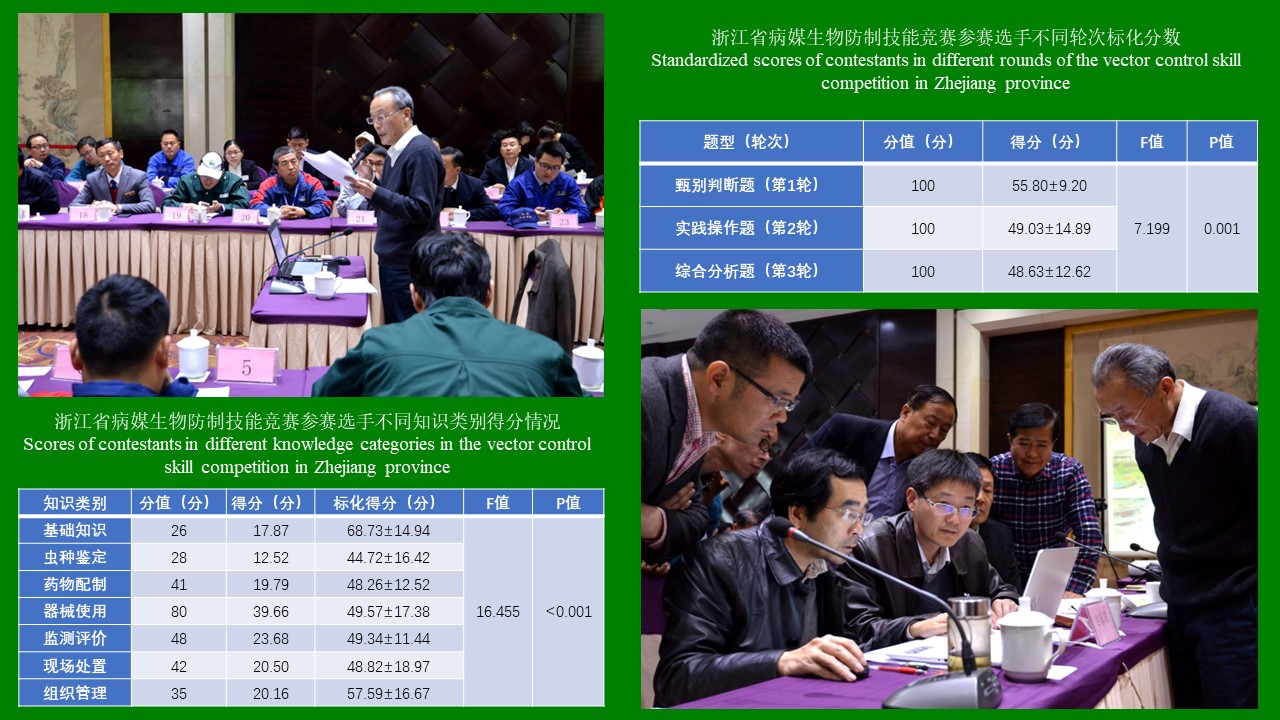
Objective To master the basic theoretical knowledge, on-site disposal, and comprehensive analysis capabilities of practitioners in vector control services in Zhejiang province, China, and to provide a decision-making basis for improving training strategies. Methods Based on a vector control skills competition organized by the Zhejiang Provincial Association for Elimination of the Four Pests with the participation of 45 technicians from 15 AAA-level members of the association, the contestants' mastery of control knowledge was analyzed, and differences in scores between different question types, regions, vector species, and knowledge categories were analyzed. SPSS 17.0 software was used for difference comparison and variance analysis. Results After standardized by a 100-point conversion, the average score of all contestants was 51.15 points, with the highest score of 72.00 points and the lowest score of 27.83 points. According to three different rounds of discriminatory judgment questions, field practical questions, and comprehensive analysis questions, the scores in the first round showed significant differences from those in the second round (F=9.789, P=0.003) and in the third round (F=11.768, P=0.001). There were no significant differences in scores between different regions (F=0.310, P=0.735). In the analysis of vector species, the scoring rates in the knowledge about rodents, mosquitoes, multiple vectors, and cockroaches decreased in turn. Except for mosquitoes and rats, cockroaches and multiple vectors, there were statistically significant differences between the scores of other vectors (all P<0.5). In the analysis of 7 knowledge categories, the contestants' mastery of basic knowledge and organizational management knowledge was significantly higher than that of 5 other knowledge categories such as insect species identification and on-site disposal (all P<0.5). Conclusion Practitioners in vector control services in Zhejiang province have overall low professional skills, insufficient coverage of knowledge categories, uneven mastery level, and weak spots in some knowledge categories, especially the identification of insect species, on-site disposal, and monitoring and evaluation. It is necessary to do a good job in training the basic knowledge of practitioners in a targeted manner, and to highlight the training of skills such as on-site practical operation and comprehensive analysis.
[1] 张新卫, 高奕. 公共环境病媒生物防制指南[M]. 杭州:浙江科学技术出版社, 2021:2. Zhang XW, Gao Y. Guidelines for vector control in the public environment[M]. Hangzhou:Zhejiang Science and Technology Publishing House, 2021:2. (in Chinese)
[2] 蒋洪, 沈培谊. 提升有害生物防治公司应急能力的探讨[J]. 中华卫生杀虫药械, 2021, 27(2):97-101. DOI:10.19821/j.1671-2781.2021.02.001. Jiang H, Shen PY. Development strategies of emergency response capacity for pest control enterprises[J]. Chin J Hyg Insect Equip, 2021, 27(2):97-101. DOI:10.19821/j.1671-2781.2021. 02.001.(in Chinese)
[3] 刘起勇. 新时代媒介生物传染病形势及防控对策[J]. 中国媒介生物学及控制杂志, 2019, 30(1):1-6, 11. DOI:10.11853/j.issn.1003.8280.2019.01.001. Liu QY. Epidemic profile of vector-borne diseases and vector control strategies in the new era[J]. Chin J Vector Biol Control, 2019, 30(1):1-6, 11. DOI:10.11853/j.issn.1003.8280.2019.01. 001.(in Chinese)
[4] 龚震宇, 张新卫, 侯娟, 等.浙江省病媒生物防制工作实践、存在的问题及对策建议[J].中国媒介生物学及控制杂志, 2020, 31 (2):121-125. DOI:10.11853/j.issn.1003.8280.2020.02.001. Gong ZY, Zhang XW, Hou J, et al. Practice, deficiencies, and countermeasures of vector control in Zhejiang province, China[J]. Chin J Vect Biol Control, 2020, 31(2):121-125. DOI:10.11853/j.issn.1003.8280.2020.02.001. (in Chinese)
[5] 龚震宇, 刘钦梅, 王金娜, 等. 新时代中国特色爱国卫生运动增添新内涵:病媒生物预防控制浙江模式的探索[J]. 疾病监测, 2021, 36(4):312-317. DOI:10.3784/jbjc.202104010422. Gong ZY, Liu QM, Wang JN, et al. New connotations for patriotic health campaign with Chinese characteristics in new era:Exploration of vector prevention and control pattern in Zhejiang[J]. Dis Surveill, 2021, 36(4):312-317. DOI:10.3784/jbjc. 202104010422.(in Chinese)
[6] 张莉莉, 蔡路, 张雅明, 等. 病媒生物应急能力模拟演练模式的探讨[J]. 中国媒介生物学及控制杂志, 2016, 27(4):416-417. DOI:10.11853/j.issn.1003.8280.2016.04.029. Zhang LL, Cai L, Zhang YM, et al. Discussion on the drill model of the emergency vector control[J]. Chin J Vect Biol Control, 2016, 27(4):416-417. DOI:10.11853/j.issn.1003.8280.2016. 04.029.(in Chinese)
[7] 季恒青, 涂涛田, 冯绍全, 等. 重庆市有害生物防治行业现状与发展需求调查分析[J]. 中华卫生杀虫药械, 2016, 22(6):599-602. DOI:10.19821/j.1671-2781.2016.06.024. Ji HQ, Tu TT, Feng SQ, et al. Survey and analysis of pest control operations in Chongqing city[J]. Chin J Hyg Insect Equip, 2016, 22(6):599-602. DOI:10.19821/j.1671-2781.2016.06.024.(in Chinese)
[8] 王伟, 张静, 秦娜. 天津市有害生物防治从业人员问卷调查与分析[J]. 中国媒介生物学及控制杂志, 2013, 24(6):541-543. DOI:10.11853/j.issn.1003.4692.2013.06.019. Wang W, Zhang J, Qin N. Questionnaire survey and analysis of pest control workers in Tianjin, China[J]. Chin J Vect Biol Control, 2013, 24(6):541-543. DOI:10.11853/j.issn.1003.4692. 2013.06.019.(in Chinese)
[9] 杜志辉, 邓兵, 谭雅宁, 等. 我国PCO产业的技术局限性探讨[J]. 中华卫生杀虫药械, 2017, 23(5):477-479. DOI:10.19821/j.1671-2781.2017.05.022. Du ZH, Deng B, Tan YN, et al. Discussion on the technical limitations of PCO industry in China[J]. Chin J Hyg Insect Equip, 2017, 23(5):477-479. DOI:10.19821/j.1671-2781. 2017.05.022.(in Chinese)
[10] 付彦平, 高希武. 国内PCO行业从业人员现状浅析[J]. 中国媒介生物学及控制杂志, 2010, 21(6):624-625, 637. Fu YP, Gao XW. The status quo of professionals in pest control organizations in China[J]. Chin J Vect Biol Control, 2010, 21(6):624-625, 637. (in Chinese)
[11] 冯向阳. 有害生物防治业参与卫生城市创建的思考[J]. 中国媒介生物学及控制杂志, 2018, 29(2):175-176, 196. DOI:10.11853/j.issn.1003.8280.2018.02.015. Feng XY. Thoughts about the participation of pest control operations in creation of a healthy city[J]. Chin J Vect Biol Control, 2018, 29(2):175-176, 196. DOI:10.11853/j.issn.1003. 8280.2018.02.015.(in Chinese)
[12] 龚沙磊, 陈耀荣, 白勇, 等. 浅谈国内外PCO产业现状与发展对策[J]. 中国媒介生物学及控制杂志, 2009, 20(6):615. Gong SL, Chen YR, Bai Y, et al. Current status and development of domestic and foreign pest control organization[J]. Chin J Vect Biol Control, 2009, 20(6):615. (in Chinese)
[13] 蒋洪. 后疫情时代有害生物防治业发展策略探讨[J]. 中华卫生杀虫药械, 2020, 26(5):401-405. DOI:10.19821/j.1671-2781.2020.05.001. Jiang H. Development strategies for pest control industry after pandemic of COVID-19[J]. Chin J Hyg Insect Equip, 2020, 26(5):401-405. DOI:10.19821/j.1671-2781.2020.05.001.(in Chinese)
[14] 王桂安, 孙斌, 马晓, 等. 媒介生物防制培训信息系统的建设及实践[J]. 中国媒介生物学及控制杂志, 2018, 29(4):420-423. DOI:10.11853/j.issn.1003.8280.2018.04.026. Wang GA, Sun B, Ma X, et al. Construction and practice of vector control training information system[J]. Chin J Vect Biol Control, 2018, 29(4):420-423. DOI:10.11853/j.issn.1003.8280.2018. 04.026.(in Chinese)
[15] 周良才, 施维, 倪涛, 等. 武汉市社区外环境有害生物防制工作质量控制研究[J]. 中国媒介生物学及控制杂志, 2016, 27(4):404-406. DOI:10.11853/j.issn.1003.8280.2016.04.025. Zhou LC, Shi W, Ni T, et al. Quality control on pest management services for the external environment in Wuhan city[J]. Chin J Vect Biol Control, 2016, 27(4):404-406. DOI:10.11853/j.issn. 1003.8280.2016.04.025.(in Chinese)

