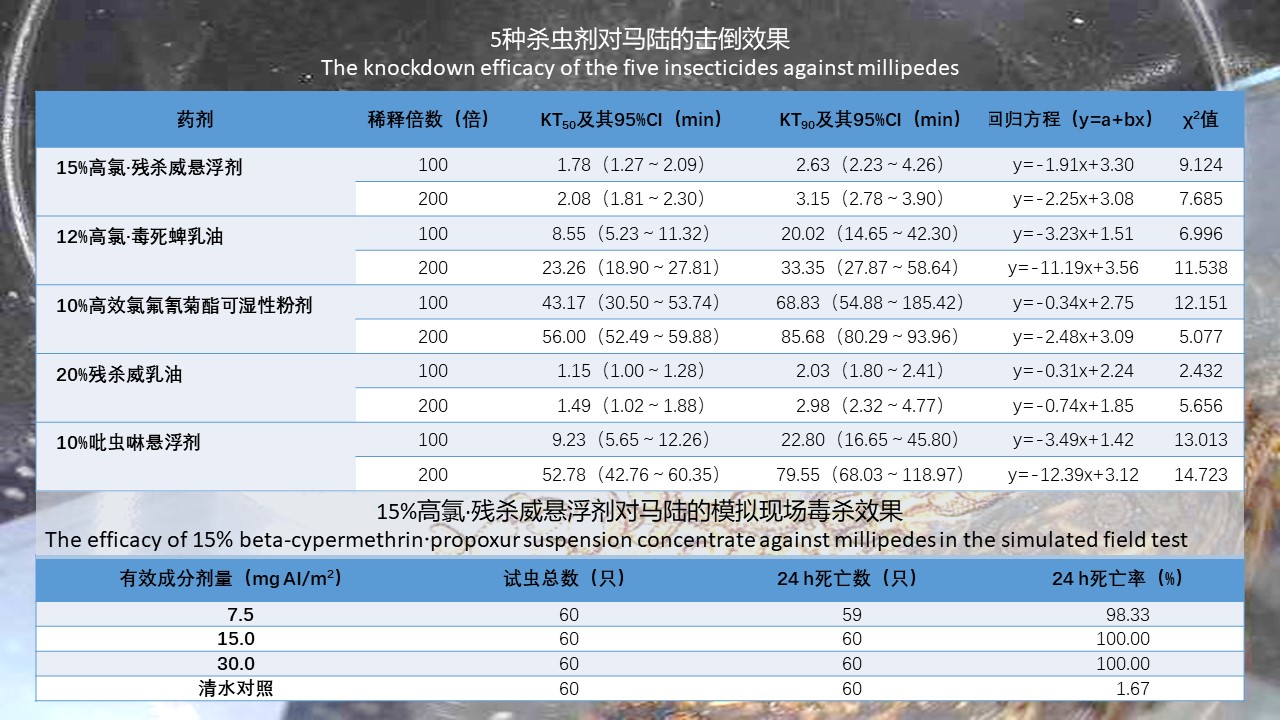
Objective To investigate the killing efficacy of several commonly used public health insecticides for the control of millipedes, and to provide scientific evidence for millipede control. Methods The insecticide screening test was performed to determine the toxicity of five insecticides with different insecticidal mechanisms to millipedes. The median lethal dose (LD50) of 15% beta-cypermethrin·propoxur suspension concentrate (SC) was estimated, followed by simulated filed testing to verify its killing efficacy. Excel 2016 and SPSS 19.0 softwares were used for data analysis. The Chi-squared test was used to compare the knockdown effects of different insecticides on millipedes. Results The insecticide screening test showed that the 100 fold dilutions of 15% beta-cypermethrin·propoxur SC, 12% beta-cypermethrin·chlorpyrifos emulsifiable concentrate (EC), 10% lambda-cyhalothrin wettable powder, 20% propoxur EC, and 10% imidacloprid SC had:median knockdown times (KT50) being 1.78, 8.55, 43.17, 1.15, and 9.23 min, respectively; times taken to knockdown 90% of millipedes (KT90) being 2.63, 20.02, 68.83, 2.03, and 22.80 min, respectively; 2-h mortality rates after insecticide application being 76.25%, 56.25%, 73.33%, 56.67%, and 46.67%, respectively; and 24-h mortality rates all being 100%. The 200 fold dilutions of the five insecticides had:KT50 being 2.08, 23.26, 56.00, 1.49, and 52.78 min, respectively; KT90 being 3.15, 33.35, 85.68, 2.98, and 79.55 min, respectively; 2-h mortality rates being 65.00%, 47.50%, 68.33%, 40.00%, and 36.67%; and 24-h mortality rates all being 100%. The laboratory toxicity test showed that the LD50 of 15% beta-cypermethrin·propoxur SC against millipedes was 5.42 mg AI/m2. The simulated field test showed that the 24-h mortality rates of millipedes with 15% beta-cypermethrin·propoxur SC at 7.5, 15.0, and 30.0 mg AI/m2 were 98.33%, 100%, and 100%, respectively. Conclusion Among the five commonly used insecticides, 15% beta-cypermethrin·propoxur SC has relatively excellent efficacy in killing millipedes, which provides a reference for insecticide selection to control millipedes in public environment.
ZHENG Feng-yun, CHEN Feng-ling, HUANG He
. Comparative study on the killing efficacy of 15% beta-cypermethrin·propoxur suspension concentrate and other four insecticides on millipede[J]. Chinese Journal of Vector Biology and Control, 2022
, 33(3)
: 438
-441
.
DOI: 10.11853/j.issn.1003.8280.2022.03.024
[1] 杨美霞, 申健, 杨超, 等. 奇马陆亚科分类研究进展[J]. 西安文理学院学报(自然科学版), 2018, 21(6):78-80, 100. DOI:10.3969/j.issn.1008-5564.2018.06.018. Yang MX, Shen J, Yang C, et al. Research progress on the taxonomy of subfamily paradoxosomatinae[J]. J Xi'an Univ (Nat Sci Ed), 2018, 21(6):78-80, 100. DOI:10.3969/j.issn.1008-5564.2018.06.018.(in Chinese)
[2] Sierwald P, Bond JE. Current status of the myriapod class Diplopoda (Millipedes):Taxonomic diversity and phylogeny[J]. Ann Rev Entomol, 2007, 52(1):401-420. DOI:10.1146/annurev.ento.52.111805.090210.
[3] 王梦茹, 傅声雷, 徐海翔, 等. 陆地生态系统中马陆的生态功能[J]. 生物多样性, 2018, 26(10):1051-1059. DOI:10.17520/biods.2018086. Wang MR, Fu SL, Xu HX, et al. Ecological functions of millipedes in the terrestrial ecosystem[J]. Biodiv Sci, 2018, 26(10):1051-1059. DOI:10.17520/biods.2018086.(in Chinese)
[4] Shelley RM. Taxonomy of extant Diplopoda (Millipeds) in the modern era:Perspectives for future advancements and observations on the global diplopod community (Arthropoda:Diplopoda)[J]. Zootaxa, 2007, 1668(1):343-362. DOI:10. 11646/zootaxa.1668.1.18.
[5] Ashwini KM, Sridhar KR. Distribution of pill millipedes (Arthrosphaera) and associated soil fauna in the Western Ghats and west coast of India[J]. Pedosphere, 2008, 18(6):749-757. DOI:10.1016/S1002-0160(08)60070-3.
[6] 张雪萍, 李春艳, 张思冲. 马陆在森林生态系统物质转化中的功能研究[J]. 生态学报, 2001, 21(1):75-79. DOI:10.3321/j.issn:1000-0933.2001.01.012. Zhang XP, Li CY, Zhang SC. Study of the function of millipedes in substance decomposition[J]. Acta Ecol Sin, 2001, 21(1):75-79. DOI:10.3321/j.issn:1000-0933.2001.01.012.(in Chinese)
[7] 王静, 孔飞, 刘艳, 等. 陕西地区马陆的发生规律及防治技术[J]. 陕西林业科技, 2011(2):58-59. DOI:10.3969/j.issn.1001-2117.2011.02.017. Wang J, Kong F, Liu Y, et al. The occurrence regularity and control techniques of Spirobolus bungii in Shaanxi[J]. Shaanxi Forest Sci Technol, 2011(2):58-59. DOI:10.3969/j.issn.1001-2117.2011.02.017.(in Chinese)
[8] 汪彩云, 李勇. 马陆为害毛木耳耳片的调查与防治建议[J]. 中国蔬菜, 2010(19):28-29. Wang CY, Li Y. Investigation and prevention recommendations on millipedes damage Auricularia auricula[J]. China Veget, 2010(19):28-29. (in Chinese)
[9] Douglas J, Hoffmann A, Umina P, et al. Factors influencing damage by the portuguese millipede, Ommatoiulus moreleti (Julida:Julidae), to crop seedlings[J]. J Econom Entomol, 2019, 112(6):2695-2702. DOI:10.1093/jee/toz180.
[10] Brunke AJ, Bahlai CA, Sears MK, et al. Generalist predators (Coleoptera:Carabidae, Staphylinidae) associated with millipede populations in sweet potato and carrot fields and implications for millipede management[J]. Environ Entomol, 2009, 38(4):1106-1116. DOI:10.1603/022.038.0418.
[11] Messelink GJ, Bloemhard CMJ. Woodlice (Isopoda) and millipedes (Diplopoda):Control of rare greenhouse pests[J]. Proc Neth Entomol Soc Meet, 2007, 18:43-48.
[12] 吴仁海, 孙慧慧, 苏旺苍, 等. 马陆防治措施研究[J]. 河南农业科学, 2015, 44(1):90-93. DOI:10.15933/j.cnki.1004-3268. 2015.01.019. Wu RH, Sun HH, Su WC, et al. Research on control strategies of millipede[J]. J Henan Agric Sci, 2015, 44(1):90-93. DOI:10.15933/j.cnki.1004-3268.2015.01.019.(in Chinese)

