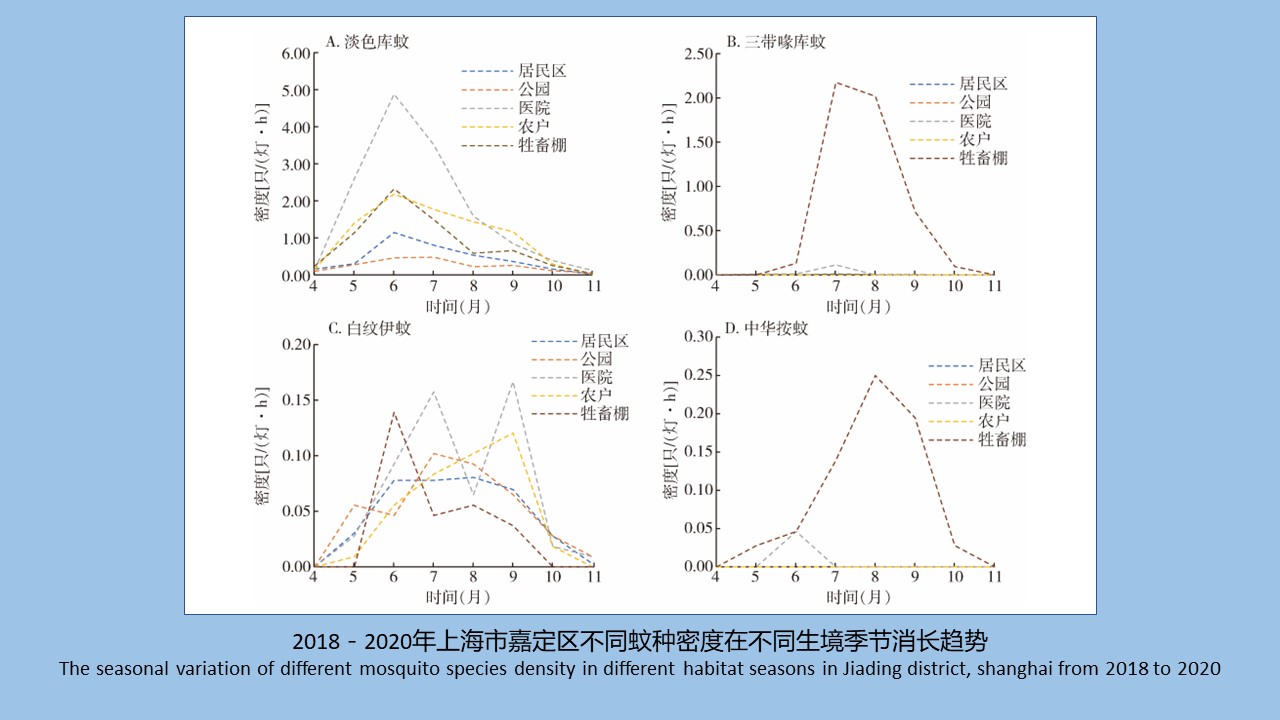
Objective To investigate the species, population density, habitat distribution, and seasonal trend of adult mosquitoes in Jiading district, Shanghai, China in recent years, and to provide a scientific basis for the control of mosquitoes and mosquito-borne diseases. Methods Adult mosquitoes were monitored by the CO2-baited baited light trap method in various habitats from 2018 to 2020, and analyzed mosquito species composition, seasonal fluctuation, and density differences between various habitats.Differences in mosquito species composition were examined using Chi-squared test, and ANOVA was used to analyze differences of density in different habitats. Results Culex pipiens pallens accounted for the highest proportion (82.70%) of the captured mosquitoes, followed by Cx. tritaeniorhynchus (10.32%) and Aedes albopictus (5.49%). The composition ratio of each mosquito species was significantly different in different years (P ≤ 0.001). The densities of Cx. pipiens pallens and Cx. tritaeniorhynchus peaked in June and July, respectively, being 2.28 and 0.39 mosquitoes/lamp·h, respectively. The peak periods of Ae. albopictus and Anopheles sinensis lasted for a longer time, appearing from June to September and from July to September, respectively. Among various types of habitats, the average mosquito density was highest in hospitals (1.41 mosquitoes/lamp·h) and lowest in parks (0.25 mosquitoes/lamp·h). Cx. pipiens pallens was the absolutely dominant species in all monitored habitats. The densities of Cx. tritaeniorhynchus (0.51 mosquitoes/lamp·h) and An. sinensis (0.07 mosquitoes/lamp·h) in livestock sheds were significantly much higher than their densities in other habitats (F=3.763, P=0.012; F=6.194, P<0.001). The peak time of Ae. albopictus varied greatly in different habitats. During the peak season of mosquito activity, Ae. albopictus densities in hospitals and parks showed a decrease followed by an increase, with the decline occurring in August and June, respectively. Conclusion The density of mosquitoes in Jiading district is generally at a relatively low level. However, mosquito control in hospitals, livestock sheds, and residential areas should be strengthened. Targeted, scientific, and effective control strategies should be taken according to the activity patterns of different mosquito species.
[1] 潘士贤. 蚊虫与疾病[J]. 应用预防医学, 2013, 19(4):190, 257. DOI:10.3969/j.issn.1673-758X.2013.04.001. Pan SX. Mosquitoes and disease[J]. Appl Prev Med, 2013, 19(4):190, 257. DOI:10.3969/j.issn.1673-758X.2013.04.001.(in Chinese)
[2] 梁国栋. 虫媒病毒:重要的被忽略的热带传染病病原体[J]. 中国热带医学, 2018, 18(1):1-5. DOI:10.13604/j.cnki.46-1064/r.2018.01. Liang GD. Arbovirus-the very important pathogen of neglected tropical infectious disease in the world[J]. China Trop Med, 2018, 18(1):1-5. DOI:10.13604/j.cnki.46-1064/r.2018.01.(in Chinese)
[3] 张洁, 刘学升, 王子江, 等. 辽宁省2014-2018年登革热流行特征分析[J]. 中国热带医学, 2019, 19(12):1191-1193. DOI:10.13604/j.cnki.46-1064/r.2019.12.22. Zhang J, Liu XS, Wang ZJ, et al. Epidemiological analysis of dengue fever in Liaoning, 2014-2018[J]. China Trop Med, 2019, 19(12):1191-1193. DOI:10.13604/j.cnki.46-1064/r.2019.12.22.(in Chinese)
[4] 薛海滨, 孟金霞, 任乐, 等. 山东省临沂市2018-2020年白纹伊蚊幼蚊监测与风险评估[J]. 中国媒介生物学及控制杂志, 2021, 32(6):686-690. DOI:10.11853/j.issn.1003.8280.2021. 06.006. Xue HB, Meng JX, Ren L, et al. Larval Aedes albopictus mosquito surveillance and risk assessment in Linyi, Shandong province, China, 2018-2020[J]. Chin J Vector Biol Control, 2021, 32(6):686-690. DOI:10.11853/j.issn.1003.8280.2021.06.006.(in Chinese)
[5] Yue YJ, Sun JM, Liu XB, et al. Spatial analysis of dengue fever and exploration of its environmental and socio-economic risk factors using ordinary least squares:A case study in five districts of Guangzhou city, China, 2014[J]. Int J Infect Dis, 2018, 75:39-48. DOI:10.1016/j.ijid.2018.07.023.
[6] Focks DA, Haile DG, Daniels E, et al. Dynamic life table model for Aedes aegypti (Diptera:Culicidae):Simulation results and validation[J]. J Med Entomol, 1993, 30(6):1018-1028. DOI:10.1093/jmedent/30.6.1018.
[7] 张承启, 段丽琼, 吕炜, 等. 浅谈登革热媒介控制的重点[J]. 中华卫生杀虫药械, 2021, 27(2):189-190. DOI:10.19821/j.1671-2781.2021.02.025. Zhang CQ, Duan LQ, Lyu W, et al. Discussion on the key points of dengue vector control[J]. Chin J Hyg Insect Equip, 2021, 27(2):189-190. DOI:10.19821/j.1671-2781.2021.02.025.(in Chinese)
[8] 朱江, 刘洪霞, 刘曜, 等. 上海地区2010-2016年蚊虫监测结果分析[J]. 上海预防医学, 2018, 30(8):635-639. DOI:10.19428/j.cnki.sjpm.2018.18785. Zhu J, Liu HX, Liu Y, et al. Mosquito monitoring result analysis in Shanghai, 2010-2016[J]. Shanghai J Prev Med, 2018, 30(8):635-639. DOI:10.19428/j.cnki.sjpm.2018.18785.(in Chinese)
[9] 林晨, 冯磊, 顾盈培, 等. 上海市浦东新区2017-2019年蚊虫密度与种群构成研究[J]. 上海预防医学, 2020, 32(12):974-979. DOI:10.19428/j.cnki.sjpm.2020.20316. Lin C, Feng L, Gu YP, et al. Mosquito population composition and density fluctuation in Shanghai Pudong new area from 2017 to 2019[J]. Shanghai J Prev Med, 2020, 32(12):974-979. DOI:10.19428/j.cnki.sjpm.2020.20316.(in Chinese)
[10] 吴海霞, 鲁亮, 孟凤霞, 等. 2006-2015年我国蚊虫监测报告[J]. 中国媒介生物学及控制杂志, 2017, 28(5):409-415. DOI:10.11853/j.issn.1003.8280.2017.05.001. Wu HX, Lu L, Meng FX, et al. Reports on national surveillance of mosquitoes in China, 2006-2015[J]. Chin J Vector Biol Control, 2017, 28(5):409-415. DOI:10.11853/j.issn.1003. 8280.2017.05.001.(in Chinese)
[11] 王韶华, 武峥嵘, 钟培松, 等. 上海市嘉定区白纹伊蚊分布及其种群密度监测[J]. 上海预防医学, 2018, 30(8):640-644. DOI:10.19428/j.cnki.sjpm.2018.18776. Wang SH, Wu ZR, Zhong PS, et al. Distribution of Aedes albopictus and its population density monitoring in Jiading district of Shanghai[J]. Shanghai J Prev Med, 2018, 30(8):640-644. DOI:10.19428/j.cnki.sjpm.2018.18776.(in Chinese)
[12] 高强, 曹晖, 熊成龙, 等. 两种方法监测成蚊种群构成与变化的差异性研究[J]. 中华卫生杀虫药械, 2015, 21(3):254-258. DOI:10.19821/j.1671-2781.2015.03.014. Gao Q, Cao H, Xiong CL, et al. Comparison of mosquito population composition and dynamics between human-baited landing and CO2-baited trapping monitoring methods[J]. Chin J Hyg Insect Equip, 2015, 21(3):254-258. DOI:10.19821/j.1671-2781.2015.03.014.(in Chinese)
[13] 杨维芳, 张育富, 刘大鹏, 等. 江苏省2008-2018年蚊虫种群消长研究[J]. 中国媒介生物学及控制杂志, 2021, 32(1):45-51. DOI:10.11853/j.issn.1003.8280.2021.01.009. Yang WF, Zhang YF, Liu DP, et al. A study of mosquito population variation in Jiangsu province, China, 2008-2018[J]. Chin J Vector Biol Control, 2021, 32(1):45-51. DOI:10.11853/j.issn.1003.8280.2021.01.009.(in Chinese)
[14] 李春晓, 郭晓霞, 黄恩炯, 等. 城市中三带喙库蚊新孳生地的发现[J]. 中国媒介生物学及控制杂志, 2007, 18(1):31. DOI:10.3969/j.issn.1003-4692.2007.01.034. Li CX, Guo XX, Huang EJ, et al. Discovery of new breeding sites of Culex tritaeniorhynchus in urban areas[J]. Chin J Vector Biol Control, 2007, 18(1):31. DOI:10.3969/j.issn.1003-4692. 2007.01.034. (in Chinese)
[15] 马德珍, 明明, 陆华. 光催化诱蚊灯与BG-trap捕蚊器诱蚊效果比较研究[J]. 中国媒介生物学及控制杂志, 2020, 31(6):685-689. DOI:10.11853/j.issn.1003.8280.2020.06.012. Ma DZ, Ming M, Lu H. Mosquito-trapping effect of photocatalysis mosquito lamp versus BG-trap mosquito lamp[J]. Chin J Vector Biol Control, 2020, 31(6):685-689. DOI:10.11853/j.issn.1003. 8280.2020.06.012.(in Chinese)

