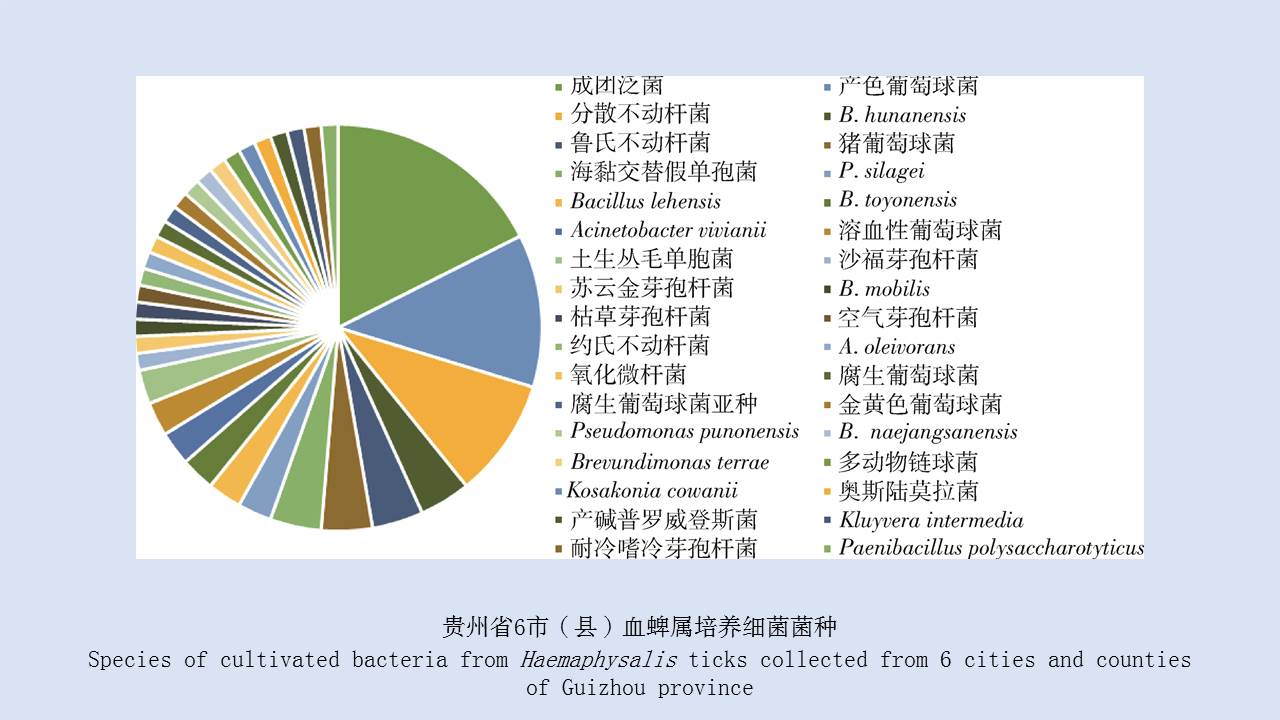
Objective To investigate the situation of ticks and tick-borne bacteria in some areas of Guizhou province, China, and to provide a scientific basis for the prevention and control of tick-borne diseases. Methods Parasitic ticks were collected from the body surface of cattle, sheep, and rodents in Xiuwen county, Qinglong county, Xingyi city, Xingren city, Wangmo county, and Jiangkou county of Guizhou province, in April 2017 and April 2019. Morphological identification was performed on the ticks. Some ticks were selected for bacterial culture using blood agar and brain-heart infusion agar. Colonies with different morphologies were selected for bacterial passage and purification, followed by full 16S rDNA amplification and sequencing to identify the species of bacteria. Results A total of 742 on-host ticks belonging to 6 species of 3 genera were collected. Haemaphysalis longicornis was the dominant species, accounting for 69.81% of the total catches, followed by Rhipicephalus microplus, accounting for 23.05%, and the other tick species only accounted for 7.14%. A total of 188 strains of bacteria were acquired from culture, belonging to 28 genera in 3 phyla. Proteobacteria was the dominant phylum, followed by Firmicutes and Actinobacteria. Conclusion In these areas of Guizhou province, tick species are abundant, and they carry varied species of bacteria, including a variety of zoonotic pathogens. In order to prevent ticks from harming people and livestock, the investigation, monitoring, and control of ticks and tick-borne pathogens should be strengthened.
[1] 康发亮. 蜱分类的方法及我国蜱分类的研究进展[J]. 安徽农业科学,2011,39(33):20495-20497,20500. DOI:10.13989/j.cnki.0517-6611.2011.33.142. Kang FL. Method and research progress of tick taxonomy in China[J]. J Anhui Agric Sci,2011,39(33):20495-20497,20500. DOI:10.13989/j.cnki.0517-6611.2011.33.142.(in Chinese)
[2] Frenot Y,de Oliveira E,Gauthier-Clerc M,et al. Life cycle of the tick Ixodes uriae in penguin colonies:Relationships with host breeding activity[J]. Int J Parasitol,2001,31(10):1040-1047. DOI:10.1016/S0020-7519(01)00232-6.
[3] Brites-Neto J,Roncato Duarte KM,Fernandes Martins T. Tick-borne infections in human and animal population worldwide[J]. Vet World,2015,8(3):301-315. DOI:10.14202/vetworld.2015. 301-315.
[4] Rollins RE,Yeyin Z,Wyczanska M,et al. Spatial variability in prevalence and genospecies distributions of Borrelia burgdorferi sensu lato from ixodid ticks collected in southern Germany[J]. Ticks Tick Borne Dis,2021,12(1):101589. DOI:10.1016/J.TTBDIS.2020.101589.
[5] Takumi K,Sprong H,Hofmeester TR. Impact of vertebrate communities on Ixodes ricinus-borne disease risk in forest areas[J]. Parasit Vectors,2019,12(1):434. DOI:10.1186/s13071-019-3700-8.
[6] Granquist EG,Aleksandersen M,Bergström K,et al. A morphological and molecular study of Anaplasma phagocytophilum transmission events at the time of Ixodes ricinus tick bite[J]. Acta Vet Scand,2010,52(1):43. DOI:10.1186/1751-0147-52-43.
[7] 张宏泽,尹家祥. 中国人粒细胞无形体病流行现状及其影响因素[J]. 中国人兽共患病学报,2018,34(5):478-481. DOI:10.3969/j.issn.1002-2694.2018.00.070. Zhang HZ,Yin JX. Epidemic situation and influential factors of human granulocytic anaplasmosis in China[J]. Chin J Zoonoses,2018,34(5):478-481. DOI:10.3969/j.issn.1002-2694.2018. 00.070.(in Chinese)
[8] Knap N,Žele D,Glinšek Biškup U,et al. The prevalence of Coxiella burnetii in ticks and animals in Slovenia[J]. BMC Vet Res,2019,15(1):368. DOI:10.1186/s12917-019-2130-3.
[9] Borawski K,Dunaj J,Czupryna P,et al. Prevalence of spotted fever group rickettsia in north-eastern Poland[J]. Infect Dis (Lond),2019,51(11/12):810-814. DOI:10.1080/23744235. 2019.1660800.
[10] Yin XH,Guo SC,Ding CL,et al. Spotted fever group rickettsiae in Inner Mongolia,China,2015-2016[J]. Emerg Infect Dis,2018,24(11):2105-2107. DOI:10.3201/eid2411.162094.
[11] Wang Q,Zhao SS,Wureli H,et al. Brucella melitensis and B. abortus in eggs,larvae and engorged females of Dermacentor marginatus[J]. Ticks Tick Borne Dis,2018,9(4):1045-1048. DOI:10.1016/j.ttbdis.2018.03.021.
[12] Zhang K,Li AJ,Wang Y,et al. Investigation of the presence of Ochrobactrum spp. and Brucella spp. in Haemaphysalis longicornis[J]. Ticks Tick Borne Dis,2021,12(1):101588. DOI:10.1016/j.ttbdis.2020.101588.
[13] Li YC,Wen XX,Li M,et al. Molecular detection of tick-borne pathogens harbored by ticks collected from livestock in the Xinjiang Uygur Autonomous Region,China[J]. Ticks Tick Borne Dis,2020,11(5):101478. DOI:10.1016/j.ttbdis.2020.101478.
[14] 陈泽,杨晓军. 蜱的系统分类学[M]. 北京:科学出版社,2021:126. Chen Z,Yang XJ. Systematics and taxonomy of Ixodida[M]. Beijing:Science Press,2021:126.(in Chinese)
[15] 陈泽,刘敬泽. 蜱分类学研究进展[J]. 应用昆虫学报,2020,57(5):1009-1045. DOI:10.7679/j.issn.2095-1353.2020.104. Chen Z,Liu JZ. Recent progress in tick taxonomy and a global list of tick species[J]. Chin J Appl Entomol,2020,57(5):1009-1045. DOI:10.7679/j.issn.2095-1353.2020.104.(in Chinese)
[16] 刘联坤,郭建军. 贵州禽畜寄生蜱种类及优势种[J]. 西南师范大学学报(自然科学版),2011,36(1):98-101. DOI:10.13718/j.cnki.xsxb.2011.01.040. Liu LK,Guo JJ. Species of poultry ticks and its dominant species in Guizhou province[J]. J Southwest China Normal Univ (Natl Sci Ed),2011,36(1):98-101. DOI:10.13718/j.cnki.xsxb.2011. 01.040.(in Chinese)
[17] 邓国藩,姜在阶. 《中国经济昆虫志》第三十九册,蜱螨亚纲:硬蜱科[J]. 昆虫知识,1992,29(1):52. Deng GF,Jiang ZJ. Economic insect fauna of China,fasc 39,Acari:Ixodidae[J]. Chin J Appl Entomol,1992,29(1):52.(in Chinese)
[18] 郑洪远. 长角血蜱的野外生态学研究[D]. 石家庄:河北师范大学,2009. Zheng HY. Field ecology researches on Haemaphysalis longicornis[D]. Shijiazhuang:Hebei Normal University,2009.(in Chinese)
[19] 姚佳玲,陈兆国,龚海燕. 几种动物来源的蜱携带的细菌和原虫的检测[J]. 中国动物传染病学报,2021,29(3):107-113. DOI:10.19958/j.cnki.cn31-2031/s.2021.03.016. Yao JL,Chen ZG,Gong HY. Investigation of tick harbored bacteria and protoza from several animals species[J]. Chin J Anim Infect Dis,2021,29(3):107-113. DOI:10.19958/j.cnki.cn31-2031/s.2021.03.016.(in Chinese)
[20] 黄邵军,张一,罗学辉,等. 基于高通量测序技术分析浙江省余姚市蜱中携带细菌菌群多样性[J]. 疾病监测,2020,35(7):642-645. DOI:10.3784/j.issn.1003-9961.2020.07.019. Huang SJ,Zhang Y,Luo XH,et al. High-throughput sequencing based analysis on diversity of pathogens carried by ticks in Yuyao,Zhejiang[J]. Dis Surveill,2020,35(7):642-645. DOI:10.3784/j.issn.1003-9961.2020.07.019.(in Chinese)
[21] Jenul C,Horswill AR. Regulation of Staphylococcus aureus virulence[J]. Microbiol Spectr,2019,7(2). 1-34. DOI:10.1128/microbiolspec.GPP3-0031-2018.
[22] Lowy FD. Staphylococcus aureus infections[J]. N Engl J Med,1998,339(8):520-532. DOI:10.1056/NEJM199808203390806.
[23] Eltwisy HO,Abdel-Fattahb M,Elsisi AM,et al. Pathogenesis of Staphylococcus haemolyticus on primary human skin fibroblast cells[J]. Virulence,2020,11(1):1142-1157. DOI:10.1080/21505594.2020.1809962.
[24] do Carmo Ferreira N,Schuenck RP,dos Santos KRN,et al. Diversity of plasmids and transmission of high-levelmupirocin mupA resistance gene in Staphylococcus haemolyticus[J]. FEMS Immunol Med Microbiol,2011,61(2):147-152. DOI:10.1111/j.1574-695X.2010.00756.x.
[25] Schuenck RP,Pereira EM,Iorio NLP,et al. Multiplex PCR assay to identify methicillin-resistant Staphylococcus haemolyticus[J]. FEMS Immunol Med Microbiol,2008,52(3):431-435. DOI:10.1111/j.1574-695X.2008.00387.x.
[26] Andreotti R,de León AAP,Dowd SE,et al. Assessment of bacterial diversity in the cattle tick Rhipicephalus (Boophilus) microplus through tag-encoded pyrosequencing[J]. BMC Microbiol,2011,11(1):6. DOI:10.1186/1471-2180-11-6.
[27] Devriese LA,Baele M,Vaneechoutte M,et al. Identification and antimicrobial susceptibility of Staphylococcus chromogenes isolates from intramammary infections of dairy cows[J]. Vet Microbiol,2002,87(2):175-182. DOI:10.1016/s0378-1135(02)00047-0.
[28] Andresen LO,Ahrens P,Daugaard L,et al. Exudative epidermitis in pigs caused by toxigenic Staphylococcus chromogenes[J]. Vet Microbiol,2005,105(3/4):291-300. DOI:10.1016/j.vetmic.2004. 12.006.
[29] Portillo A,Palomar AM,de Toro M,et al. Exploring the bacteriome in anthropophilic ticks:to investigate the vectors for diagnosis[J]. PLoS One,2019,14(3):e0213384. DOI:10.1371/journal.pone.0213384.
[30] Egan SL,Loh SM,Banks PB,et al. Bacterial community profiling highlights complex diversity and novel organisms in wildlife ticks[J]. Ticks Tick Borne Dis,2020,11(3):101407. DOI:10.1016/j.ttbdis.2020.101407.
[31] Jiang J,An HJ,Lee JS,et al. Molecular characterization of Haemaphysalis longicornis-borne rickettsiae,Republic of Korea and China[J]. Ticks Tick Borne Dis,2018,9(6):1606-1613. DOI:10.1016/j.ttbdis.2018.07.013.

