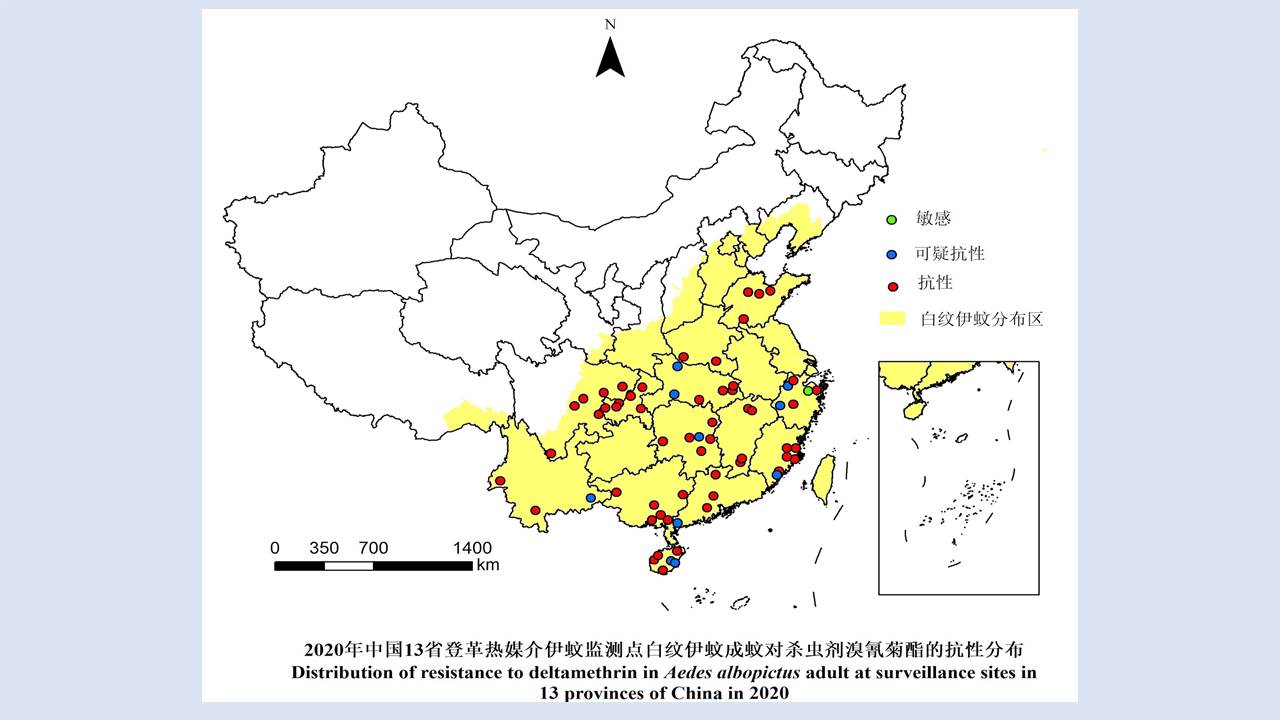
Objective To investigate the resistance level of Aedes albopictus against some commonly used insecticides in dengue endemic provinces of China, and to provide guidance for the proper usage of insecticides and epidemic prevention and control. Methods Excel 2016 software was used to collect and sum up the bioassay data of Ae. albopictus resistance to commonly used insecticides from 80 surveillance sites in 13 provinces in China. The WHO tube method was used to monitor the resistance of adult mosquitoes against 9 insecticides, and larval dip method was used to monitor the resistance of larvae mosquitoes against 3 insecticides. According to the Implementation Plan for National Vector Surveillance (2016), the resistance level was statistically analyzed and mapped using ArcGIS 10.3 software. Results The resistance of Ae. albopictus was monitored at 80 surveillance sites in China in 2020. For pyrethroid insecticides, Ae. albopictus adults developed resistance to deltamethrin, permethrin, beta-cypermethrin and beta-cyhalothrin at 83.08% (54/65), 77.97% (46/59), 87.30% (55/63),and 79.31% (46/58) of the surveillance sites, respectively. For carbamate insecticides, Ae. albopictus adults developed resistance to propoxur in 1.49% (1/67) sites, while none of the 61 sites showed resistance to bendiocarb. For organophosphorus insecticides, the Ae. albopictus adults at the 6.45% (4/62) surveillance sites developed resistance to malathion, while the 52 and 59 sites did not develop resistance to fenitrothion and chlorpyrifos. Ae. albopictus larvae at 93.48% (43/46), 28.30% (15/53), and 25.45% (14/55) of the sites showed medium or high resistance to pyriproxyfen, propoxur and temephos, respectively. Conclusion The resistance level of adult Ae. albopictus to pyrethroid insecticides and larva to pyriproxyfen were serious in dengue endemic and risk areas in China. However, both adult and larva were more susceptible to carbamate and organophosphorus insecticides at most of surveillance sites. Local authorities and program managers should adjust their insecticide use planning for Aedes mosquito control and dengue prevention and control according to the current insecticide resistance status.
ZHAO Chun-chun, ZHOU Xin-xin, LI Wen-yu, LUN Xin-chang, LIU Xiao-bo, WU Hai-xia, WANG Jun, LIU Qi-yong, MENG Feng-xia
. Insecticide resistance surveillance and characteristic analysis of dengue vector Aedes albopictus in 13 provinces of China in 2020[J]. Chinese Journal of Vector Biology and Control, 2022
, 33(1)
: 30
-37
.
DOI: 10.11853/j.issn.1003.8280.2022.01.006
[1] 孟凤霞,王义冠,冯磊,等. 我国登革热疫情防控与媒介伊蚊的综合治理[J]. 中国媒介生物学及控制杂志,2015,26(1):4-10. DOI:10.11853/j.issn.1003.4692.2015.01.002. Meng FX,Wang YG,Feng L,et al. Review on dengue prevention and control and integrated mosquito management in China[J]. Chin J Vector Biol Control,2015,26(1):4-10. DOI:10.11853/j.issn.1003.4692.2015.01.002.(in Chinese)
[2] Liu HM,Liu LH,Cheng P,et al. Bionomics and insecticide resistance of Aedes albopictus in Shandong,a high latitude and high-risk dengue transmission area in China[J]. Parasit Vectors,2020,13(1):11. DOI:10.1186/s13071-020-3880-2.
[3] 李志强,钟俊鸿. 登革热媒介昆虫抗药性的研究进展[J]. 昆虫知识,2008,45(6):857-862. DOI:10.3969/j.issn.0452-8255. 2008.06.004. Li ZQ,Zhong JH. Advance in the research of insecticide resistance in dengue fever vectors[J]. Chin Bull Entomol,2008,45(6):857-862. DOI:10.3969/j.issn.0452-8255.2008.06.004.(in Chinese)
[4] 王伟善,申硕. 登革热疫苗研发的主要障碍[J]. 中国生物制品学杂志,2019,32(1):114-118. DOI:10.13200/j.cnki.cjb. 002454. Wang WS,Shen S. Impediments to development of dengue fever vaccine[J]. Chin J Biol,2019,32(1):114-118. DOI:10.13200/j.cnki.cjb.002454.(in Chinese)
[5] 邱星辉. 白纹伊蚊抗药性分子机制研究进展[J]. 寄生虫与医学昆虫学报,2019,26(3):194-198. DOI:10.3969/j.issn.1005-0507.2019.03.009. Qiu XH. Current knowledge about the molecular mechanisms underlying insecticide resistance in Aedes albopictus[J]. Acta Parasitol Med Entomol Sin,2019,26(3):194-198. DOI:10.3969/j.issn.1005-0507.2019.03.009.(in Chinese)
[6] 张杰,陆崇华,姬淑红,等. 上海市杨浦区白纹伊蚊幼虫对4种杀虫剂的抗性测定[J]. 中华卫生杀虫药械,2019,25(3):289-290. DOI:10.19821/j.1671-2781.2019.03.026. Zhang J,Lu CH,Ji SH,et al. Resistance determination of Aedes albopictus larvae to four insecticides in Yangpu district of Shanghai city[J]. Chin J Hyg Insect Equip,2019,25(3):289-290. DOI:10.19821/j.1671-2781.2019.03.026.(in Chinese)
[7] 开文龙. 白纹伊蚊杀虫剂敏感品系的纯化与应用[D]. 北京:中国疾病预防控制中心,2018. Kai WL. Application and purification of insecticide susceptible strain of Aedes albopictus[D]. Beijing:Chinese Center for Disease Control and Prevention,2018. (in Chinese)
[8] 师灿南,开文龙,刘起勇,等. 景洪市登革热媒介伊蚊对吡丙醚的敏感性及其作用特点[J]. 中国媒介生物学及控制杂志,2017,28(2):108-112. DOI:10.11853/j.issn.1003.8280.2017. 02.003. Shi CN,Kai WL,Liu QY,et al. Resistance and mortality pattern of dengue vectors exposed to pyriproxyfen in Jinghong city,Yunnan province[J]. Chin J Vector Biol Control,2017,28(2):108-112. DOI:10.11853/j.issn.1003.8280.2017.02.003.(in Chinese)
[9] 徐建敏,梁雪莹,严子锵,等. 白纹伊蚊对3种拟除虫菊酯类杀虫剂的抗药性调查[J]. 中华卫生杀虫药械,2014,20(5):439-440,443. DOI:10.19821/j.1671-2781.2014.05.014. Xu JM,Liang XY,Yan ZQ,et al. Resistance of Aedes albopictus to three pyrethroids insecticides[J]. Chin J Hyg Insect Equip,2014,20(5):439-440,443. DOI:10.19821/j.1671-2781.2014. 05.014.(in Chinese)
[10] 余品红,张华勋,黄光全,等. 嗜人按蚊分布区媒介按蚊对溴氰菊酯敏感性的监测[J]. 寄生虫与医学昆虫学报,2003,10(3):152-156. DOI:10.3969/j.issn.1005-0507.2003.03.005. Yu PH,Zhang HX,Huang GQ,et al. Surveillance of susceptibility of Anopheles vectors to deltamethrin in An. anthropophagous areas[J]. Acta Parasitol Med Entomol Sin,2003,10(3):152-156. DOI:10.3969/j.issn.1005-0507.2003. 03.005.(in Chinese)
[11] 赵春春,朱彩英,贾清臣,等. 2017-2018年我国不同区域白纹伊蚊对常用杀虫剂的抗药性[J]. 中国媒介生物学及控制杂志,2020,31(2):126-132. DOI:10.11853/j.issn.1003.8280. 2020.02.002. Zhao CC,Zhu CY,Jia QC,et al. Resistance of Aedes albopictus to commonly used insecticides in different areas of China,2017-2018[J]. Chin J Vector Biol Control,2020,31(2):126-132. DOI:10.11853/j.issn.1003.8280.2020.02.002.(in Chinese)
[12] World Health Organization. Monitoring and managing insecticide resistance in Aedes mosquito populations interim guidance for entomologists[EB/OL]. (2016)[2021-11-11]. https://apps.who.int/iris/bitstream/handle/10665/204588/WHO_ZIKV_VC_16.1_eng.pdf.
[13] 刘斯璐,崔峰,燕帅国,等. 中国媒介蚊虫对有机磷类和拟除虫菊酯类杀虫剂的抗性调查[J]. 中国媒介生物学及控制杂志,2011,22(2):184-189. Liu SL,Cui F,Yan SG,et al. Investigation of organophosphate and pyrethroid resistance in vector mosquitoes in China[J]. Chin J Vector Biol Control,2011,22(2):184-189. (in Chinese)
[14] 李春晓. 淡色库蚊对有机磷和氨基甲酸酯抗性相关基因的研究[D]. 北京:中国人民解放军军事医学科学院,2005. Li CX. Study on the genes responsible for organophosphate and carbamate resistance in Culex pipiens pallens[D]. Beijing:Academy of Military Medical Sciences,2005. (in Chinese)
[15] Ishaaya I,Kontsedalov S,Horowitz AR. Biorational insecticides:mechanism and cross-resistance[J]. Arch Insect Biochem Physiol,2005,58(4):192-199. DOI:10.1002/arch.20042.
[16] Shah RM,Abbas N,Shad SA,et al. Selection,resistance risk assessment,and reversion toward susceptibility of pyriproxyfen in Musca domestica L.[J]. Parasitol Res,2015,114(2):487-494. DOI:10.1007/s00436-014-4206-0.
[17] 徐仁权,刘洪霞,冷培恩,等. 0.5%吡丙醚颗粒剂对白纹伊蚊控制效果的研究[J]. 中国媒介生物学及控制杂志,2010,21(4):297-299. Xu RQ,Liu HX,Leng PE,et al. Effectiveness of 0.5% pyriproxyfen granules for Aedes albopictus control[J]. Chin J Vector Biol Control,2010,21(4):297-299. (in Chinese)

