Vector Surveillance

Ecological surveillance and resistance testing results of dengue fever vector Aedes albopictus in Panzhihua, Sichuan Province, China

  • Jin HUANG ,
  • Gang TANG ,
  • Shou-yu LIU ,
  • Xiao-hui HAN ,
  • Kang YANG ,
  • Yuan GUO ,
  • Xin-ying CHEN , *
Expand
  • Department of Endemic and Vector Control, Panzhihua Center for Disease Control and Prevention, Panzhihua, Sichuan 617000, China

Received date: 2024-10-17

  Online published: 2025-08-26

Supported by

Guided Science and Technology Program Fund of Panzhihua(2023ZD-S-36)

Copyright

All rights reserved. Unauthorized reproduction is prohibited.

Abstract

Objective: To investigate the density, seasonality, and resistance to commonly used insecticides of Aedes albopictus populations in Panzhihua, Sichuan Province, China, and analyze regional insecticide application practices, so as to provide evidence-based recommendations for rational insecticide use and dengue fever prevention and control strategies. Methods: From May to October of 2016-2023, Ae. albopictus ecological surveillance was conducted in residential areas, parks, rural houses, and other suitable habitats across Panzhihua, using the double mosquito net method for adults and the Breteau index (BI) method for larvae. Field-collected larval and adult Ae. albopictus specimens were reared together to the F1 generation in the laboratory and the resistance of Ae. albopictus to commonly used insecticides was detected by dipping method for the larvae and the WHO tube bioassay for the adults. Results: From 2016 to 2023 in Panzhihua, Ae. albopictus density features were as following: BI=14.41; container index (CI)=18.53; net trap index=6.49 mosquitoes/(trap∙h); and larval populations all exhibited unimodal seasonal dynamics in 2016-2023, with peak BI values (12.50-44.00) occurring during July to September. The major breeding sites were water storage containers (pools, vats, and basins) and idle containers, with combined positive cases accounting for 44.50% of the tatal positive containers, and positive breeding sites were mostly located in outdoor environments. In 2018, Ae. albopictus larvae were susceptible to dichlorvos [resistance ratio (RR)=0.47], permethrin (RR=1.95), temephos (RR=0.70), deltamethrin (RR=2.20), and beta-cypermethrin (RR=1.15); the RR of beta-cypermethrin and temephos increased slightly, while those of the other three insecticides decreased, as compared with 2015; and in 2022, the RR of beta-cypermethrin rose to 122.51, with resistance level escalating from susceptibility to high resistance whin the five years, while the larvae showed low resistance to propoxur (RR=3.08) and phoxim (RR=3.73). From 2019 to 2022, adult populations showed declined susceptibility to deltamethrin (mortality, from 66.43% to 62.37%); a transition from susceptibility to possible resistance was observed for malathion (mortality, from 100% to 87.78%) and propoxur (mortality, from 100% to 96.47%); and the response to beta-cypermethrin remained at a level of possible resistance (mortality, from 90.08% to 89.77%). Conclusions: Imported dengue cases, high-density mosquitoes, and insecticide resistance development create critical disease control challenges. Ae. albopictus larvae have developed high resistance to beta-cypermethrin, but remain susceptible to organophosphate compounds such as temephos and dichlorvos; and adults remain resistant to deltamethrin and malathion. It is recommended to manage the mosquito breeding sites, reduce the use of pyrethroids with high resistance in chemical control, and rotate the application of sensitive insecticides, so as to enhance Ae. albopictus control effectiveness and delay the development and progression of resistance.

Cite this article

Jin HUANG , Gang TANG , Shou-yu LIU , Xiao-hui HAN , Kang YANG , Yuan GUO , Xin-ying CHEN . Ecological surveillance and resistance testing results of dengue fever vector Aedes albopictus in Panzhihua, Sichuan Province, China[J]. Chinese Journal of Vector Biology and Control, 2025 , 36(4) : 480 -486 . DOI: 10.11853/j.issn.1003.8280.2025.04.008

白纹伊蚊(Aedes albopictus)是登革热的主要传播媒介之一,此外还可传播基孔肯雅热、裂谷热、寨卡、黄热病等疾病[1]。2019-2023年,国内报告登革热病例数累计43 095例(港、澳、台地区数据未统计),四川省及其邻近的云南省、重庆市等地均出现登革热暴发流行[2]。作为四川省南向开放门户,攀枝花市与云南省及东盟国家交流频繁,登革热输入性疫情风险尤为突出,2019-2023年累计报告4例输入性病例,其中1例于2019年7月自柬埔寨傣族自治州输入,3例(含2例确诊)于2023年8月自西双版纳傣族自治州输入。攀枝花市地处川滇干热河谷,年均温20.3 ℃,雨季集中(6-9月),为伊蚊提供了理想的孳生条件。而白纹伊蚊的生态特点进一步加剧了防控难度:其幼蚊常孳生于户外小型积水,孳生地隐蔽且分散,常规环境治理效率有限[3]。在此背景下,化学防治仍是核心手段,但长期单一用药导致蚊虫抗药性快速发展[4]。陈祖华等[5-6]的初步研究表明,攀枝花市白纹伊蚊在2015年已对溴氰菊酯和氯菊酯产生抗性(死亡率 < 80%),且幼蚊密度高峰集中于8月。为应对持续发展的抗药性风险与输入性疫情压力,本研究于2019-2023年开展四川省攀枝花市白纹伊蚊生态学、抗药性监测,掌握白纹伊蚊种群密度、季节消长及其对常用杀虫剂的抗药性水平,旨在为优化区域防控策略提供科学依据。

1 材料与方法

1.1 试虫

市域内多点采集的白纹伊蚊幼蚊和成蚊带回实验室混合饲养,选取繁殖后F1代三龄末四龄初的健康幼蚊和羽化后3~5 d未吸血的健康雌性成蚊进行测定。

1.2 监测工具及材料

1.2.1 监测工具

双层叠帐,外帐:长×宽×高=1.8 m×1.8 m×1.5 m;内帐:长×宽×高=1.2 m×1.2 m×2.0 m)。

1.2.2 试剂耗材

幼蚊测试药物:97.4%残杀威、99.4%溴氰菊酯、99.0%氯菊酯、97.6%敌敌畏、95.8%高效氯氰菊酯、99.4%辛硫磷和95.1%双硫磷。成蚊测试药膜:0.08%高效氯氰菊酯、0.03%溴氰菊酯、0.5%马拉硫磷、0.05%残杀威及对照药膜。所用测试药物及药膜均来自中国疾病预防控制中心传染病预防控制所媒介生物控制室。溶剂丙酮(分析纯)由成都市科龙化工试剂厂生产。

1.3 方法

1.3.1 生态学监测[7-8]

1.3.1.1 布雷图指数法

选择2个县(市、区)作为监测点,每个监测点分别选择2个乡镇(街道),2016-2018年每年5-10月在每个乡镇(街道)调查50户,其中居民区户内15户,户外10户,公园/绿化带25户,每月中旬监测1次。2019年起监测点增加至4个,每个监测点各选择1个乡镇(街道),含居民区、居民区外环境、公园/绿化带等生境,调查≥25户。每个家庭、集体宿舍/单位办公室/酒店的2个房间、农贸市场/花房/外环境/室内公共场所等每30 m2定义为1户。检查并记录所有积水及其幼蚊孳生情况,计算布雷图指数(Breteau index,BI)和容器指数(container index,CI)。
$\mathrm{BI}=\frac{\text { 阳性容器、积水数 }(\text { 处 })}{\text { 调查户数 }(\text { 户 })} \times 100$
$\mathrm{CI}=\frac{\text { 阳性容器、积水数 }(\text { 处 })}{\text { 有水容器数 }(\text { 个 })} \times 100$

1.3.1.2 双层叠帐法

2016-2018年每年5-10月,在幼蚊监测点选择的乡镇(街道)内,选择居民区外环境和公园/绿化带生境各1处,各生境布双层叠帐1顶,共布放8顶。2019年起监测生境调整为公园/竹林、居民区、轮胎堆集地/废品站/工地3类,每生境每次开展2帐次。在伊蚊的活动高峰期(15:00-18:00)诱集者位于内部封闭蚊帐中暴露2条小腿,收集者利用电动吸蚊器在两层蚊帐之间收集停落在蚊帐上的伊蚊,时间持续0.5 h,计算帐诱指数。
$\text { 帐诱指数 }[\text { 只 } /(\text { 顶 } \cdot \mathrm{h})]=\frac{\text { 捕获雌蚊数 }(\text { 只 })}{\text { 蚊帐数 }(\text { 顶 }) \times 30 \mathrm{~min}} \times 60 \mathrm{~min} / \mathrm{h}$

1.3.2 抗药性监测

参照《全国病媒生物监测实施方案》(2016)[8]及《蚊虫抗药性检测方法生物测定法》(GB/T 26347―2010)[9],采用成蚊接触筒法和幼虫浸渍法。

1.3.2.1 成蚊接触筒法

将药膜衬垫于接触筒内壁,然后将预先挑选好的羽化后3~5 d未吸血的健康雌蚊25~30只放入1只接触筒内,关闭隔板,接触药膜1 h后抽开隔板,将蚊虫吹入恢复筒,以10%葡萄糖溶液饲养,24 h后观察死亡率。以涂抹有白油和乙醚混合物的滤纸作为对照。成蚊的死亡判定标准:试虫完全不动或仅有震颤、无法爬行或起飞者,视为死亡。每试验重复3次,24 h后观察试虫死亡情况并计算死亡率。

1.3.2.2 幼虫浸渍法

经过预实验确定死亡率在10%~90%间的杀虫剂浓度,用丙酮配制5~7个系列浓度;取相应数量的烧杯,各加入200 ml脱氯水,并用微量移液器吸去100 µl;首先在对照组烧杯加入100 µl丙酮,再依次向试验组中加入100 µl各浓度药液,每个浓度设置至少3个重复。按对照组、低浓度组到高浓度组顺序依次分别加入20只幼蚊,24 h后查看幼蚊的死亡情况并计算半数致死浓度(median lethal concentration,LC50)及抗性倍数(resistance ratio,RR)。
$\text { 抗性倍数 }(\mathrm{RR})=\frac{\text { 野外种群 } \mathrm{LC}_{50}}{\text { 敏感品系 } \mathrm{LC}_{50}}$

1.4 结果判定

1.4.1 登革热传播风险判断

BI=5为控制登革热传播的阈值,≥5有传播风险,≥10有暴发风险,≥20有区域流行风险[10]

1.4.2 幼蚊抗性水平判定

RR < 3为敏感,3≤RR < 10为低抗,10≤RR < 40为中抗,RR≥40为高抗。

1.4.3 成蚊抗性水平判定

死亡率≥98%为敏感种群,80%≤死亡率 < 98%为可能抗性种群,死亡率 < 80%为抗性种群。

1.4.4 数据处理

对照组死亡率在5%~20%时,用Abbott公式校正处理死亡率;若对照组死亡率 > 20%,实验视为无效。
$\text { 校正死亡率 } \left.=\frac{(\text { 处理组死亡率 }- \text { 对照组死亡率 })}{(1-\text { 对照组死亡率 })}\right) \times 100 \%$

1.5 统计学分析

利用WPS Office 2024表格录入并整理数据,汇总统计生态学及抗药性监测结果。利用SPSS 25.0软件对数据进行分析:对不同年份间的幼蚊密度水平进行Kruskal-Wallis H秩和检验,对户内和户外的幼蚊孳生情况进行χ2检验,成蚊密度水平进行单因素方差分析,幼蚊抗药性水平进行概率单位回归分析(probability unite regression,Probit回归),计算幼蚊的LC50及其95%置信区间等。

2 结果

2.1 总体情况

2016-2023年全市共计调查6 626户,检查积水容器、小型积水5 153处,其中阳性955处,平均BI为14.41,平均CI为18.53。捕获白纹伊蚊雌性成蚊1 058只,帐诱指数6.49只/(顶·h)。2018年BI值最低,其余年份BI值均 > 10.00,2022年BI值> 20.00。不同年份BI差异无统计学意义(H=7.000,P=0.429)。见表 1
表1 2016-2023年四川省攀枝花市登革热媒介白纹伊蚊生态学监测结果

Tab. 1 Ecological surveillance results of the dengue fever vector Aedes albopictus in Panzhihua, Sichuan Province, China, 2016-2023

年份 幼蚊 成蚊
户数(户) 调查容器、积水(处) 阳性容器、积水(处) 布雷图指数 容器指数 布设蚊帐数(顶) 白纹伊蚊数(只) 帐诱指数[只/(顶·h)]
2016 1 201 910 228 18.98 25.05 48 190 6.19
2017 1 200 794 160 13.33 20.15 48 167 5.56
2018 1 200 1 222 89 7.42 7.28 48 59 1.91
2019 600 375 73 12.17 19.47 36 94 5.22
2020 600 310 78 13.00 25.16 36 108 6.00
2021 600 297 106 17.67 35.69 36 86 4.78
2022 603 793 135 22.39 17.02 38 219 11.53
2023 622 452 86 13.83 19.03 36 135 7.50
合计 6 626 5 153 955 14.41 18.53 326 1 058 6.49
阳性积水以贮水池、缸、盆阳性数最多,为217处,其次是闲置容器208处,合计阳性数占总阳性积水数的44.50%,而CI值最高的是竹头、树洞、石穴,为27.27,其次是废旧轮胎(26.25)。户内阳性积水中,最多的为其他水体(泡菜坛水槽)105处,占户内阳性积水数的55.26%,其次为贮水池、缸、盆(40处)。户外阳性积水中,贮水池、缸、盆和闲置容器合计362处,占户外阳性积水数的47.32%,其次是盆景、水生植物(92处)。户内和户外CI差异有统计学意义(χ2=38.055,P < 0.001)。见表 2
表2 2016-2023年四川省攀枝花市不同环境不同水体类型的白纹伊蚊幼蚊孳生情况

Tab. 2 Larval Aedes albopictus density in different environments and water bodies in Panzhihua, Sichuan Province, China, 2016-2023

容器、积水类型 户内 户外 总计
调查容器、积水(处) 阳性容器、积水(处) 容器指数 调查容器、积水(处) 阳性容器、积水(处) 容器指数 调查容器、积水(处) 阳性容器、积水(处) 容器指数
盆景、水生植物 130 22 16.92 431 92 21.35 561 114 20.32
贮水池、缸、盆 241 40 16.60 744 177 23.79 985 217 22.03
闲置容器(碗、瓶、缸、罐) 147 23 15.65 818 185 22.62 965 208 21.55
明渠、假山水池 - - - 326 39 11.96 326 39 11.96
竹头、树洞、石穴 - - - 209 57 27.27 209 57 27.27
废旧轮胎 2 0 0.00 299 79 26.42 301 79 26.25
绿化带小积水 44 0 0.00 437 74 16.93 481 74 15.38
其他水体 878 105 11.96 447 62 13.87 1 325 167 12.60
合计 1 442 190 13.18 3711 765 20.61 5 153 955 18.53

注:- 无此数据项。

2.2 季节消长情况

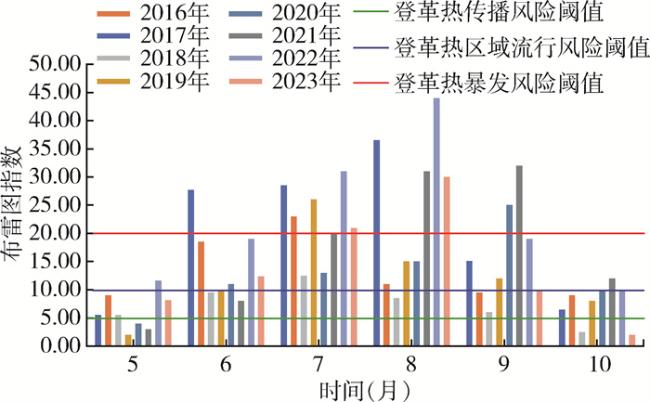
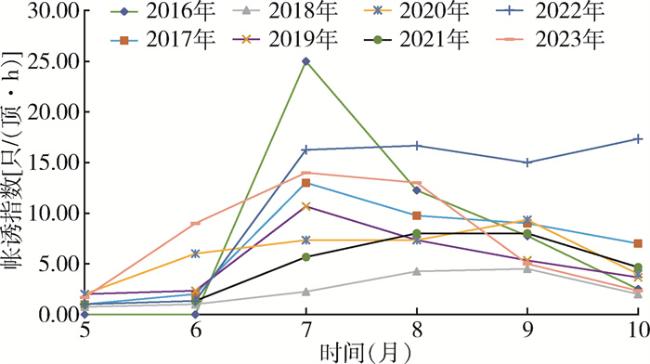
2016-2023年攀枝花市白纹伊蚊幼蚊密度变化均呈先升高后降低的趋势。2016-2018年幼蚊峰值出现在7和8月,且呈逐年下降的趋势;2019年增加监测点后,2019-2023年白纹伊蚊幼蚊密度的峰值出现在7、8、9月,最高峰值为2022年8月(44.00),最低峰值为2018年7月的12.50,见图 1。89.58%(43/48)的监测月份BI > 5,56.25%(27/48)的月份BI > 10,25.00%(12/48)的月份BI > 20。2016-2018年白纹伊蚊成蚊帐诱指数同幼蚊消长趋势一致,逐年下降,峰值出现在7和9月;2019-2023年则逐年上升后在2023年回落,峰值大致在7-9月,其中2022年在7月陡然升高,9月略微回落后,在监测结束月(10月)达到最高峰值(17.33)。单因素方差分析表明,帐诱指数季节差异有统计学意义(F=15.124,P < 0.001)。见图 2
图1 2016-2023年四川省攀枝花市白纹伊蚊幼蚊布雷图指数季节消长

Fig. 1 Seasonal variations in Breteau index of Aedes albopictus larvae in Panzhihua, Sichuan Province, China, 2016-2023

图2 2016-2023年四川省攀枝花市白纹伊蚊成蚊密度季节消长情况

Fig. 2 Seasonal fluctuations in adult Aedes albopictus density in Panzhihua, Sichuan Province, China, 2016-2023

2.3 幼蚊抗药性监测结果

攀枝花市白纹伊蚊幼蚊对对敌敌畏、氯菊酯、双硫磷、溴氰菊酯表现为敏感;对残杀威、辛硫磷抗性表现为低抗;对高效氯氰菊酯的抗性水平在2015和2018年测定为敏感,2022年为高抗。见表 3
表3 2015-2022年四川省攀枝花市白纹伊蚊幼蚊对7种杀虫剂的抗性测定结果

Tab. 3 Resistance results of Aedes albopictus larvae to seven types of insecticides in Panzhihua, Sichuan Province, China, 2015-2022

杀虫剂 测定年份 LC50及95%置信区间a 斜率b值 χ2n 敏感品系LC50b 抗性倍数 抗性水平
残杀威 2022 2.746(2.383~3.052) 3.676 0.659(3) 0.890 3.08 低抗
敌敌畏 2015 0.020(0.019~0.021) 10.846 0.091(3) 0.040 0 0.50 敏感
2018 0.001 01(0.000 818~0.000 120) 5.089 1.587(4) 0.040 0 0.47 敏感
高效氯氰菊酯 2015 0.001(0.001~0.002) 8.711 6.034(3) 0.000 873 1.14 敏感
2018 0.001 01(0.000 818~0.000 120) 2.138 3.736(4) 0.000 873 1.15 敏感
2022 0.107(0.096~0.122) 3.203 2.379(3) 0.000 873 122.51 高抗
氯菊酯 2015 0.004(0.003~0.005) 5.890 2.109(5) 0.001 96 2.04 敏感
2018 0.003 83(0.003 33~0.004 44) 2.303 3.669(5) 0.001 96 1.95 敏感
双硫磷 2015 0.001(0.001~0.001) 20.948 1.136(3) 0.001 60 0.63 敏感
2018 0.001 01(0.000 818~0.000 120) 5.115 2.350(4) 0.001 60 0.70 敏感
辛硫磷 2022 0.005 67(0.004 29~0.007 03) 1.652 4.696(3) 0.001 61 3.73 低抗
溴氰菊酯 2015 0.001(0.001~0.001) 8.574 1.951(3) 0.000 354 2.83 敏感
2018 0.000 777(0.000 643~0.000 928) 2.002 2.927(4) 0.000 354 2.20 敏感

注:LC50半数致死浓度;a 2015年LC50数据保留原文献数据,2018和2022年为体现差异,LC50值小数点后保留3位有效数字;n自由度;b敏感品系LC50均小数点后保留3位有效数字。

2.4 成蚊抗药性监测结果

白纹伊蚊成蚊对0.05%残杀威和0.50%马拉硫磷在2019年表现为敏感,2021及2022年表现为可能抗性;对0.40%和0.08%高效氯氰菊酯2019和2022年均表现为可能抗性;对0.10%和0.03%的溴氰菊酯2019、2021和2022年均表现为抗性。见表 4
表4 2019-2022年四川省攀枝花市白纹伊蚊成蚊对4种杀虫剂的抗性测定结果

Tab. 4 Resistance results of Aedes albopictus adults to four types of insecticides in Panzhihua, Sichuan Province, China, 2019-2022

杀虫剂 浓度(%) 测定年份 试虫数(只) 死亡数(只) 24 h死亡率(%) 抗性等级
残杀威 0.05 2019 136 136 100.00 敏感
0.05 2021 145 138 95.17 可能抗性
0.05 2022 85 82 96.47 可能抗性
高效氯氰菊酯 0.40 2019 121 109 90.08 可能抗性
0.08 2022 88 79 89.77 可能抗性
马拉硫磷 0.50 2019 140 140 100.00 敏感
0.50 2021 148 130 87.84 可能抗性
0.50 2022 90 79 87.78 可能抗性
溴氰菊脂 0.10 2019 140 93 66.43 抗性
0.03 2021 147 93 63.27 抗性
0.03 2022 93 58 62.37 抗性

3 讨论

2016-2023年,攀枝花市登革热传播风险持续处于高位,89.58%的监测月份突破传播风险阈值(BI > 5),56.25%达到暴发风险(BI > 10),25.00%触发区域流行预警(BI > 20)。这一现象表明攀枝花市在大部分监测时间内都面临着较高的登革热传播风险。从时间分布上看,白纹伊蚊幼蚊密度高峰出现在7-9月,与云南省边境地区及四川省内其他城市基本一致[11-13];与我国2019-2023年登革热报告病例的流行病学时间特征相符合[2],即全年均有病例发生,高峰期集中在8-10月。从空间分布来看,攀枝花市与云南省边境、东南亚国家及国内沿海高发省份人员往来频繁,面临跨境与跨省输入疫情的双重压力[14],输入性病例时空分布与本地媒介伊蚊高峰期高度重叠,形成了“输入病例-媒介高峰期”双风险窗口,增加了登革热在本地传播的风险。因此,加强输入性病例的监测和管理,以及在媒介伊蚊活动高峰期采取有效的媒介防制措施,对于降低登革热传播风险至关重要。
2020-2022年新型冠状病毒感染(新冠)疫情期间,白纹伊蚊密度仍逐年上升,2022年8月BI值达44.00。这一现象可能与公共卫生资源向新冠疫情防控倾斜,导致蚊媒监测与消杀力度阶段性削弱有关。广州市等地的研究同样指出,疫情期间户外积水容器管理效率下降,可能间接促进蚊媒繁殖[15]。建议未来突发公共卫生事件中,统筹资源配置以避免病媒防控出现短板。孳生地调查结果显示,户外环境阳性积水所占百分比达80.10%(765/955),其中闲置容器,贮水池、缸、盆,废旧轮胎和竹头、树洞、石穴等是本地主要孳生地,户外的CI显著高于户内,其中竹头、树洞、石穴和废旧轮胎的CI值居前2位,提示从4月开始,居民区外环境、废旧轮胎堆积场所需特别关注积水管理[16-17]
攀枝花市白纹伊蚊对高效氯氰菊酯的抗性倍数在2022年达122.51(高抗),较2015年增长约107倍,这一趋势与国内多地监测结果一致[4, 18-19],可能与白纹伊蚊靶标抗性或代谢抗性增强有关[20]。尽管幼蚊对溴氰菊酯(2018年RR=2.20)仍表现敏感,但成蚊监测提示溴氰菊酯已形成稳定抗性种群(死亡率62.37%~66.43%)。因此,建议在轮换使用双硫磷等敏感药物的同时,优先采用环境治理与非化学防治手段(如使用昆虫生长调节剂、微生物制剂等的生物防制)以降低选择压力。
本研究自2019年监测方案调整(新增监测点、生境分类细化)后的BI值差异可能源于样本覆盖范围扩大,而非原监测点实际密度升高,类似问题在其他地区亦有报道[21-22],提示新增监测点及生境(如公园、轮胎堆积地)的蚊媒密度可能高于原监测点和生境,表明此类生境是本地登革热传播的关键风险源。建议未来强化这些区域的密度监测、孳生地治理与针对性化学防治,以提升区域防控效率。由于本研究未开展白纹伊蚊抗性基因检测,所以对高效氯氰菊酯高抗种群的分子机制尚不清楚,今后将进一步开展相关研究。但本文通过对白纹伊蚊生态学和抗药性的持续监测,为白纹伊蚊的精准防控提供了科学依据。

利益冲突  无

本次调查得到攀枝花市东区、西区、仁和区、米易县、盐边县疾病预防控制中心的大力支持和帮助,特此一并表示感谢

1
南晓伟, 王珊珊, 陈继来, 等. 内蒙古首次采获白纹伊蚊的形态学与分子生物学鉴定[J]. 中国媒介生物学及控制杂志, 2024, 35(1): 109- 114.

DOI

Nan XW, Wang SS, Chen JL, et al. Morphological and molecular identification of Aedes albopictus first reported in Inner Mongolia Autonomous Region, China[J]. Chin J Vector Biol Control, 2024, 35(1): 109- 114.

DOI

2
李卓威, 黄晓霞, 田婷婷, 等. 我国2019-2023年登革热报告病例流行病学特征[J]. 中国热带医学, 2024, 24(8): 925- 930.

DOI

Li ZW, Huang XX, Tian TT, et al. Epidemiological characteristics of reported dengue fever cases in China, 2019-2023[J]. China Trop Med, 2024, 24(8): 925- 930.

DOI

3
赵永俏, 夏骜, 张梅花, 等. 白纹伊蚊不同发育阶段体内菌群结构及多样性分析[J]. 中国血吸虫病防治杂志, 2022, 34(5): 475- 483.

DOI

Zhao YQ, Xia A, Zhang MH, et al. Microbiota structure and diversity in Aedes albopictus at different develop-mental stages[J]. Chin J Schisto Control, 2022, 34(5): 475- 483.

DOI

4
张燕, 王丹, 周敬祝, 等. 贵阳市白纹伊蚊对3种拟除虫菊酯类杀虫剂的抗药性及击倒抗性基因研究[J]. 中国媒介生物学及控制杂志, 2023, 34(5): 600- 606.

DOI

Zhang Y, Wang D, Zhou JZ, et al. Resistance to three pyrethroid insecticides and knockdown resistance gene mutations in Aedes albopictus in Guiyang, Guizhou Province, China[J]. Chin J Vector Biol Control, 2023, 34(5): 600- 606.

DOI

5
陈祖华, 黄进, 唐刚, 等. 攀枝花市2015年白纹伊蚊监测分析[J]. 中华卫生杀虫药械, 2016, 22(5): 487- 489.

DOI

Chen ZH, Huang J, Tang G, et al. Analysis on Aedes albopictus density surveillance in Panzhihua City in 2015[J]. Chin J Hyg Insect Equip, 2016, 22(5): 487- 489.

DOI

6
陈祖华, 潘泓宇, 黄进, 等. 攀枝花市白纹伊蚊对常用杀虫剂抗药性的初步调查[J]. 中华卫生杀虫药械, 2016, 22(1): 38-39, 45.

DOI

Chen ZH, Pan HY, Huang J, et al. Resistance of Aedes albopictus to commonly used insecticides in Panzhihua City[J]. Chin J Hyg Insect Equip, 2016, 22(1): 38-39, 45.

DOI

7
中国疾病预防控制中心. 中国疾病预防控制中心关于印发登革热防治技术指南的通知[A/OL]. (2014-09-25)[2024-10-17]. http://www.nncdc.com/html/2016/dgrfk_0923/467.html.

Chinese Center for Disease Control and Prevention. Notice of the Chinese center for disease control and prevention on the issuance of the technical guidelines for dengue fever prevention and control[A/OL]. (2014-09-25) [2024-10-17]. http://www.nncdc.com/html/2016/dgrfk_0923/467.html. (in Chinese)

8
中国疾病预防控制中心. 全国病媒生物监测实施方案(2016)[R]. 北京: 中国疾病预防控制中心, 2016.

Chinese Center for Disease Control and Prevention. National vector surveillance implementation plan (2016)[R]. Beijing: Chinese Center for Disease Control and Prevention, 2016. (in Chinese)

9
中华人民共和国卫生部, 中国国家标准管理委员会. 蚊虫抗药性检测方法生物测定法: GB/T 26347-2010[S]. 北京: 中国标准出版社, 2010.

Ministry of Health of the People' Republic of China, National Standardization Administration. Test methods of mosquito resistance to insecticides—Bioassay methods: GB/T 26347-2010 [S]. Beijing: Standards Press of China, 2010. (in Chinese)

10
任飞林, 沈建勇, 刘婷, 等. 布雷图指数法与诱蚊诱卵指数法监测白纹伊蚊幼虫密度相关性分析[J]. 疾病监测, 2021, 36(9): 888- 893.

DOI

Ren FL, Shen JY, Liu T, et al. Correlation between Breteau index and mosquito oviposition index in surveillance for Aedes albopictus larvae density[J]. Dis Surveill, 2021, 36(9): 888- 893.

DOI

11
郑宇婷, 杨春梅, 杨明东, 等. 云南边境地区登革热媒介伊蚊生态学及抗药性监测[J]. 中国媒介生物学及控制杂志, 2022, 33(1): 38- 43.

DOI

Zheng YT, Yang CM, Yang MD, et al. Ecological and insecticide resistance surveillance of dengue vector Aedes in Yunnan border region of China[J]. Chin J Vector Biol Control, 2022, 33(1): 38- 43.

DOI

12
曹一鸥, 周兴余, 刘学成, 等. 四川省2016-2018年登革热媒介伊蚊监测结果分析[J]. 中国媒介生物学及控制杂志, 2020, 31(2): 185- 189.

DOI

Cao YO, Zhou XY, Liu XC, et al. An analysis of surveillance results of dengue vector Aedes in Sichuan Province, China, 2016-2018[J]. Chin J Vector Biol Control, 2020, 31(2): 185- 189.

DOI

13
陈华, 文艳, 张昭, 等. 2016-2022年四川省绵阳市登革热媒介伊蚊监测结果分析[J]. 中华卫生杀虫药械, 2023, 29(5): 434- 438.

DOI

Chen H, Wen Y, Zhang Z, et al. Analysis of Aedes mosquito surveillance results for dengue fever in Mianyang City, Sichuan Province from 2016 to 2022[J]. Chin J Hyg Insect Equip, 2023, 29(5): 434- 438.

DOI

14
岳玉娟, 任东升, 刘小波, 等. 2014-2018年中国登革热病例空间特征及相关关系研究[J]. 中国媒介生物学及控制杂志, 2020, 31(5): 517- 520.

DOI

Yue YJ, Ren DS, Liu XB, et al. A study on spatial characteristics and correlations of different types of dengue cases in Chinese mainland, 2014-2018[J]. Chin J Vector Biol Control, 2020, 31(5): 517- 520.

DOI

15
周金华, 何时雨, 刘通, 等. 2021-2023年广州市白纹伊蚊监测[J]. 中国血吸虫病防治杂志, 2025, 37(1): 76- 80.

DOI

Zhou JH, He SY, Liu T, et al. Surveillance for Aedes albopictus in Guangzhou City from 2021 to 2023[J]. Chin J Schisto Control, 2025, 37(1): 76- 80.

DOI

16
林良强, 张韶华, 朱子犁, 等. 2017年深圳市登革热白纹伊蚊密度与气象因素关系研究[J]. 中华卫生杀虫药械, 2022, 28(2): 140- 143.

DOI

Lin LQ, Zhang SH, Zhu ZL, et al. The relationship between dengue fever vector Aedes albopictus density and meteorological factors in Shenzhen in 2017[J]. Chin J Hyg Insect Equip, 2022, 28(2): 140- 143.

DOI

17
杨迎宇, 王莹莹, 陈芸, 等. 上海市宝山区登革热媒介白纹伊蚊密度指数与气象因素的关系[J]. 中华疾病控制杂志, 2021, 25(4): 466- 471.

DOI

Yang YY, Wang YY, Chen Y, et al. Study on the associations of density indexes of Aedes albopictus for dengue with meteorological factors in Baoshan District of Shanghai[J]. Chin J Dis Control Prev, 2021, 25(4): 466- 471.

DOI

18
胡雅劼, 李观翠, 余技钢. 四川省白纹伊蚊对4种常用杀虫剂的抗药性水平调查[J]. 中国媒介生物学及控制杂志, 2020, 31(5): 612- 614.

DOI

Hu YJ, Li GC, Yu JG. Investigation on the resistance levels of Aedes albopictus to four common insecticides in Sichuan Province, China[J]. Chin J Vector Biol Control, 2020, 31(5): 612- 614.

DOI

19
吴丽群, 陈晓敏, 包继永, 等. 武汉市2019-2021年白纹伊蚊对常见卫生杀虫剂的抗药性调查[J]. 中国媒介生物学及控制杂志, 2023, 34(1): 101- 104.

DOI

Wu LQ, Chen XM, Bao JY, et al. Resistance of Aedes albopictus to commonly used insecticides in Wuhan, Hubei Province, China, 2019-2021[J]. Chin J Vector Biol Control, 2023, 34(1): 101- 104.

DOI

20
邱星辉. 白纹伊蚊抗药性分子机制研究进展[J]. 寄生虫与医学昆虫学报, 2019, 26(3): 194- 198.

DOI

Qiu XH. Current knowledge about the molecular mechanisms underlying insecticide resistance in Aedes albopictus[J]. Acta Parasitol Med Entomol Sin, 2019, 26(3): 194- 198.

DOI

21
元永艇, 冯磊, 顾盈培, 等. 上海市浦东新区2017-2023年蚊虫监测结果分析[J]. 中华卫生杀虫药械, 2024, 30(5): 436- 440.

DOI

Yuan YT, Feng L, Gu YP, et al. Analysis of mosquito surveillance in Pudong New Area of Shanghai from 2017 to 2023[J]. Chin J Hyg Insect Equip, 2024, 30(5): 436- 440.

DOI

22
刘燿, 周萍, 肖权泉, 等. 2017-2023年四川省宜宾市登革热媒介伊蚊监测结果分析[J]. 中国媒介生物学及控制杂志, 2025, 36(2): 165- 170.

DOI

Liu Y, Zhou P, Xiao QQ, et al. Surveillance of Aedes mosquitoes as vectors of dengue fever in Yibin, Sichuan Province, China, 2017-2023[J]. Chin J Vector Biol Control, 2025, 36(2): 165- 170.

DOI

Outlines

/