Vector Surveillance

An analysis of rodent surveillance data in Zaozhuang, Shandong Province, China, 2021-2023

  • Chao QIU , 1 ,
  • Jing-wen GUO 1 ,
  • Can-ru LIU 1 ,
  • Ping REN , 2, *
Expand
  • 1. Department of Vector Control and Disinfection/Department of Health Education, Zaozhuang Center for Disease Control and Prevention, Zaozhuang, Shandong 277000, China
  • 2. Yicheng District Center for Disease Control and Prevention of Zaozhuang, Zaozhuang, Shandong 273000, China

Received date: 2024-12-18

  Online published: 2025-07-01

Copyright

All rights reserved. Unauthorized reproduction is prohibited.

Abstract

Objective: To investigate rodent species and density and their changes in different seasons and ecological environments in Zaozhuang, a national surveillance site for rodent ecology, Shandong Province, China, so as to provide scientific basis and decision support for rodent control, public health policy formulation, and public education. Methods: From 2021 to 2023, rodent density was monitored by night trapping in odd-numbered months in one county and one district of Zaozhuang, which included three types of habitats (urban residential areas, special industries, and rural villages). Excel 2010 and SPSS 26.0 softwares were used for statistical analysis. The Chi-square test was performed for rodent density comparison. Results: A total of 21 560 effective traps were retrieved in Zaozhuang from 2021 to 2023 and 97 rodents were caught, with an average rodent density of 0.45% during the three years. Rodent density differed significantly between the three years (χ2=25.508, P < 0.001). The density of rodents was significantly higher in rural villages (0.75%) than in urban residential areas (0.35%) and special industries (0.29%) (χ2=18.777, P < 0.001). The dominant rodent species monitored during the three years were Rattus norvegicus and Mus musculus, with the composition ratios being 45.36% and 50.52%, respectively. By season, rodent density showed a unimodal distribution in any year and any habitat, all peaking in May. Conclusions: The dominant rodent species in Zaozhuang are R. norvegicus and M. musculus, and the density of rodents in rural areas is higher than that in urban areas. Rodent control measures should be developed according to the habits of different rodent species and the seasonal trend of rodent density, so as to improve the effects of rodent prevention and control.

Cite this article

Chao QIU , Jing-wen GUO , Can-ru LIU , Ping REN . An analysis of rodent surveillance data in Zaozhuang, Shandong Province, China, 2021-2023[J]. Chinese Journal of Vector Biology and Control, 2025 , 36(3) : 345 -348 . DOI: 10.11853/j.issn.1003.8280.2025.03.008

鼠类是许多传染病病原体的贮存宿主或传播媒介。它们不仅能传播多种疾病,如鼠疫、流行性出血热、钩端螺旋体病等[1-2],对人类生命健康造成严重危害,还会通过盗取食物、损坏物品、破坏管线等行为,给人们的生产和生活造成严重损失。开展鼠密度监测是做好鼠类防制的基础性工作,是制定鼠类及鼠传疾病防制方案和防制效果评价的重要依据。枣庄市自20世纪80年代开始开展鼠生态学监测工作。2013年因创建省级卫生城工作需要,开始在全市范围内开展鼠生态学监测工作。2021年,枣庄市被设立为鼠生态学监测中央转移支付项目监测点(国家级监测点),枣庄地区的鼠监测数据是国家了解鼠生态学现况数据来源的组成部分。本研究分析了2021-2023年山东省枣庄市居民生活区及其周围环境中常见鼠种类、密度及季节变化趋势,为政府制定防鼠灭鼠措施提供依据。

1 材料与方法

1.1 监测点设置

枣庄市选取滕州市和薛城区开展监测。每个监测县(区)设城镇居民区、重点行业、农村居民区3种类型的监测生境。

1.2 监测方法

按照《全国病媒生物监测实施方案》[3]的要求,采用夹夜法监测鼠类密度。每年奇数月中旬监测1次,2次监测时间间隔≥30 d。统一选用规格为120 mm×65 mm的中型钢板夹,以生花生米为诱饵。晚放晨收。室内按每15 m2布夹1只,超过100 m2的房间沿墙根每5 m布夹1只。室外选择鼠类经常出没的地点,每5 m布放1只,行间距≥50 m。每处监测生境每月布放有效夹累计≥200只。记录布夹数、有效夹数、捕获鼠数,鉴定鼠种,计算鼠密度。
$\text { 鼠密度 }=\frac{\text { 捕鼠总数 }(\text { 只 })}{\text { 有效夹总数 }(\text { 只 })} \times 100 \%$

1.3 统计学分析

采用Excel 2010建立数据库,SPSS 26.0软件对数据进行统计学分析,率的比较采用χ2检验,P < 0.05为差异有统计学意义。

2 结果

2.1 鼠密度

2.1.1 不同年度鼠密度

2021-2023年枣庄市共布放有效鼠夹21 560只,捕获鼠类97只,各年鼠密度分别为0.85%、0.27%和0.36%,平均鼠密度为0.45%。不同年份鼠密度差异有统计学意义(χ2=25.508,P < 0.001)。见表 1
表1 山东省枣庄市2021-2023年不同生境鼠密度

Tab. 1 Rodent density in different habitats in Zaozhuang, Shandong Province, 2021-2023

年份 城镇居民区 特殊行业 农村自然村 总计
有效夹数(夹) 捕鼠数(只) 鼠密度(%) 有效夹数(夹) 捕鼠数(只) 鼠密度(%) 有效夹数(夹) 捕鼠数(只) 鼠密度(%) 有效夹数(夹) 捕鼠数(只) 鼠密度(%)
2021 2 263 14 0.62 1 515 11 0.73 1 539 20 1.30 5 317 45 0.85
2022 3 063 6 0.20 2 660 3 0.11 2 298 13 0.57 8 021 22 0.27
2023 2 934 9 0.31 2 740 6 0.22 2 548 15 0.59 8 222 30 0.36
合计 8 260 29 0.35 6 915 20 0.29 6 385 48 0.75 21 560 97 0.45

2.1.2 不同生境鼠密度

农村自然村鼠密度(0.75%) > 城镇居民区(0.35%) > 特殊行业(0.29%),不同生境鼠密度差异有统计学意义(χ2=18.777,P < 0.001)。城镇居民区、特殊行业和农村自然村3种生境中均以2021年鼠密度最高,2022年最低,2023年鼠密度比2022年略有升高。见表 1

2.2 鼠种构成

枣庄市主要鼠种为褐家鼠(Rattus norvegicus)和小家鼠(Mus musculus),构成比分别为45.36%和50.52%。黑线姬鼠(Apodemus agrarius)、黄胸鼠(R. tanezumi)和黄毛鼠(R. losea)构成比较低,仅为2.06%、1.03%和1.03%。2021-2023年褐家鼠构成比分别为31.11%、45.45%和66.67%,差异有统计学意义(χ2=9.181,P=0.010);小家鼠构成比分别为64.45%、54.55%和26.67%,差异有统计学意义(χ2=10.462,P=0.005)。不同生境优势鼠种不同,在城镇居民区和农村自然村中小家鼠略高于褐家鼠,在特殊行业褐家鼠略高于小家鼠。见表 23
表2 山东省枣庄市2021-2023年鼠种构成

Tab. 2 Species composition of rodents in Zaozhuang, Shandong Province, 2021-2023

年份 捕获总数(只) 褐家鼠 黄胸鼠 小家鼠 黑线姬鼠 黄毛鼠
数量(只) 构成比(%) 数量(只) 构成比(%) 数量(只) 构成比(%) 数量(只) 构成比(%) 数量(只) 构成比(%)
2021 45 14 31.11 0 0.00 29 64.45 2 4.44 0 0.00
2022 22 10 45.45 0 0.00 12 54.55 0 0.00 0 0.00
2023 30 20 66.67 1 3.33 8 26.67 0 0.00 1 3.33
合计 97 44 45.36 1 1.03 49 50.52 2 2.06 1 1.03
表3 山东省枣庄市2021-2023年不同生境鼠种构成

Tab. 3 Rodent species composition in different habitats in Zaozhuang, Shandong Province, 2021-2023

生境 捕获总数(只) 褐家鼠 黄胸鼠 小家鼠 黑线姬鼠 黄毛鼠
数量(只) 构成比(%) 数量(只) 构成比(%) 数量(只) 构成比(%) 数量(只) 构成比(%) 数量(只) 构成比(%)
城镇居民区 29 12 41.38 1 3.45 16 55.17 0 0.00 0 0
特殊行业 20 11 55.00 0 0.00 7 35.00 1 5.00 1 5
农村自然村 48 21 43.75 0 0.00 26 54.17 1 2.08 0 0
合计 97 44 45.36 1 1.03 49 50.52 2 2.06 1 1.03

2.3 季节消长趋势

2.3.1 不同年度鼠密度季节消长

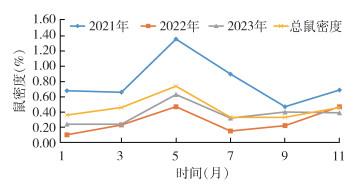
2021-2023年各年鼠密度均呈单峰分布,密度峰值均在5月,分别为1.36%、0.47%和0.63%。见图 1
图1 山东省枣庄市2021-2023年不同年度鼠密度季节消长

Fig. 1 Seasonal fluctuations in rodent density in different years in Zaozhuang, Shandong Province, 2021-2023

2.3.2 不同生境鼠密度季节消长

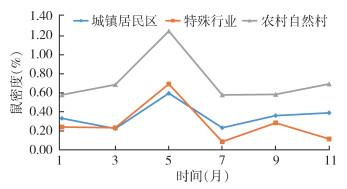
2021-2023年枣庄市城镇居民区、特殊行业和农村自然村3种生境鼠密度季节消长基本相同,均呈单峰分布,高峰期均出现在5月,鼠密度分别为0.60%、0.69%和1.25%。见图 2
图2 山东省枣庄市2021-2023年不同生境鼠密度季节消长

Fig. 2 Seasonal fluctuations in rodent density in different habitats in Zaozhuang, Shandong Province, 2021-2023

3 讨论

2021-2023年监测结果显示,小家鼠和褐家鼠是枣庄市滕州市和薛城区的主要鼠种,其中小家鼠构成比最高,为50.52%。这与2010-2018年山东省国家级鼠类监测点[2]和2017-2021年国家级鼠类监测点青岛市[4]以褐家鼠构成比最高不同,但与聊城市2018-2020年[5]、日照市2019年[6]等地监测结果相同。枣庄地区城镇居民区生境中老旧小区比例较高,建筑结构存在破损或老化,如墙体裂缝、门窗不严等,为小家鼠提供了便利的生存条件,加之老旧小区防鼠措施不到位,这可能是导致小家鼠比例略高的原因。
监测中捕获的黑线姬鼠较少,这可能与其生活习性有关。黑线姬鼠主要栖息在农田、森林等野外环境,而监测生境主要为城镇居民区、重点行业室内、农村自然村室内及院落等区域[4, 7]。监测中捕获黄胸鼠仅1只,主要是因为该鼠种分布属于亚热带型,在我国主要在长江以南地区活动,北方发现较少[8]。但严慧等[9]发现黄胸鼠有向西向北扩散的趋势,可能与交通运输以及气候变暖有关,提示下一步不能忽视对黄胸鼠的监测。
2023年的鼠密度较2022年略有升高,不同生境鼠密度变化趋势与总体鼠密度基本一致。分析原因,一方面是由于2021年枣庄市进入新一轮国家卫生城复审,全市大力开展巩固卫生城市工作,很大程度破坏了鼠类的繁殖和生活环境,使得鼠密度降低[10];另一方面也有可能受新型冠状病毒感染疫情影响,监测人员行动受限,监测质量有所下降有关。另外,农村居民区鼠密度明显比城镇居民区和特殊行业高。这与国内多地监测结果一致[11-14]。分析原因一是因为农村地区为粮食、蔬菜和瓜果的产区,为鼠类生存提供了较为丰富的食物,加之农村居民区的房屋结构和环境易于鼠类获取水源,更有利于鼠类生存繁殖[4];二是2013年以来的卫生城(镇)创建,城镇居民区和特殊行业开展了大规模的环境治理与集中灭鼠,而农村卫生环境相对较差,生活垃圾往往未得到及时清理和处理,无法做到日产日清,且环境设施较差,河沟污水等卫生死角较多,适宜鼠类栖息及捕食场所较多,缺乏统一的灭鼠行动,造成了农村鼠密度偏高[4, 11]。由于农村居民区鼠密度最高,应着重加强农村防鼠灭鼠工作。要持续加强农村环境卫生整治,定期清理农村环境中的垃圾、杂物和堆积物,特别是村边地头、房屋周边、田间地头的枯枝烂叶、禽畜尸体等,减少鼠类的食物来源和栖息场所。同时在每年的春、冬季集中开展村内统一灭鼠工作,有效降低鼠密度。城镇居民区和特殊行业鼠类防控作为卫生城(镇)创建工作的重要部分,更应常抓不懈,持续做好防鼠、灭鼠工作。
季节消长方面,不同年度鼠密度的季节消长规律不同,可能与当年的温度、湿度和降水量等自然条件有关。不同生境鼠密度季节消长规律基本相同,鼠密度高峰均出现在5月,与总体鼠密度季节消长规律也基本一致。这与2016-2018年吉林省鼠类密度监测结果[15]相同。分析原因主要是5月气候适宜,食物逐渐丰富,此时鼠类觅食活动增加,并进入繁殖期,监测鼠类密度达到高峰。
近年来,枣庄市持续开展卫生城(镇)创建和新农村建设,通过改善居住环境,治理鼠类孳生地和集中灭鼠行动等措施,促使鼠密度不断降低。但防鼠灭鼠工作依然重要,需常抓不懈。结合本次研究,建议在每年的5月加大对鼠类的防控力度,集中开展统一的灭鼠行动。在兼顾城镇和特殊行业的基础上,对农村区域适当倾斜。加强防鼠灭鼠知识的宣传力度,通过向公众宣传鼠类的危害、防鼠措施和灭鼠方法,提高防鼠灭鼠效果。同时根据鼠密度的季节消长规律,针对不同的生境制定科学的防制措施,建立以环境治理为主的长效综合防制机制。

利益冲突  无

1
吴海霞, 鲁亮, 孟凤霞, 等. 2006-2015年我国鼠类监测报告[J]. 中国媒介生物学及控制杂志, 2017, 28 (6): 517- 522.

DOI

Wu HX, Lu L, Meng FX, et al. Reports on national surveillance of rodents in China, 2006-2015[J]. Chin J Vector Biol Control, 2017, 28 (6): 517- 522.

DOI

2
王学军, 孙钦同, 韩英男, 等. 2010-2018年山东省国家级鼠类监测点监测报告[J]. 中国媒介生物学及控制杂志, 2020, 31 (3): 300- 304.

DOI

Wang XJ, Sun QT, Han YN, et al. Surveillance report of national rodent surveillance sites in Shandong Province, China, 2010-2018[J]. Chin J Vector Biol Control, 2020, 31 (3): 300- 304.

DOI

3
中国疾病预防控制中心. 全国病媒生物监测实施方案[Z]. 北京: 中国疾病预防控制中心, 2016.

Chinese Center for Disease Control and Prevention. National vector surveillance implementation plan[Z]. Beijing: Chinese Center for Disease Control and Prevention, 2016. (in Chinese)

4
宋富成, 修璟威, 王伟, 等. 2017-2021年青岛市国家级鼠类监测点监测报告[J]. 中国媒介生物学及控制杂志, 2022, 33 (5): 696- 700.

DOI

Song FC, Xiu JW, Wang W, et al. Surveillance report on rodents at national rodent surveillance sites of Qingdao, China, 2017-2021[J]. Chin J Vector Biol Control, 2022, 33 (5): 696- 700.

DOI

5
闫青芳, 赵洪林, 姜健康, 等. 山东省聊城市国家级监测点2018-2020年鼠类监测结果分析[J]. 中国媒介生物学及控制杂志, 2022, 33 (1): 100- 103.

DOI

Yan QF, Zhao HL, Jiang JK, et al. Rodent surveillance results of national surveillance sites in Liaocheng City of Shandong Province, China, 2018-2020[J]. Chin J Vector Biol Control, 2022, 33 (1): 100- 103.

DOI

6
于治远, 李凯, 李晓, 等. 2019年日照市重要病媒生物监测分析[J]. 预防医学论坛, 2020, 26 (9): 714- 717.

DOI

Yu ZY, Li K, Li X, et al. Analysis on monitoring data of important vectors, Rizhao City, 2019[J]. Prev Med Trib, 2020, 26 (9): 714- 717.

DOI

7
张慧敏, 李春辉, 王学军, 等. 2020-2022年山东省烟台市鼠类监测分析[J]. 中华卫生杀虫药械, 2024, 30 (2): 127- 131.

DOI

Zhang HM, Li CH, Wang XJ, et al. An analysis of the rodents surveillance results in Yantai, Shandong Province from 2020 to 2022[J]. Chin J Hyg Insect Equip, 2024, 30 (2): 127- 131.

DOI

8
李贵昌, 王玉姣, 鲁亮, 等. 2019年全国鼠类监测报告[J]. 中国媒介生物学及控制杂志, 2020, 31 (4): 389- 394.

DOI

Li GC, Wang YJ, Lu L, et al. National surveillance report on rodents in China, 2019[J]. Chin J Vector Biol Control, 2020, 31 (4): 389- 394.

DOI

9
严慧, 刘世友, 齐顺祥, 等. 黄胸鼠的分布与迁移[J]. 医学动物防制, 2022, 38 (5): 463- 466.

DOI

Yan H, Liu SY, Qi SX, et al. Distribution and migration of Rattus tanezumi[J]. J Med Pest Control, 2022, 38 (5): 463- 466.

DOI

10
李广帅, 刘美美, 庞松涛, 等. 西安市2015-2019年鼠密度监测结果[J]. 中国热带医学, 2021, 21 (5): 471- 474.

DOI

Li GS, Liu MM, Pang ST, et al. Surveillance results of rodent density in Xi'an, 2015-2019[J]. China Trop Med, 2021, 21 (5): 471- 474.

DOI

11
周博, 吴旭, 郎义, 等. 2015-2019年沈阳市鼠类种群密度及季节消长监测分析[J]. 中华卫生杀虫药械, 2022, 28 (1): 53- 55.

DOI

Zhou B, Wu X, Lang Y, et al. Monitoring and analysis of population density and seasonal fluctuation of rodents in Shenyang from 2015 to 2019[J]. Chin J Hyg Insect Equip, 2022, 28 (1): 53- 55.

DOI

12
唐天勇, 袁东娅, 江凡, 等. 大竹县2016-2018年鼠类监测结果分析[J]. 医学动物防制, 2021, 37 (3): 269- 271.

DOI

Tang TY, Yuan DY, Jiang F, et al. Analysis on rodent monitoring results in Dazhu from 2016 to 2018[J]. J Med Pest Control, 2021, 37 (3): 269- 271.

DOI

13
张家勇, 王纯玉, 白玉银, 等. 辽宁省2018-2020年鼠类种群密度与季节消长监测分析[J]. 中国媒介生物学及控制杂志, 2023, 34 (1): 39- 43.

DOI

Zhang JY, Wang CY, Bai YY, et al. Rodent density and seasonal fluctuation in Liaoning Province, China, 2018-2020[J]. Chin J Vector Biol Control, 2023, 34 (1): 39- 43.

DOI

14
王纯玉, 张家勇, 白玉银, 等. 辽宁省2020年主要病媒生物监测结果分析[J]. 中国媒介生物学及控制杂志, 2022, 33 (1): 76- 82.

DOI

Wang CY, Zhang JY, Bai YY, et al. Surveillance results of the main vectors in Liaoning Province of China in 2020[J]. Chin J Vector Biol Control, 2022, 33 (1): 76- 82.

DOI

15
苏海涛, 刘晓杰, 刘维, 等. 2016-2018年吉林省鼠类密度监测结果分析[J]. 中国卫生工程学, 2020, 19 (4): 509- 511.

DOI

Su HT, Liu XJ, Liu W, et al. Analysis on the monitoring results of rodent density in Jilin Province from 2016 to 2018[J]. Chin J Public Health Eng, 2020, 19 (4): 509- 511.

DOI

Outlines

/