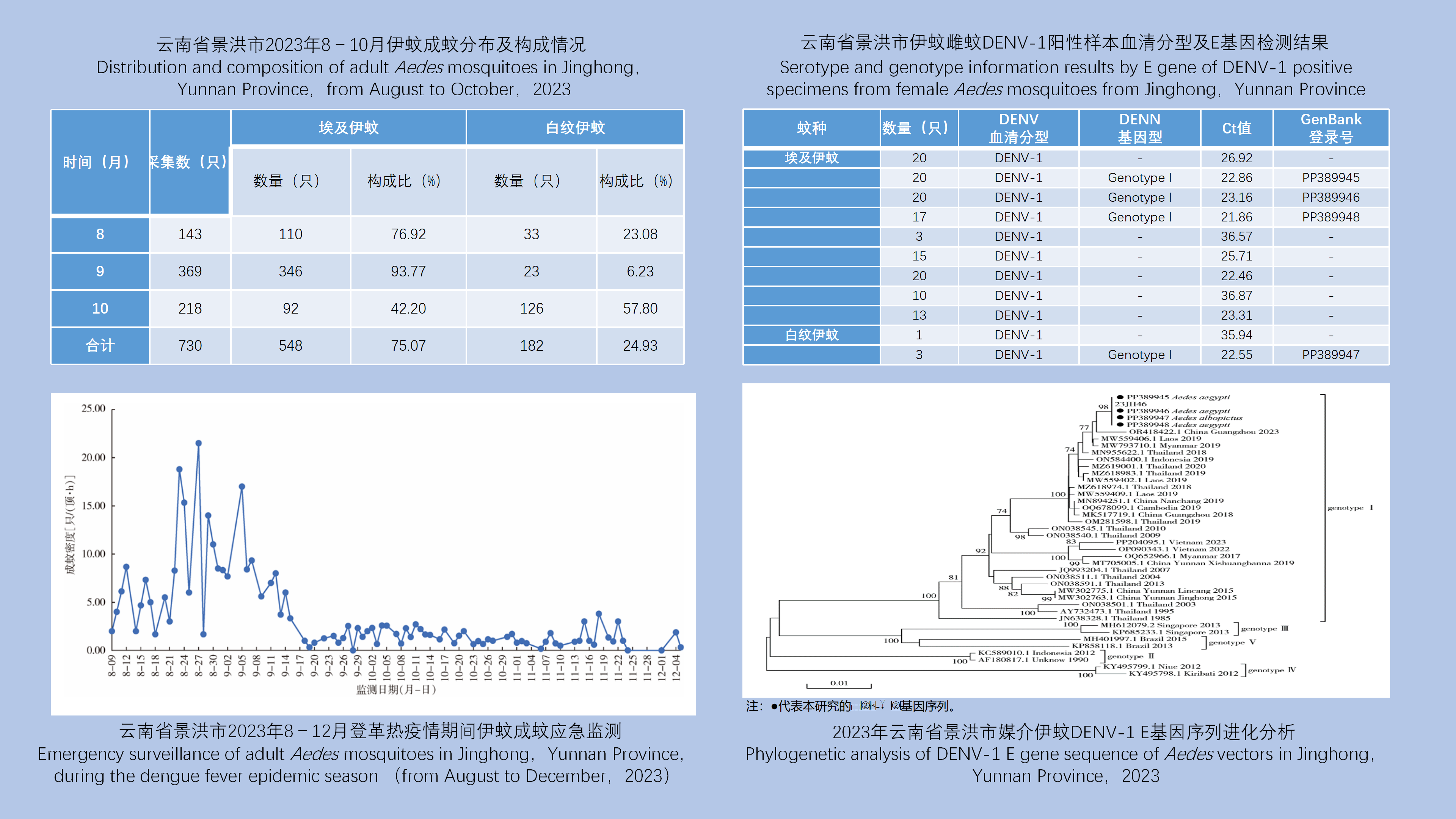
Objective To investigate the population composition and arbovirus infection of Aedes aegypti and Ae. albopictus in Jinghong, Xishuangbanna Dai Autonomous Prefecture (Xishuangbanna Prefecture), Yunnan Province, China during the dengue fever epidemic season in 2023, so as to provide a basis for the prevention and control of dengue fever and other arboviral diseases. Methods During the dengue fever epidemic season in 2023 (from August to October), the change of population composition of Ae. aegypti and Ae. albopictus was monitored in urban areas and Aedes mosquitoes were collected using the double mosquito net method. The infections with Dengue virus, Chikungunya virus, and Zika virus were detected using quantitative PCR (qPCR). The E gene sequences of the viruses were amplified using reverse transcription-PCR (RT-PCR), and a phylogenetic analysis was performed for homological analysis. Results A total of 730 Aedes mosquitoes were collected, of which 548 (75.07%) were Ae. aegypti and 182 (24.93%) were Ae. albopictus. All mosquitoes were divided into 76 groups (21 groups for Ae. albopictus and 55 groups for Ae. aegypti) based on species, sex, and time and location of acquisition. Out of the 76 groups, 11 (14.47%) tested positive for Dengue virus type 1 (DENV-1), yielding an infection rate of 9.52% (2/21) for Ae. albopictus and an infection rate of 16.36% (9/55) for Ae. aegypti, with no significant difference between the two species (χ2=0.574, P=0.449). Zika virus and Chikungunya virus were not detected in any of the mosquitoes. Four DENV-1 E gene sequences (1 from Ae. albopictus and 3 from Ae. aegypti) were successfully obtained from the 11 groups of DENV-1 positive specimens. The sequence similarity of the four sequences was 100%, and all sequences belonged to genotype Ⅰ. The phylogenetic analysis revealed that the strains were closely related to the 2023 Jinghong strain, 2023 Guangzhou strain, 2019 Laos strain, and 2019 Myanmar strain. Conclusions Ae. aegypti is more widely distributed than Ae. albopictus in Jinghong during the dengue fever epidemic season, and DENV-1 is detected in both species. Investigation and research should be enhanced for arboviral infection with Aedes mosquitoes.
WANG Xue-fei, CHEN Li, TAN Li-tao, ZOU Jian-hong, JIANG Jin-yong
. Investigation of the population composition and arbovirus infection of Aedes vector during dengue fever epidemic season in Jinghong, Yunnan Province, China, 2023[J]. Chinese Journal of Vector Biology and Control, 2025
, 36(2)
: 251
-257
.
DOI: 10.11853/j.issn.1003.8280.2025.02.018
[1] Lwande OW,Obanda V,Lindstrom A,et al. Globe-trotting Aedesaegypti and Aedesalbopictus:Risk factors for arbovirus pandemics[J]. Vector Borne Zoonotic Dis,2020,20(2):71-81. DOI:10.1089/vbz.2019.2486.
[2] Liu HX,Wang JN,Mi PF,et al. Epidemiological characteristics of dengue fever in Xishuangbanna,2013[J]. Soft Sci Health,2014,28(6):399-402. (in Chinese) 刘华兴,王江宁,弥鹏飞,等. 西双版纳州2013年登革热流行病学特征分析[J]. 卫生软科学,2014,28(6):399-402.
[3] Wei C,Guo XL,Yang R,et al. Epidemic situation of dengue fever in Yunnan Province from 2020 to 2022[J]. J Trop Dis Parasitol,2023,21(5):250-253. DOI:10.3969/j.issn.1672-2302.2023.05.002.(in Chinese) 魏春,郭小连,杨锐,等. 2020-2022年云南省登革热流行特征分析[J]. 热带病与寄生虫学,2023,21(5):250-253. DOI:10.3969/j.issn.1672-2302.2023.05.002.
[4] Wei C,Guo XL,Yang R,et al. Epidemiological and cluster characteristics of dengue fever in Yunnan Province,China,2013-2020[J]. Chin J Vector Biol Control,2021,32(6):720-724,743. DOI:10.11853/j.issn.1003.8280.2021.06.013.(in Chinese) 魏春,郭小连,杨锐,等. 云南省2013-2020年登革热流行及聚集特征分析[J]. 中国媒介生物学及控制杂志,2021,32(6):720-724,743. DOI:10.11853/j.issn.1003.8280.2021.06.013.
[5] Fan JH,Gao Y,Zhu J,et al. Epidemiological characteristics of dengue fever and surveillance results of Aedes mosquitoes in Xishuangbanna Prefecture,Yunnan Province,China,2006-2020[J]. Chin J Vector Biol Control,2022,33(2):245-251,304. DOI:10.11853/j.issn.1003.8280.2022.02.015.(in Chinese) 范建华,高阳,朱进,等. 云南省西双版纳州2006-2020年登革热流行特征及媒介伊蚊监测分析[J]. 中国媒介生物学及控制杂志,2022,33(2):245-251,304. DOI:10.11853/j.issn.1003.8280.2022.02.015.
[6] Li D,Cao JD,Kang JR,et al. Epidemiological and etiological investigation of the first imported Zika case in Yunnan Province[J]. Chin J Viral Dis,2022,12(5):358-363. DOI:10.16505/j.2095-0136.2022.0077.(in Chinese) 李多,曹继东,康家荣,等. 云南省首例输入性寨卡病毒病病例流行病学调查及病原分子特征分析[J]. 中国病毒病杂志,2022,12(5):358-363. DOI:10.16505/j.2095-0136.2022.0077.
[7] Yin XX,Liu YH,Zhang HL,et al. An outbreak of chikungunya fever in Yunnan Province near the China-Myanmar border in 2019[J]. Chin J Exp Clin Virol,2020,34(6):600-604. DOI:10.3760/cma.j.cn112866-20200609-00185.(in Chinese) 尹小雄,刘永华,张海林,等. 2019年云南中缅边境基孔肯雅热暴发疫情的流行病学特征[J]. 中华实验和临床病毒学杂志,2020,34(6):600-604. DOI:10.3760/cma.j.cn112866-20200609-00185.
[8] Li N,Meng JX,Li LL,et al. Investigation on Chikungunya virus infection in humans in Cangyuan County,Yunnan Province[J]. China Tropical Medicine,2023,23(12):1249-1253. DOI:10.13604/j.cnki.46-1064/r.2023.12.02.(in Chinese) 李楠,孟锦昕,李玲丽,等. 云南省沧源县人基孔肯雅病毒感染调查[J]. 中国热带医学,2023,23(12):1249-1253. DOI:10.13604/j.cnki.46-1064/r.2023.12.02.
[9] Li YY,Zhu J,Li HB. Distribution of the dengue fever vector in Xishuangbanna Prefecture of Yunnan[J]. China Trop Med,2016,16(3):237-240. DOI:10.13604/j.cnki.46-1064/r.2016.03.10.(in Chinese) 李园园,朱进,李鸿斌. 云南西双版纳州登革热传播媒介分布调查[J]. 中国热带医学,2016,16(3):237-240. DOI:10.13604/j.cnki.46-1064/r.2016.03.10.
[10] Wang G,Zhang HD,Gao J,et al. Investigation on the breeding sites of Aedesaegypti and Aedesalbopictus in border areas of Yunnan Province[J]. Acta Parasitol Med Entomol Sin,2021,28(3):159-164. DOI:10.3969/j.issn.1005-0507.2021.03.005.(in Chinese) 王戈,张恒端,高剑,等. 云南省边境地区埃及伊蚊和白纹伊蚊孳生特征调查[J]. 寄生虫与医学昆虫学报,2021,28(3):159-164. DOI:10.3969/j.issn.1005-0507.2021.03.005.
[11] Zhang HL,Zi DY,Mi ZQ,et al. Characterized distribution of Aedes albopictus and their relation with arbovirus in Yunnan Province[J]. Chin J Vector Biol Control,2001,12(2):103-105. DOI:10.3969/j.issn.1003-4692.2001.02.007.(in Chinese) 张海林,自登云,米竹青,等. 云南白纹伊蚊分布特点及与虫媒病毒的关系[J]. 中国媒介生物学及控制杂志,2001,12(2):103-105. DOI:10.3969/j.issn.1003-4692.2001.02.007.
[12] Guo XF,Zhou KM,Chen ZL,et al. Investigation of arboviruses carried by vector Aedes mosquitoes in the urban areas of Xishuangbanna Prefecture,Yunnan Province during the dengue fever epidemic season of 2018[J]. Acta Parasitol Med Entomol Sin,2023,30(4):202-209. DOI:10.3969/j.issn.1005-0507.2023.04.003.(in Chinese) 郭晓芳,周克梅,陈子龙,等. 2018年登革热流行季节云南西双版纳州城区媒介伊蚊携带虫媒病毒调查[J]. 寄生虫与医学昆虫学报,2023,30(4):202-209. DOI:10.3969/j.issn.1005-0507.2023.04.003.
[13] State Administration for Market Regulation,National Standardization Administration. GB/T 23797-2020Surveillance methods for vector density-Mosquito[S]. Beijing:Standards Press of China,2020. (in Chinese) 国家市场监督管理总局,国家标准化管理委员会. GB/T 23797-2020病媒生物密度监测方法 蚊虫[S]. 北京:中国标准出版社,2020.
[14] Dong XS,Zhou HN,Gong ZD. The mosquito fauna of Yunnan, China[M]. Kunming:Yunnan Science and Technology Press,2010. (in Chinese) 董学书,周红宁,龚正达. 云南蚊类志[M]. 昆明:云南科技出版社,2010.
[15] Deng SZ, Liu XY, Chang LT, et al. Epidemiological characteristics of an outbreak of dengue fever in Yunnan Province, 2023 [J]. Chin J Front Health Quar, 2024, 47(5):500-504.(in Chinese) 邓淑珍,刘肖钰,常利涛,等. 2023年云南省登革热暴发疫情的流行病学特征分析 [J]. 中国国境卫生检疫杂志, 2024, 47(5):500-504.
[16] Li H,Jiang JY,Dong LM,et al. Emergency monitoring and analysis of the epidemiological characteristics and vectors of a dengue fever outbreak in Mengla County in 2018[J]. J Pathog Biol,2020,15(1):83-85,90. DOI:10.13350/j.cjpb.200117.(in Chinese) 李宏,姜进勇,董利民,等. 2018年勐腊县城区登革热暴发流行特征与媒介应急监测分析[J]. 中国病原生物学杂志,2020,15(1):83-85,90. DOI:10.13350/j.cjpb.200117.
[17] Wang J,Liu JY,Mao Q,et al. Epidemiological characteristics of dengue fever in Mengla County,Yunnan Province in 2019[J]. Shanghai J Prev Med,2022,34(6):555-558. DOI:10.19428/j.cnki.sjpm.2022.21571.(in Chinese) 王娇,刘江云,毛琦,等. 2019年云南省勐腊县登革热流行病学特征分析[J]. 上海预防医学,2022,34(6):555-558. DOI:10.19428/j.cnki.sjpm.2022.21571.
[18] Yin XX,Liu YH,Yang ZL,et al. Epidemiological characteristics of dengue fever and monitoring of Aedes mosquitoes in Ruili City of Yunnan Province in 2022[J]. Chin J Front Health Quar,2023,46(4):372-376. DOI:10.16408/j.1004-9770.2023.04.016.(in Chinese) 尹小雄,刘永华,杨召兰,等. 2022年云南省瑞丽市登革热流行特征及媒介伊蚊监测分析[J]. 中国国境卫生检疫杂志,2023,46(4):372-376. DOI:10.16408/j.1004-9770.2023.04.016.
[19] Teng XB,Xu X,Yang R,et al. The larvae charateristics of dengue vector mosquitoes in residential area of Gengma County,Yunnan Province in 2016[J]. Chin J Vector Biol Control,2018,29(4):355-357,363. DOI:10.11853/j.issn.1003.8280.2018.04.008.(in Chinese) 滕兴波,许翔,杨锐,等. 云南省耿马县2016年居民区登革热媒介伊蚊孳生情况调查[J]. 中国媒介生物学及控制杂志,2018,29(4):355-357,363. DOI:10.11853/j.issn.1003.8280.2018.04.008.
[20] Liu YH,Yin XX,Zhang HL,et al. Epidemiological characteristics of dengue fever and monitoring of Aedes vector mosquitoes in Dehong Dai and Jingpo Autonomous Prefecture of Yunnan Province,China,2013-2019[J]. Chin J Vector Biol Control,2021,32(2):173-180. DOI:10.11853/j.issn.1003.8280.2021.02.011.(in Chinese) 刘永华,尹小雄,张海林,等. 云南省德宏州2013-2019年登革热流行特征及媒介伊蚊监测分析[J]. 中国媒介生物学及控制杂志,2021,32(2):173-180. DOI:10.11853/j.issn.1003.8280.2021.02.011.
[21] Yang MD,Jiang JY,Zheng YT,et al. Distribution survey on Aedesaegypti in the border areas of Yunnan Province,China[J]. Chin J Vector Biol Control,2015,26(4):406-408. DOI:10.11853/j.issn.1003.4692.2015.04.020.(in Chinese) 杨明东,姜进勇,郑宇婷,等. 云南省边境地区埃及伊蚊分布调查[J]. 中国媒介生物学及控制杂志,2015,26(4):406-408. DOI:10.11853/j.issn.1003.4692.2015.04.020.
[22] Yang YX,Lin ZR,Na A,et al. Surveillances of the important ecological habits and insecticides resistance to dengue vector Aedes mosquito in Gengma County,China-Myanmar border[J]. J Pathog Biol,2023,18(4):447-450. DOI:10.13350/j.cjpb. 230415.(in Chinese) 杨耀翔,林祖锐,娜安,等. 中缅边境耿马县登革热媒介伊蚊重要生态习性及抗药性调查[J]. 中国病原生物学杂志,2023,18(4):447-450. DOI:10.13350/j.cjpb.230415.
[23] Macdonald WW. Aedes aegypti in Malaya.Ⅰ. Distribution and dispersal[J]. Ann Trop Med Parasitol,1956,50(4):385-398. DOI:10.1080/00034983.1956.11685781.
[24] Li YP,An Q,Sun Z,et al. Distribution areas and monthly dynamic distribution changes of three Aedes species in China:Aedesaegypti,Aedesalbopictus and Aedesvexans[J]. Parasit Vectors,2023,16(1):297. DOI:10.1186/s13071-023-05924-9.
[25] Kobayashi D,Kai I,Faizah AN,et al. Comparative analysis of the susceptibility of Aedesaegypti and Japanese Aedesalbopictus to all Dengue virus serotypes[J]. Trop Med Health,2023,51(1):61. DOI:10.1186/s41182-023-00553-5.
[26] Bara JJ,Clark TM,Remold SK. Susceptibility of larval Aedesaegypti and Aedesalbopictus (Diptera:Culicidae) to Dengue virus[J]. J Med Entomol,2013,50(1):179-184. DOI:10.1603/me12140.

