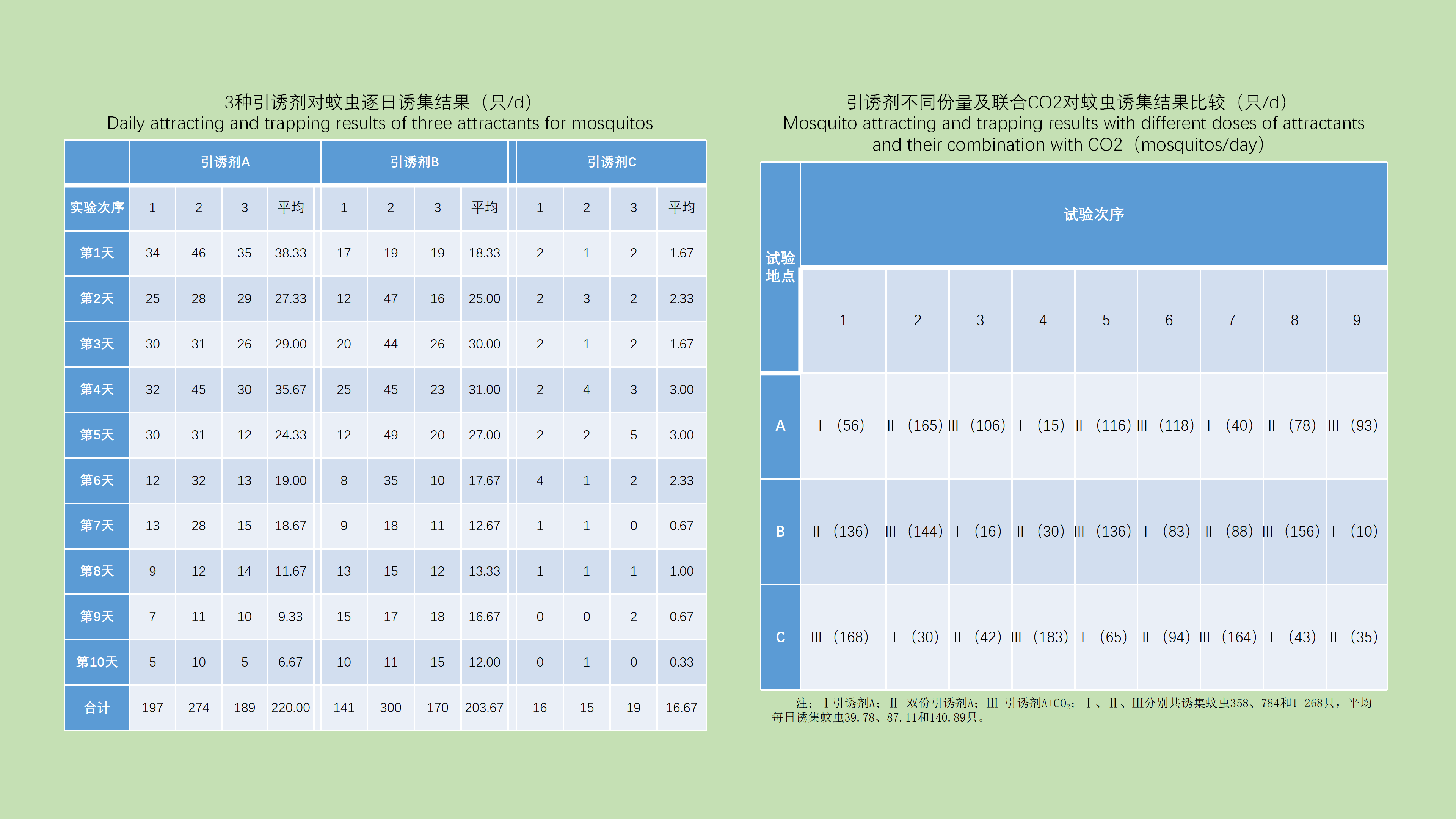
Objective To compare the effectiveness of three chemical attractants (A, B, and C) and carbon dioxide (CO2) as well as their combinations in attracting and trapping common mosquitos by conducting experiments in large residential areas, so as to provide a scientific basis for the application of chemical attractants and CO2 in mosquito surveillance and control. Methods Mosquito attracting and trapping experiments were conducted in the field using three attractants over 10 consecutive days. The mosquito attracting and trapping abilities were analyzed for each day. Experiments with the attractants and combination of the attractants and 150 ml/min flow CO2 were conducted using Latin square design and cross-over method. Analysis of variance and rank sum test were performed to evaluate the effectiveness of the attractants and CO2 in mosquito attracting and trapping, as well as the impact of CO2 on the species and sex of mosquitos attracted and trapped. Results The average numbers of mosquitos attracted and trapped by attractants A, B, and C over 10 consecutive days were 220.00, 203.67, and 16.67, respectively, with the maximum number being 46, 49, and 5 per day, respectively. Attractant A, double attractant A, and attractant A combined with 150 ml/min flow CO2 attracted and trapped 358, 784, and 1 268 mosquitos, respectively, with significant differences in any two of the three groups (all P<0.05). Attractants A and B combined with 150 ml/min flow CO2 respectively enhanced the effectiveness of attracting mosquitos, with significant differences observed in Culex pipiens quinquefasciatus and Aedes albopictus (all P<0.001) and between the female and male mosquitoes ofthem(all P<0.001). Conclusions Chemical attractants have a certain lasting effect in trapping mosquitos in the field. The combination of attractants with CO2 can enhance the trapping effect more significantly than increasing the portion of attractants, making them applicable in mosquito surveillance and control.
DENG Hui, DUAN Jin-hua, LU Rui-peng, CHENG Zong-jing, CHENG Ming-ji, HU Sheng-jun, SHEN Xiu-ting, ZHONG Yu-wen
. A study of the effectiveness of chemical attractants and carbon dioxide in attracting and trapping mosquitos in the field[J]. Chinese Journal of Vector Biology and Control, 2025
, 36(1)
: 18
-21
.
DOI: 10.11853/j.issn.1003.8280.2025.01.004
[1] Guo YH, Wu HX, Liu XB, et al. National vectors surveillance report on mosquitoes in China, 2018[J]. Chin J Vector Biol Control, 2019, 30(2):128-133. DOI:10.11853/j.issn.1003.8280.2019.02.003.(in Chinese) 郭玉红, 吴海霞, 刘小波, 等. 2018年全国媒介蚊虫监测报告[J]. 中国媒介生物学及控制杂志, 2019, 30(2):128-133. DOI:10.11853/j.issn.1003.8280.2019.02.003.
[2] National Health and Family Planning Commission. National vector surveillance programme[Z]. 2016. (in Chinese) 国家卫生计划生育委员会. 全国病媒生物监测方案[Z]. 2016.
[3] Deng H, Liu LP, Xu QA, et al. The luring and trapping effect of three mosquito attractants and carbon dioxide at different flow rates on Aedes albopictus[J]. Chin J Vector Biol Control, 2021, 32(5):637-641. DOI:10.11853/j.issn.1003.8280.2021.05.026.(in Chinese) 邓惠, 刘礼平, 许齐爱, 等. 3种蚊虫引诱剂与不同流量CO2对白纹伊蚊诱集效果的研究[J]. 中国媒介生物学及控制杂志, 2021, 32(5):637-641. DOI:10.11853/j.issn.1003.8280.2021.05.026.
[4] Wang F, Xu HD, Li X, et al. Attractive action of different chemical substances for Aedes albopictus[J]. Chin J Vector Biol Control, 2023, 34(4):447-450, 496. DOI:10.11853/j.issn.1003.8280.2023.04.001.(in Chinese) 王飞, 徐皓迪, 李鑫, 等. 几种化学物质对白纹伊蚊的引诱效果研究[J]. 中国媒介生物学及控制杂志, 2023, 34(4):447-450, 496. DOI:10.11853/j.issn.1003.8280.2023.04.001.
[5] Hu CY, Hu LP. How to use analysis of variance correctly:An analysis of variance for the univariate quantitative data collected from the Latin square design[J]. Sichuan Mental Health, 2022, 35(2):114-119. DOI:10.11886/scjsws20220310004.(in Chinese) 胡纯严, 胡良平. 如何正确运用方差分析:拉丁方设计定量资料一元方差分析[J]. 四川精神卫生, 2022, 35(2):114-119. DOI:10.11886/scjsws20220310004.
[6] Liu B. Development on attractant to Aedes albopictus and preliminary research on prewarning indices of dengue[D]. Guangzhou:Southern Medical University, 2010. (in Chinese) 刘彬. 白纹伊蚊引诱剂的研制及登革热预警指标的初步探讨[D]. 广州:南方医科大学, 2010.
[7] Skinner WA, Tong H, Pearson T, et al. Human sweat components attractive to mosquitoes[J]. Nature, 1965, 207(4997):661-662. DOI:10.1038/207661a0.
[8] Kline DL. Evaluation of various models of propane-powered mosquito traps[J]. J Vector Ecol, 2002, 27(1):1-7.
[9] Deng HP, Xu YX, Wang SH. Comparison of ultraviolet lamp and CO2 trap in mosquito capture[J]. Chin J Hyg Insect Equip, 2016, 22(6):539-541. DOI:10.19821/j.1671-2781.2016.06.005.(in Chinese) 邓海平, 徐友祥, 王韶华. 紫外线灯诱法与CO2灯诱法捕蚊效果的比较[J]. 中华卫生杀虫药械, 2016, 22(6):539-541. DOI:10.19821/j.1671-2781.2016.06.005.
[10] Ding SY. The filtration of attractiveness to hematophagia mosquito and its effect on the behavior of mosquitos[D]. Wuhan:Huazhong Agricultural University, 2007. (in Chinese) 丁思悦. 吸血蚊虫引诱剂的筛选及其对蚊虫行为的影响[D]. 武汉:华中农业大学, 2007.
[11] Mao J. Study on population density and attractive technology of Culex pipiens pallens[D]. Hangzhou:Zhejiang University, 2017. (in Chinese) 毛杰. 淡色库蚊种群密度调查及引诱技术研究[D]. 杭州:浙江大学, 2017.
[12] Schreck CE, Kline DL, Carlson DA. Mosquito attraction to substances from the skin of different humans[J]. J Am Mosq Control Assoc, 1990, 6(3):406-410.

