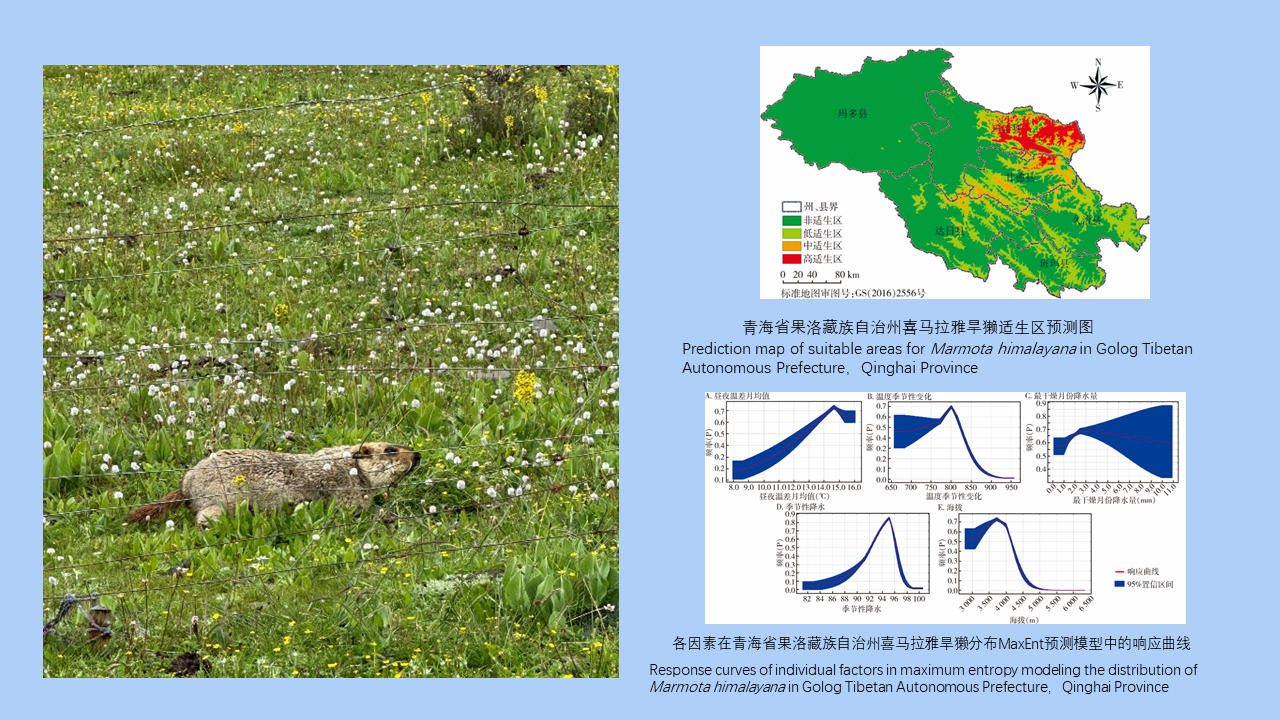
Objective To analyze and predict the suitable areas for Marmota himalayana in Golog Tibetan Autonomous Prefecture (Golog Prefecture), China using ecological niche models, so as to provide a theoretical basis for scientific and efficient plague host surveillance in the future. Methods According to field survey data on the longitude and latitude of 96 M. himalayana distribution points as well as data on elevation and climate (19 factors) from the WorldClim website, the suitable areas of M. himalayana in Golog Prefecture were modeled using a maximum entropy model (MaxEnt) and ArcGIS 10.6 software, and the results were evaluated through the receivers operating characteristic curve (ROC). Results The area under the curve (AUC) of the MaxEnt was 0.928, indicating that the prediction results of the model were reliable. The percentage contribution rate of the top five factors in descending order were precipitation of the driest month(35.7%), temperature seasonality(26.3%), precipitation seasonality(20.5%), monthly average diurnal temperature range(10.2%), and elevation(7.3%). When the monthly average diurnal temperature range was 14.7 ℃, the temperature seasonality was 800, the precipitation of the driest month was 2.4 mm, the precipitation seasonality was 95, and the elevation was 3 720 m, their respective response curves reached the highest. The highly suitable area for M. himalayana in Golog Prefecture was estimated at 2 445.24 km2, and the moderately suitable area was estimated at 4 240.76 km2, which were mainly located in Maqen County and Gade County. Conclusions The MaxEnt model can produce reliable prediction results that are consistent with the actual situation, providing a scientific and efficient theoretical basis for plague surveillance in the future. The highly and moderately suitable habitats of M. himalayana are largely located in Maqen and Gade counties, where surveillance should be strengthened.
DUOJIE Ang-qian, GENG Yong-qiang, LI Ling-wen, MI Bao-yu, YOU Pei-song, WANG Mei, LI Jun, LI Bin, WANG Yong-shun
. Identification of suitable areas for Marmota himalayana in Golog Tibetan Autonomous Prefecture, China[J]. Chinese Journal of Vector Biology and Control, 2024
, 35(4)
: 483
-488
.
DOI: 10.11853/j.issn.1003.8280.2024.04.018
[1] 国家市场监督管理总局,国家标准化管理委员会. GB 16883— 2022鼠疫自然疫源地及动物鼠疫流行判定[S]. 北京:中国标准出版社,2022. State Administration for Market Regulation,Standardization Administration of the People's Republic of China. GB 16883-2022 Determination for natural plague foci and plague epizootics[S]. Beijing:Standards Press of China,2022.(in Chinese)
[2] 丛显斌,鞠成. 中国人间鼠疫[M]. 北京:人民卫生出版社, 2018:1-31,105-108. Cong XB,Ju C. Human plague in China[M]. Beijing:People's Medical Publishing House,2018:1-31,105-108.(in Chinese)
[3] 丛显斌,刘振才,李群. 中国鼠疫自然疫源地(1950-2014) [M]. 北京:人民卫生出版社,2019:806-811. Cong XB,Liu ZC,Li Q. Natural focus of plague in China(1950- 2014)[M]. Beijing:People's Medical Publishing House,2019: 806-811.(in Chinese)
[4] 王祖郧,李超. 青海鼠疫[M]. 北京:人民卫生出版社,2016: 374-378. Wang ZY,Li C. Plague prevention and control in Qinghai[M]. Beijing:People's Medical Publishing House,2016:374-378.(in Chinese)
[5] 栾淑丽. 玉树市喜马拉雅旱獭的适生区识别研究与应用[D]. 上海:华东师范大学,2022. DOI:10.27149/d.cnki.ghdsu. 2022. 003463. Luan SL. Research and application on the identification of the suitable areas for Marmota himalayana in Yushu City[D]. Shanghai:East China Normal University,2022. DOI:10.27149/d. cnki.ghdsu.2022.003463.(in Chinese)
[6] Jaynes ET. Information theory and statistical mechanics[J]. Phys Rev,1957,106(4):620-630. DOI:10.1103/PhysRev.106.620.
[7] 郑楠,赵坚,李玉贵,等. 基于MaxEnt与3S技术预测长爪沙鼠在中国的适生区分布[J]. 中国预防医学杂志,2015,16(1): 68-70. DOI:10.16506/j.1009-6639.2015.01.019. Zheng N,Zhao J,Li YG,et al. Potential habitat prediction of Meriones unguiculatus based on MaxEnt and 3S technology[J]. Chin Prev Med,2015,16(1):68-70. DOI:10.16506/j. 1009- 6639.2015.01.019.(in Chinese)
[8] 闫东,刘冠纯,候芝林,等. 利用两种生态位模型预测长爪沙鼠鼠疫疫源地动物间疫情潜在风险[J]. 中国媒介生物学及控制杂志,2020,31(1):12-15. DOI:10.11853/j.issn. 1003. 8280. 2020.01.003. Yan D,Liu GC,Hou ZL,et al. Using two ecological niche models to predict the potential risk of epizootic situation in the foci of Meriones unguiculatus plague[J]. Chin J Vector Biol Control, 2020,31(1):12-15. DOI:10.11853/j. issn. 1003. 8280. 2020. 01.003.(in Chinese)
[9] Lu L,Ren ZP,Yue YJ,et al. Niche modeling predictions of the potential distribution of Marmota himalayana,the host animal of plague in Yushu County of Qinghai[J]. BMC Public Health, 2016,16:183. DOI:10.1186/s12889-016-2697-6.
[10] Wang ZC,Kang YK,Wang Y,et al. Himalayan marmot (Marmota himalayana) redistribution to high latitudes under climate change[J]. Animals(Basel),2023,13(17):2736. DOI: 10.3390/ani13172736.
[11] Fick SE,Hijmans RJ. WorldClim 2:New 1-km spatial resolution climate surfaces for global land areas[J]. Int J Climatol,2017,37(12):4302-4315. DOI:10.1002/joc.5086.
[12] 张彦静,斯琴,胡洁,等. 气候变化情景下裸冠菊在中国的潜在适生区分布预测[J]. 生态学报,2023,43(21):8852-8864. DOI:10.20103/j.stxb.202210212992. Zhang YJ,Si Q,Hu J,et al. Prediction of the potential geographical distribution of the invasive plant Gymnocoronis spilanthoides in China under climate change[J]. Acta Ecol Sin, 2023,43(21):8852-8864. DOI:10.20103/j.stxb.202210212992. (in Chinese)
[13] Swets JA. Measuring the accuracy of diagnostic systems[J]. Science,1988,240(4857):1285-1293. DOI:10.1126/science. 3287615.
[14] 荣文文,黄祥,牛攀新,等. 基于最大熵模型的中药材木贼麻黄潜在适生区[J]. 生态学报,2023,43(20):8631-8646. DOI: 10.20103/j.stxb.202209162641. Rong WW,Huang X,Niu PX,et al. Potentially suitable areas for traditional Chinese medicinal material Ephedra equisetina based on MaxEnt model[J]. Acta Ecol Sin,2023,43(20):8631-8646. DOI:10.20103/j.stxb.202209162641.(in Chinese)
[15] 张娟. 西藏中南部喜马拉雅旱獭(Marmota himalayana)栖息地选择研究[D]. 拉萨:西藏大学,2023. DOI:10.27735/d.cnki. gxzdx.2023.000048. Zhang J. Study on habitat selection by Himalayan marmot (Marmota himalayana) in the South Central Tibet Plateau[D]. Lasa:Tibet University,2023. DOI:10.27735/d.cnki.gxzdx. 2023. 000048.(in Chinese)
[16] 李响,张成福,贺帅,等. MaxEnt模型综合应用研究进展分析[J]. 绿色科技,2020(14):14-17. DOI:10.16663/j. cnki. lskj. 2020.14.003. Li X,Zhang CF,He S,et al. Research progress analysis on the comprehensive application of MaxEnt model[J]. J Green Sci Technol,2020(14):14-17. DOI:10.16663/j.cnki.lskj. 2020. 14. 003.(in Chinese)
[17] 岳玉娟,吴朝学,杨闯,等. 四川省喜马拉雅旱獭生境分析及适生区预测[J]. 环境卫生学杂志,2023,13(12):916-922. DOI:10.13421/j.cnki.hjwsxzz.2023.12.008. Yue YJ,Wu ZX,Yang C,et al. Habitant analysis and prediction of suitable habitants of Himalayan marmots in Sichuan Province, China[J]. J Environ Hyg,2023,13(12):916-922. DOI: 10.13421/j.cnki.hjwsxzz.2023.12.008.(in Chinese)
[18] 蒋可,熊浩明,靳海晓,等. 喜马拉雅旱獭生态学研究进展[J]. 中国媒介生物学及控制杂志,2024,35(1):121-127. DOI: 10.11853/j.issn.1003.8280.2024.01.022. Jiang K,Xiong HM,Jin HX,et al. Research progress on ecology of Marmota himalayana[J]. Chin J Vector Biol Control,2024,35(1):121-127. DOI:10.11853/j.issn.1003.8280.2024.01.022.(in Chinese)
[19] 唐新元,王梅,田富彰,等. 青海省喜马拉雅旱獭鼠疫自然疫源地生态特征概述[J]. 中国地方病防治,2023,38(4): 284-286. Tang XY,Wang M,Tian FZ,et al. Overview of ecological characteristics of natural plague focus of Marmota himalayana in Qinghai Province[J]. Chin J Ctrl Endem Dis,2023,38(4):284- 286.(in Chinese)

