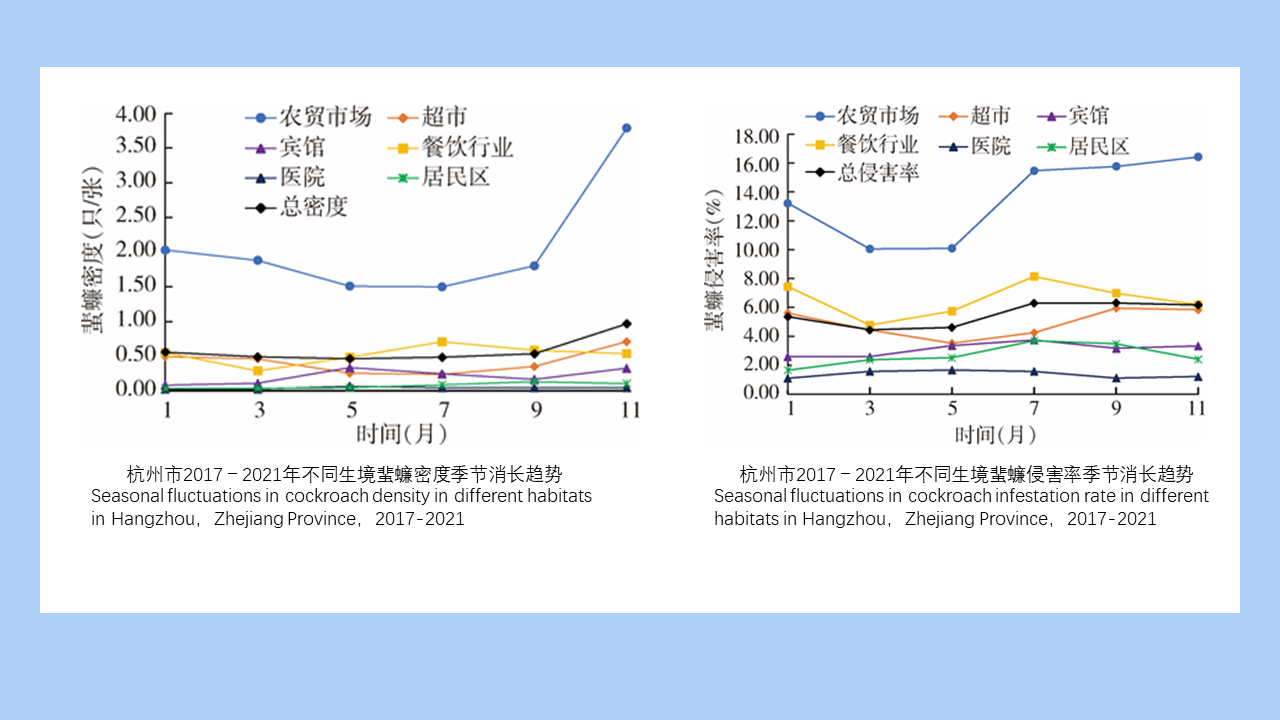
Objective To investigate the population composition, density distribution, and seasonal fluctuations of cockroaches in different habitats in Hangzhou, Zhejiang Province, China, so as to provide a scientific basis for cockroach control. Methods From 2017 to 2021, cockroaches were monitored using the sticky trap method in six types of habitats (farmers' markets, catering industry, hotels, supermarkets, residential areas, and hospitals) in 15 counties/districts/cities of Hangzhou. Excel 2016 and SPSS 20.0 softwares were used for data collation and statistical analysis of cockroach species composition and density distribution. Density and seasonality by year and habitat were compared. One-way analysis of variance was performed to test for differences in cockroach density. The Chi-square test was conducted to compare the infestation rate and composition ratio of cockroaches. Results A total of 32 978 cockroaches were captured in the city from 2017 to 2021, with an average density of 0.58 cockroaches/trap and an average infestation rate of 5.53%. Among them, Blattella germanica was the dominant species, accounting for 99.05% of the total catches. The cockroach density and infestation rate were highest in farmers' markets, followed by catering industry, supermarkets, hotels, residential areas, and hospitals. In general, cockroach average density showed a unimodal trend, peaking in November, while the cockroach infestation rate showed a bimodal trend, with peaks in January and September, respectively. For farmers' markets, both the cockroach density and infestation rate had two peaks throughout a year, which occurred in January and November, respectively. Conclusions B. germanica was the dominant species in Hangzhou. Farmers' markets and catering industry should be the focus of cockroach control. The cockroach infestation rate mainly peaks in summer and autumn, while cockroach density mainly peaks in winter. Comprehensive control measures should be taken before the peak of cockroach activity based on seasonal fluctuations in cockroach density and the infestation rate in various habitats, so as to control the density and infestation rate of cockroaches.
[1] Xu Y. Research progress on cockroaches as carriers of pathogens[J]. Pract Prev Med,2015,22(5):636-639. DOI:10.3969/j.issn.1006-3110.2015.05.043.(in Chinese)徐毅. 蜚蠊病原体携带研究进展[J]. 实用预防医学,2015,22(5):636-639. DOI:10.3969/j.issn.1006-3110.2015.05.043.
[2] Jin BB, Wei LY, Cao Y,et al. An analysis of mosquito population density and seasonal fluctuation monitoring results in Hangzhou,Zhejiang Province,China,2017-2021[J]. Chin J Vector Biol Control,2023,34(3):351-355. DOI:10.11853/j.issn.1003. 8280.2023.03.012.(in Chinese)金彬彬,韦凌娅,曹阳,等. 杭州市2017—2021年蚊虫种群密度与季节消长监测结果分析[J]. 中国媒介生物学及控制杂志,2023,34(3):351-355. DOI:10.11853/j.issn.1003.8280. 2023.03.012.
[3] Liu QY, Meng FX, Fan JC. Vector surveillance and control in emergencies in China:Proceedings and perspectives[J]. Chin J Vector Biol Control,2011,22(1):1-4. (in Chinese)刘起勇,孟凤霞,樊景春. 中国重要病媒生物应急监测与控制[J]. 中国媒介生物学及控制杂志,2011,22(1):1-4.
[4] Ren DS, Wu HX, Guo YH,et al. National vectors surveillance report on cockroaches in China,2018[J]. Chin J Vector Biol Control,2019,30(2):142-145. DOI:10.11853/j.issn.1003. 8280.2019.02.006.(in Chinese)任东升,吴海霞,郭玉红,等. 2018年全国蜚蠊监测报告[J]. 中国媒介生物学及控制杂志,2019,30(2):142-145. DOI:10.11853/j.issn.1003.8280.2019.02.006.
[5] Yue YJ, Ren DS, Wu HX,et al. National surveillance report on cockroaches in China,2019[J]. Chin J Vector Biol Control,2020,31(4):412-416. DOI:10.11853/j.issn.1003.8280.2020. 04.006.(in Chinese)岳玉娟,任东升,吴海霞,等. 2019年全国蜚蠊监测报告[J]. 中国媒介生物学及控制杂志,2020,31(4):412-416. DOI:10.11853/j.issn.1003.8280.2020.04.006.
[6] Wu YY, Gong ZY, Hou J,et al. Analysis of vector surveillance from 2011 to 2013 in Zhejiang Province,China[J]. Chin J Vector Biol Control,2015,26(4):394-397. DOI:10.11853/j.issn.1003. 4692.2015.04.017.(in Chinese)吴瑜燕,龚震宇,侯娟,等. 浙江省2011—2013年病媒生物监测结果分析[J]. 中国媒介生物学及控制杂志,2015,26(4):394-397. DOI:10.11853/j.issn.1003.4692.2015.04.017.
[7] Xu R, Ma X, Zhu GF,et al. Analysis of vector surveillance in Ningbo,2014[J]. Chin J Vector Biol Control,2015,26(6):630-633. DOI:10.11853/j.issn.1003.4692.2015.06.025.(in Chinese)徐荣,马晓,朱光锋,等. 宁波市2014年病媒生物监测结果分析[J]. 中国媒介生物学及控制杂志,2015,26(6):630-633. DOI:10.11853/j.issn.1003.4692.2015.06.025.
[8] Zhang JL, Hou YX. An analysis of surveillance results for cockroaches in Anhui Province,China,2017-2019[J]. Chin J Vector Biol Control,2021,32(4):464-467. DOI:10.11853/j.issn.1003.8280.2021.04.016.(in Chinese)张家林,侯银续. 安徽省2017—2019年蜚蠊监测结果分析[J]. 中国媒介生物学及控制杂志,2021,32(4):464-467. DOI:10.11853/j.issn.1003.8280.2021.04.016.
[9] Wang XJ, Sun QT, Qi ZB,et al. Surveillance report of cockroaches in Shandong Province,China,2016-2020[J]. Chin J Vector Biol Control,2022,33(4):525-529. DOI:10.11853/j.issn.1003.8280.2022.04.016.(in Chinese)王学军,孙钦同,亓宗宝,等. 山东省2016—2020年蜚蠊监测分析[J]. 中国媒介生物学及控制杂志,2022,33(4):525-529. DOI:10.11853/j.issn.1003.8280.2022.04.016.
[10] Yu JG, Hu YJ, Li GC,et al. Investigation on the density and infestation of cockroaches in cities of Sichuan Province in 2019[J]. Chin J Hyg Insect Equip,2021,27(5):429-431. DOI:10.19821/j.1671-2781.2021.05.011.(in Chinese)余技钢,胡雅劼,李观翠,等. 2019年四川省城市蟑螂密度与侵害情况监测[J]. 中华卫生杀虫药械,2021,27(5):429-431. DOI:10.19821/j.1671-2781.2021.05.011.
[11] Wang CY, Bai YY, Zhang JY,et al. Analysis of surveillance results of cockroaches in Liaoning Province,China,2015-2020[J]. Chin J Vector Biol Control,2022,33(2):225-229. DOI:10.11853/j.issn.1003.8280.2022.02.011.(in Chinese)王纯玉,白玉银,张家勇,等. 辽宁省2015—2020年蜚蠊监测结果分析[J]. 中国媒介生物学及控制杂志,2022,33(2):225-229. DOI:10.11853/j.issn.1003.8280.2022.02.011.
[12] Zhu J, Zhou YB, Fan MQ,et al. Analysis on spatiotemporal patterns of the population density of cockroaches in Shanghai[J]. Chin J Hyg Insect Equip,2020,26(3):232-235. DOI:10.19821/j.1671-2781.2020.03.012.(in Chinese)朱江,周毅彬,范明秋,等. 2009—2018年上海市蟑螂种群密度时空变化分析[J]. 中华卫生杀虫药械,2020,26(3):232-235. DOI:10.19821/j.1671-2781.2020.03.012.
[13] Du EX, Li S. Molecular mystery of the “little mighty” cockroach[J]. Chin J Vector Biol Control,2021,32(4):385-389. DOI:10.11853/j.issn.1003.8280.2021.04.001.(in Chinese)都二霞,李胜. 蟑螂为"小强"的分子奥秘[J]. 中国媒介生物学及控制杂志,2021,32(4):385-389. DOI:10.11853/j.issn. 1003.8280.2021.04.001.
[14] Li TQ, Wu YY, Liu QM,et al. Surveillance results of the insecticide resistance of Blattella germanica in Zhejiang Province of China,2018[J]. Chin J Vector Biol Control,2022,33(4):462-465. DOI:10.11853/j.issn.1003.8280.2022.04.003.(in Chinese)李天奇,吴瑜燕,刘钦梅,等. 浙江省2018年德国小蠊抗药性监测结果分析[J]. 中国媒介生物学及控制杂志,2022,33(4):462-465. DOI:10.11853/j.issn.1003.8280.2022.04.003.
[15] Zou YM, Lan CJ, Zhu D,et al. An analysis of resistance of Blattella germanica to commonly used insecticides in Wuxi,Jiangsu Province,China,2010-2018[J]. Chin J Vector Biol Control,2021,32(2):193-196. DOI:10.11853/j.issn.1003. 8280.2021.02.014.(in Chinese)邹亚明,兰策介,朱丁,等. 江苏省无锡市2010—2018年德国小蠊对常用杀虫剂的抗药性发展趋势分析[J]. 中国媒介生物学及控制杂志,2021,32(2):193-196. DOI:10.11853/j.issn.1003.8280.2021.02.014.
[16] Hu J, Liu Y, Zhang SH,et al. An analysis of resistance of Blattella germanica to commonly used insecticides in Shenzhen,China[J]. Chin J Vector Biol Control,2021,32(1):70-73. DOI:10.11853/j.issn.1003.8280.2021.01.014.(in Chinese)胡静,刘阳,张韶华,等. 广东省深圳市德国小蠊对常用杀虫剂的抗药性分析[J]. 中国媒介生物学及控制杂志,2021,32(1):70-73. DOI:10.11853/j.issn.1003.8280.2021.01.014.
[17] Huo XB. Invasion of Blattella germanica and its infestation management in urban environment in China[J]. Chin J Vector Biol Control,2015,26(2):114-116. DOI:10.11853/j.issn.1003. 4692.2015.02.002.(in Chinese)霍新北. 我国城市德国小蠊的入侵及预防控制[J]. 中国媒介生物学及控制杂志,2015,26(2):114-116. DOI:10.11853/j.issn.1003.4692.2015.02.002.
[18] Liu LJ, Wang HF, Zhao YQ,et al. Review on integrated control of cockroaches[J]. Chin J Vector Biol Control,2010,21(1):83-86. (in Chinese)刘丽娟,王海防,赵玉强,等. 蜚蠊综合防治研究概况[J]. 中国媒介生物学及控制杂志,2010,21(1):83-86.

