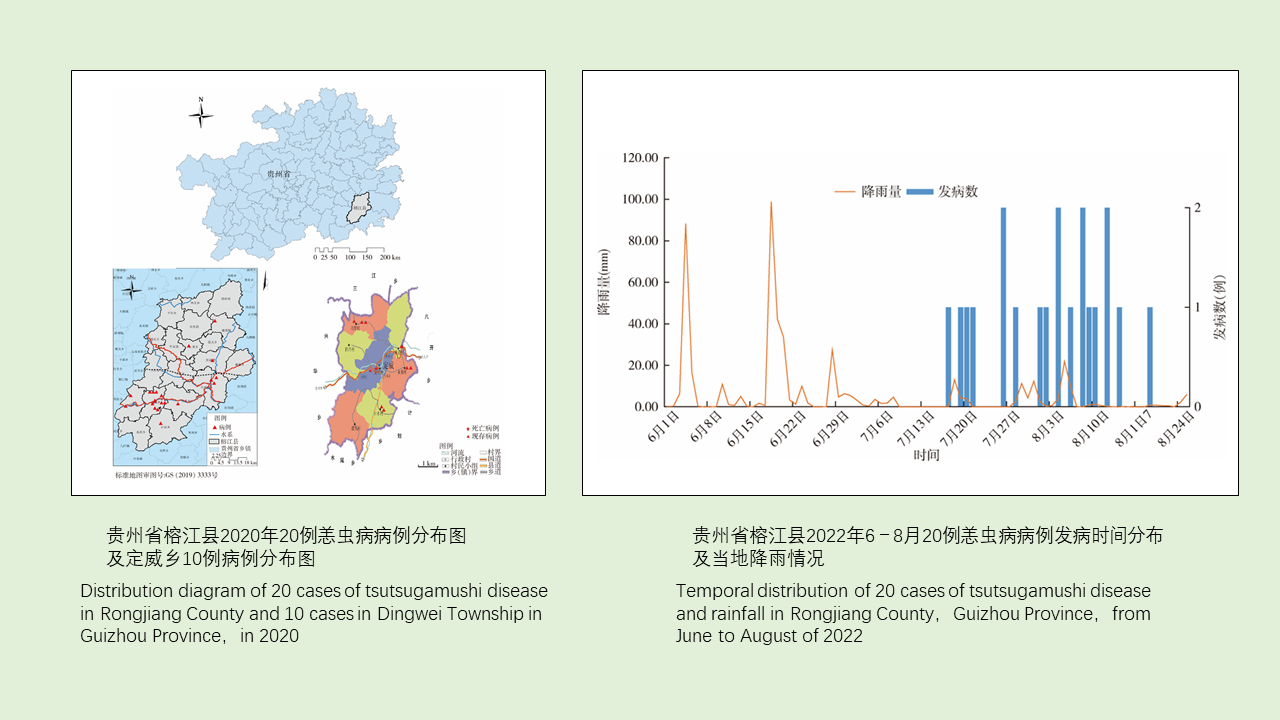
Objective To investigate and analyze an outbreak of tsutsugamushi disease occurred in Rongjiang County, Guizhou Province, China, in 2022 in terms of onset characteristics, epidemiological characteristics and influence factors for infection, so as to provide a basis for formulating targeted prevention and control measures.Methods A uniform questionnaire was used to conduct an epidemiological survey, and indirect immunofluorescence assay was used to detect the serum samples of cases. Medical records were collected, and a host survey was conducted. Descriptive epidemiology was used to analyse the data.Results A total of 20 cases of tsutsugamushi disease were identified according to the case definition, all of whom were farmers in terms of occupation, and the epidemiological survey showed that 14 patients had been to the riverside of Duliu River. There were 9 confirmed cases, 3 clinical cases, and 8 suspected cases. All patients had the symptom of pyrexia; the patients with fear of cold and headaches accounted for 65.00% and 55.00%, respectively, those with weakness and generalized aches and pains accounted for 45.00% and 30.00%, respectively, and those with specific eschar only accounted for 25.00%. Indirect immunofluorescence assay was used to detect 8 serum samples, among which 5 samples had an IgG antibody with the titer of ≥1∶128, and 5 samples showed a 4-fold increase in antibody in the convalescence stage. The mean time from onset to consultation was 5.85 days, and the mean time from consultation to diagnosis was 2.80 days.Conclusions This is a typical outbreak of tsutsugamushi disease, with the main clinical symptoms of pyrexia, fear of cold, and headache. Activities along the river after rainstorm and flood may increase the risk of the disease. The long incubation period and atypical early symptoms of tsutsugamushi disease and a lack of awareness of the disease among local villagers and clinicians are the main factors for failing to identify and dispose this epidemic in a timely manner. It is recommended to strengthen health education, and “early warning, early identification, early diagnosis, and early treatment” of tsutsugamushi disease, to effectively reduce the harm of such diseases to human health.
LUO Xiao-long, ZHOU Jing-zhu, HUANG Hong-wu, LI Qian, WANG Dan, SHI Wei-fang, LIANG Wen-qin
. Investigation and analysis of an outbreak of tsutsugamushi disease in Rongjiang County, Guizhou Province, China[J]. Chinese Journal of Vector Biology and Control, 2023
, 34(6)
: 804
-808
.
DOI: 10.11853/j.issn.1003.8280.2023.06.018
[1] Li LJ,Ren H. Infectious diseases[M]. 9th ed. Beijing:People’s Medical Publishing House,2018:147-150. (in Chinese) 李兰娟,任红. 传染病学[M]. 9版. 北京:人民卫生出版社,2018:147-150.
[2] Bonell A,Lubell Y,Newton PN,et al. Estimating the burden of scrub typhus:A systematic review[J]. PLoS Negl Trop Dis,2017,11(9):e0005838. DOI:10.1371/journal.pntd.0005838.
[3] Taylor AJ,Paris DH,Newton PN. A systematic review of mortality from untreated scrub typhus (Orientia tsutsugamushi)[J]. PLoS Negl Trop Dis,2015,9(8):e0003971. DOI:10.1371/journal.pntd.0003971.
[4] Sharma R,Mahajan SK,Singh B,et al. Predictors of severity in scrub typhus[J]. J Assoc Physicians India,2019,67(4):35-38.
[5] Yue YJ,Wang YJ,Li GC,et al. Epidemiological characteristics of scrub typhus in high-incidence areas in the mainland of China,2006-2018[J]. Dis Surveill,2020,35(4):301-306. DOI:10.3784/j.issn.1003-9961.2020.04.007.(in Chinese) 岳玉娟,王玉姣,李贵昌,等. 2006-2018年中国大陆恙虫病高发区流行病学特征分析[J]. 疾病监测,2020,35(4):301-306. DOI:10.3784/j.issn.1003-9961.2020.04.007.
[6] Jeong YJ,Kim S,Wook YD,et al. Scrub typhus:Clinical,pathologic,and imaging findings[J]. Radiographics,2007,27(1):161-172. DOI:10.1148/RG.271065074.
[7] Liao RG,He S,Xie DG,et al. The first report of tsutsugamushi disease in Jiangxi province[J]. Chin J Zoonoses,1999,15(2):31. (in Chinese) 廖如桂,何似,谢党根,等. 江西省恙虫病首例报告[J]. 中国人兽共患病杂志,1999,15(2):31.
[8] Kwak J,Kim S,Kim G, et al. Scrub typhus incidence modeling with meteorological factors in south Korea[J]. Int J Environ Res Public Health,2015,12(7):7254-7273. DOI:10.3390/ijerph 120707254.
[9] Acharya BK,Chen W,Ruan ZL,et al. Mapping environmental suitability of scrub typhus in Nepal using MaxEnt and random forest models[J]. Int J Environ Res Public Health,2019,16(23):4845. DOI:10.3390/ijerph16234845.
[10] Elliott I,Pearson I,Dahal P,et al. Scrub typhus ecology:A systematic review of Orientia in vectors and hosts[J]. Parasit Vectors,2019,12(1):513. DOI:10.1186/s13071-019-3751-x.
[11] Li GC,Li DM,Li Y,et al. Epidemiology of scrub typhus in China,2006-2016[J]. Dis Surveill,2018,33(2):139-143. DOI:10.3784/j.issn.1003-9961.2018.02.007.(in Chinese) 李贵昌,栗冬梅,李焱,等. 2006-2016年我国恙虫病流行特征分析[J]. 疾病监测,2018,33(2):139-143. DOI:10.3784/j.issn.1003-9961.2018.02.007.
[12] Han TW,Liu J,Hong RT,et al. Epidemiological characteristics of tsutsugamushi disease in Fujian,China (2010-2013)[J]. Strait J Prev Med,2015,21(6):8-10. (in Chinese) 韩腾伟,刘菁,洪荣涛,等. 福建省2010-2013年恙虫病流行特征分析[J]. 海峡预防医学杂志,2015,21(6):8-10.
[13] Li ML,Qi MG,Wang RL,et al. Investigation on an outbreak of tsutsugamushi disease,Henan[J]. Mod Prev Med,2016,43(23):4384-4387,4401. (in Chinese) 李孟磊,其木格,王若琳,等. 河南省一起恙虫病暴发疫情调查分析[J]. 现代预防医学,2016,43(23):4384-4387,4401.
[14] Zhang JX,Tan SK. New progress in epidemiology of scrub typhus[J]. China Trop Med,2022,22(3):274-279. DOI:10.13604/j.cnki.46-1064/r.2022.03.16.(in Chinese) 张嘉溪,谭盛葵. 恙虫病流行病学研究新进展[J]. 中国热带医学,2022,22(3):274-279. DOI:10.13604/j.cnki.46-1064/r.2022.03.16.

