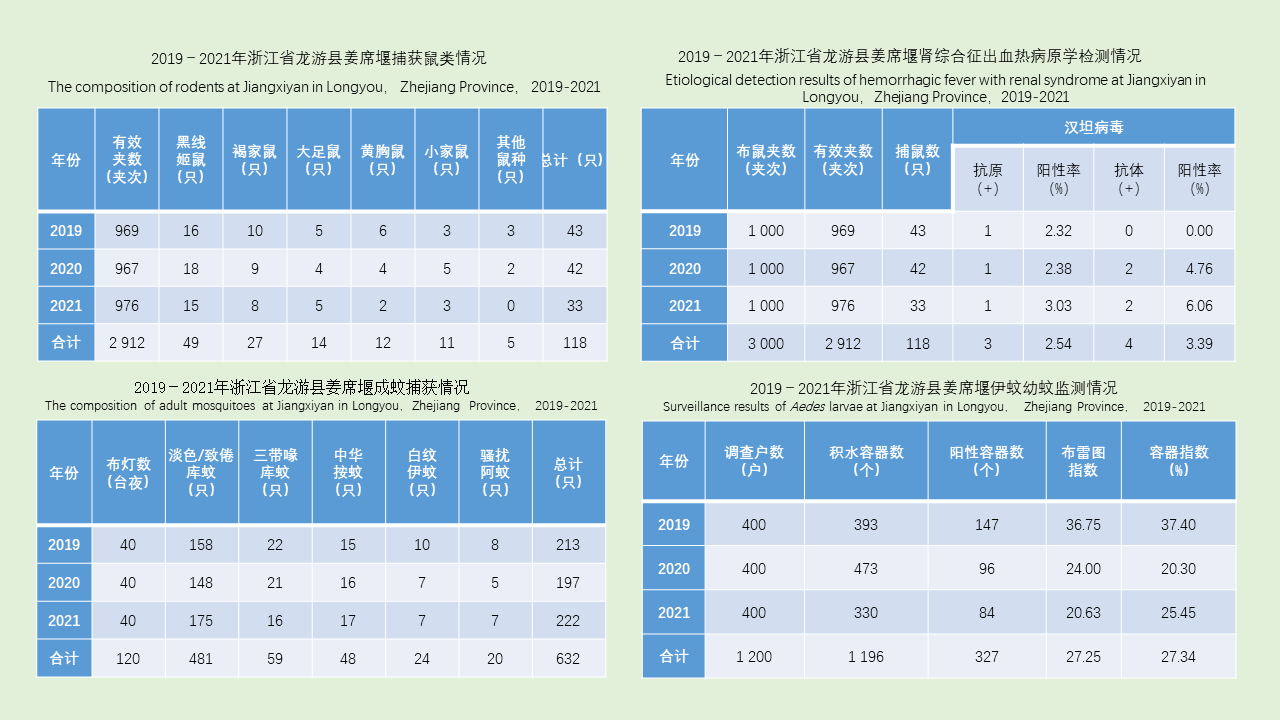
Objective To investigate the species, density, and seasonality of main vectors in Jiangxiyan, a world heritage irrigation structure in Longyou County, Zhejiang Province, China, so as to provide a scientific basis for the prevention and control of vector-borne infectious diseases.Methods According to the Zhejiang Provincial Vector Surveillance Program, rodents, mosquitoes, and ticks were monitored at Jiangxiyan in Longyou County from 2019 to 2021. Rodents were monitored by night snap trapping, adult mosquitoes by lamp trapping, larval mosquitoes using the Breteau index (BI) method, and ticks by flag dragging and animal body surface collection. The density, species composition, and seasonal trends of vectors in different habitats were analyzed by using the descriptive epidemiological methods.Results At Jiangxiyan in Longyou County from 2019 to 2021, the overall rodent density was 4.05%, and Apodemus agrarius was the dominant species, accounting for 41.53% of the total number. A total of 118 mouse lungs were tested, with a positive rate of 2.54% for Hantavirus antigen; The positive rate of Hantavirus antibody in 118 mouse blood samples was 3.39%. Culex pipiens pallens/quinquefasciatus was the dominant mosquito species, accounting for 76.11%, followed by Cx. tritaeniorhynchus, Anopheles sinensis, and Aedes albopictus. The average BI from 2019 to 2021 was 27.25. No ticks were caught.Conclusions A. agrarius is the dominant rodent species, Cx. pipiens pallens/quinquefasciatus and Ae. albopictus are the dominant mosquito species at Jiangxiyan. Targeted comprehensive control measures should be taken to control the spread of vector and vector borne infectious diseases.
WANG Li-yan, ZHOU Hui, CHEN Zhong-bing, FANG Chun-fu, CAO Guo-ping, ZHU Jian-ying, ZHANG Ying, GONG Zhen-yu
. An analysis of vector surveillance results at world heritage irrigation structure Jiangxiyan in Longyou County, Zhejiang Province, China, 2019-2021[J]. Chinese Journal of Vector Biology and Control, 2023
, 34(6)
: 744
-748
.
DOI: 10.11853/j.issn.1003.8280.2023.06.007
[1] Liu MD,Zhang Y,Qian K,et al. Study on the application of four vector surveillance standards in the center for disease control institutions[J]. Chin J Vector Biol Control,2017,28(5):416-421. DOI:10.11853/j.issn.1003.8280.2017.05.002.(in Chinese) 刘美德,张勇,钱坤,等. 病媒生物密度监测方法国家标准在疾病预防与控制机构实施情况的研究[J]. 中国媒介生物学及控制杂志,2017,28(5):416-421. DOI:10.11853/j.issn.1003. 8280.2017.05.002.
[2] Liu QY. Epidemic profile of vector-borne diseases and vector control strategies in the new era[J]. Chin J Vector Biol Control,2019,30(1):1-6,11. DOI:10.11853/j.issn.1003.8280.2019. 01.001.(in Chinese) 刘起勇. 新时代媒介生物传染病形势及防控对策[J]. 中国媒介生物学及控制杂志,2019,30(1):1-6,11. DOI:10.11853/j.issn.1003.8280.2019.01.001.
[3] Wu HX,Liu XB,Liu QY. The current situation and problems for vector biology prevention and control in China[J]. Cap J Public Health,2018,12(1):4-6. DOI:10.16760/j.cnki.sdggws.2018. 01.002.(in Chinese) 吴海霞,刘小波,刘起勇. 我国病媒生物防控现状及面临的问题[J]. 首都公共卫生,2018,12(1):4-6. DOI:10.16760/j.cnki.sdggws.2018.01.002.
[4] Gong ZY. Progress of vector surveillance in Zhejiang province[J]. Prev Med,2021,33(11):1081-1085. DOI:10.19485/j.cnki.issn2096-5087.2021.11.001.(in Chinese) 龚震宇. 浙江省病媒生物监测工作进展[J]. 预防医学,2021,33(11):1081-1085. DOI:10.19485/j.cnki.issn2096-5087.2021. 11.001.
[5] Yuan X,Liu YS,Ye SH,et al. Surveillance results of the main vectors in Wuwei city from 2018-2021[J]. Bull Dis Control Prev,2022,37(4):65-68. DOI:10.13215/j.cnki.jbyfkztb.2203039.(in Chinese) 袁祥,刘永胜,叶淑鸿,等. 2018-2021年武威市主要病媒生物监测分析[J]. 疾病预防控制通报,2022,37(4):65-68. DOI:10.13215/j.cnki.jbyfkztb.2203039.
[6] Li ZP,Wu Z,Liu XH,et al. A vector surveillance report of Gansu province,China,2018[J]. Chin J Vector Biol Control,2019,30(6):639-642. DOI:10.11853/j.issn.1003.8280.2019.06.010.(in Chinese) 李治平,吴照,刘旭红,等. 甘肃省2018年病媒生物监测报告[J]. 中国媒介生物学及控制杂志,2019,30(6):639-642. DOI:10.11853/j.issn.1003.8280.2019.06.010.
[7] Mei SL,Zhang YF,Qi ZW. Analysis of vector surveillance in Jiaozuo,He’nan,2016-2020[J]. China Trop Med,2022,22(3):266-269,288. DOI:10.13604/j.cnki.46-1064/r.2022.03.14.(in Chinese) 梅树林,张要锋,齐振文. 河南省焦作市2016-2020年病媒生物监测[J]. 中国热带医学,2022,22(3):266-269,288. DOI: 10.13604/j.cnki.46-1064/r.2022.03.14.
[8] Wang CY,Zhang JY,Bai YY,et al. Surveillance results of the main vectors in Liaoning province of China in 2020[J]. Chin J Vector Biol Control,2022,33(1):76-82. DOI:10.11853/j.issn.1003.8280.2022.01.014.(in Chinese) 王纯玉,张家勇,白玉银,等. 辽宁省2020年主要病媒生物监测结果分析[J]. 中国媒介生物学及控制杂志,2022,33(1):76-82. DOI:10.11853/j.issn.1003.8280.2022.01.014.
[9] Liu XB,Wu HX,Guo YH,et al. Annual report on Aedes vector surveillance in China,2019[J]. Chin J Vector Biol Control,2020,31(4):401-406. DOI:10.11853/j.issn.1003.8280.2020. 04.004.(in Chinese) 刘小波,吴海霞,郭玉红,等. 2019年全国媒介伊蚊监测报告[J]. 中国媒介生物学及控制杂志,2020,31(4):401-406. DOI:10.11853/j.issn.1003.8280.2020.04.004.
[10] National Vector Surveillance System,Chinese Center for Disease Control and Prevention. National surveillance report on rodent-borne pathogens of disease vectors in 2021[J]. Chin J Vector Biol Control,2023,34(1):1-8. DOI:10.11853/j.issn.1003. 8280.2023.01.001.(in Chinese) 全国重要病媒生物监测网. 2021年全国病媒生物鼠传病原监测报告[J]. 中国媒介生物学及控制杂志,2023,34(1):1-8. DOI:10.11853/j.issn.1003.8280.2023.01.001.
[11] Hou J,Gong ZY,Lei JB,et al. Integrated monitoring of rodents and rodent-borne diseases in Longyou county,Zhejiang province[J]. Chin J Vector Biol Control,2012,23(1):15-17. (in Chinese) 侯娟,龚震宇,雷金宝,等. 浙江省龙游县鼠类及其相关传染病综合监测研究[J]. 中国媒介生物学及控制杂志,2012,23(1):15-17.
[12] Li C,Xu F,Yang ZN,et al. Natural infection status of 5 pathogens in rodents in Longyou county,Zhejiang[J]. Dis Surveill,2021,36(9):910-914. DOI:10.3784/jbjc.202105310291. (in Chinese) 李婵,徐芳,杨章女,等. 浙江省龙游县鼠形动物中5种病原的自然感染情况调查[J]. 疾病监测,2021,36(9):910-914. DOI:10.3784/jbjc.202105310291.
[13] He T,Li XN,Chen ZQ,et al. A report on vector surveillance in Guangzhou from 2017 to 2019[J]. Chin J Dis Control Prev,2021,25(8):912-917. DOI:10.16462/j.cnki.zhjbkz.2021.08. 008.(in Chinese) 何涛,李晓宁,陈宗遒,等. 2017-2019年广州市病媒生物监测报告[J]. 中华疾病控制杂志,2021,25(8):912-917. DOI:10.16462/j.cnki.zhjbkz.2021.08.008.
[14] Hou X,Han N,Feng T,et al. Nonlinear effects of climate on population dynamics of Apodemus agrarius[J]. Acta Ecol Sin,2020,40(14):4836-4841. DOI:10.5846/stxb201904240836.(in Chinese) 侯祥,韩宁,封托,等. 气候因素对黑线姬鼠种群动态影响的非线性效应[J]. 生态学报,2020,40(14):4836-4841. DOI:10.5846/stxb201904240836.
[15] Liu QY. Sustainable vector management strategy and practice:Achievements in vector-borne diseases control in new China in the past seventy years[J]. Chin J Vector Biol Control,2019,30(4):361-366. DOI:10.11853/j.issn.1003.8280.2019.04.001.(in Chinese) 刘起勇. 媒介生物可持续控制策略和实践:新中国70年媒介生物传染病控制成就[J]. 中国媒介生物学及控制杂志,2019,30(4):361-366. DOI:10.11853/j.issn.1003.8280.2019.04.001.
[16] Liu QY. Impact of climate change on vector-borne diseases and related response strategies in China:Major research findings and recommendations for future research[J]. Chin J Vector Biol Control,2021,32(1):1-11. DOI:10.11853/j.issn.1003.8280. 2021.01.001.(in Chinese) 刘起勇. 气候变化对中国媒介生物传染病的影响及应对:重大研究发现及未来研究建议[J]. 中国媒介生物学及控制杂志,2021,32(1):1-11. DOI:10.11853/j.issn.1003.8280.2021. 01.001.

