

ISSN 1003-8280 CN 10-1522/R 中国疾病预防控制中心 主办
Chinese Journal of Vector Biology and Control >
Epidemiological characteristics of dengue fever in Nantong City, Jiangsu Province, China, 2014-2022
Received date: 2023-03-17
Online published: 2023-08-17
Supported by
Nantong "14th Five Year Plan" Science and Education Strengthening Health Project(通卫科教〔2021〕15号);2019 Nantong Municipal Science and Technology Plan (guiding) Project(JCZ19003)
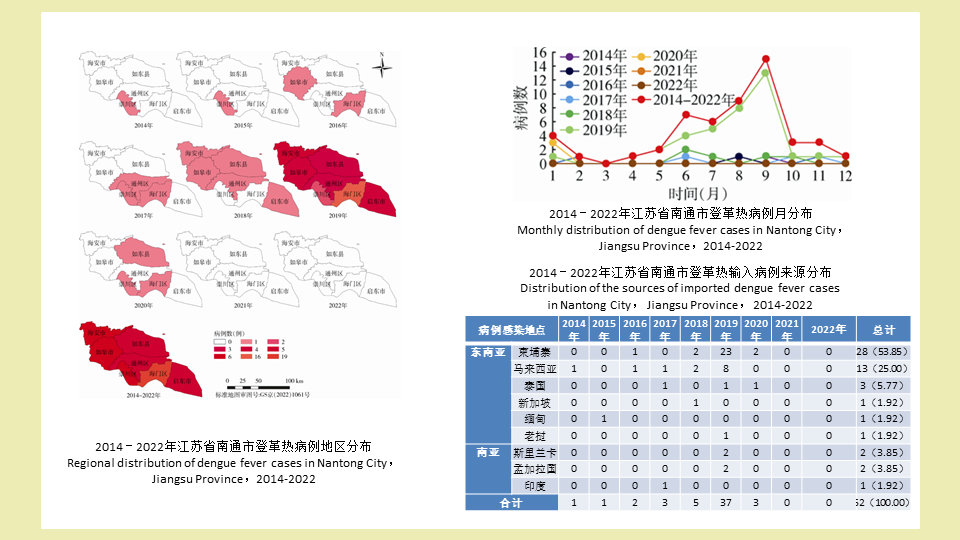
Objective: To investigate the epidemiological characteristics of dengue fever in Nantong City, Jiangsu Province, China, so as to provide a reference for formulating appropriate prevention and control strategies. Methods: The data of dengue fever cases in Nantong City in 2014-2022 were collected from the China Information System for Disease Control and Prevention and epidemiological investigation reports, and the descriptive epidemiological method was used to perform statistical analyses of the temporal, regional, and population distribution, imported sources, disease onset, and medical treatment of the cases. ArcGIS 10.8 software was used to visualize the regional distribution of the cases. SPSS 22.0 software was used to perform the Shapiro-Wilk test to investigate the normality of the interval time from disease onset to confirmed diagnosis and the interval time from arriving in Nantong City to confirmed diagnosis. Results: In 2014-2022, a total of 52 dengue fever cases were reported in Nantong City, with a mean annual incidence rate of 0.08/100 000, and the highest incidence rate of 0.51/100 000 was observed in 2019. The peak of dengue fever was observed in June to September, with 37 cases accounting for 71.15%. Cases were reported in all seven counties (cities/districts), among which Haimen District reported 19 cases, accounting for 36.55%. The age group of 40- years showed the highest number of 21 cases, which accounted for 40.38%. The male/female ratio was 9.4∶1. As for occupation, most of the patients were migrant workers, with 30 cases accounting for 57.69%. All cases were imported from abroad, mainly Southeast Asia, with 47 cases accounting for 90.38%. The majority of the cases were firstly diagnosed in tertiary medical institutions, with 28 cases accounting for 53.85%. For these 52 cases, the median time interval from disease onset to confirmed diagnosis was 6.0 days. A total of 20 cases were diagnosed in the viremia stage, accounting for 41.67%. Conclusions: The epidemic situation of dengue fever in Nantong City in 2014-2022 shows obvious imported and seasonal characteristics. It is suggested that inbound individuals from Southeast Asia should be regarded as the key population for quarantine and follow-up observation in June to September each year, and it is also recommended to enhance the surveillance and control of mosquito vectors.
Key words: Dengue fever; Imported case; Distribution; Trend; Epidemiological characteristic
Bin SUN, Ye WEI, Xiao-yi ZHOU, Jian-ming YUAN . Epidemiological characteristics of dengue fever in Nantong City, Jiangsu Province, China, 2014-2022[J]. Chinese Journal of Vector Biology and Control, 2023 , 34(4) : 530 -535 . DOI: 10.11853/j.issn.1003.8280.2023.04.016
| 1 | World Health Organization. Dengue and severe dengue[EB/OL]. (2022-01-10)[2023-03-10]. https://www.who.int/news-room/fact-sheets/detail/dengue-and-severe-dengue. |
| 2 | Brady OJ, Gething PW, Bhatt S, et al. Refining the global spatial limits of dengue virus transmission by evidence-based consensus[J]. PLoS Negl Trop Dis, 2012, 6 (8):e1760. |
| 3 | 牟笛, 崔金朝, 殷文武, 等. 2015-2018年我国登革热暴发流行病学特征分析[J]. 中华流行病学杂志, 2020, 41 (5):685-689. |
| 3 | Mu D, Cui JC, Yin WW, et al. Epidemiological characteristics of dengue fever outbreaks in China, 2015-2018[J]. Chin J Epidemiol, 2020, 41 (5):685-689. |
| 4 | 刘起勇. 我国登革热流行新趋势、防控挑战及策略分析[J]. 中国媒介生物学及控制杂志, 2020, 31 (1):1-6. |
| 4 | Liu QY. Dengue fever in China: New epidemical trend, challenges and strategies for prevention and control[J]. Chin J Vector Biol Control, 2020, 31 (1):1-6. |
| 5 | 章士军, 王智泉, 陈郁, 等. 南通市首例输入登革热的调查与防制对策[J]. 医学动物防制, 2006, 22 (10):727-729. |
| 5 | Zhang SJ, Wang ZQ, Chen Y, et al. Investigation and control strategies of the first imported dengue fever case in Nantong[J]. J Med Pest Control, 2006, 22 (10):727-729. |
| 6 | 中国疾病预防控制中心. 登革热防治技术指南[Z]. 北京: 中国疾病预防控制中心, 2014. |
| 6 | Chinese Center for Disease Control and Prevention. Technical guideline for dengue fever prevention and treatment[Z]. Beijing: Chinese Center for Disease Control and Prevention, 2014. (in Chinese) |
| 7 | 肖东楼.登革热防治手册[M].2版.北京:人民卫生出版社,2008:3-4. |
| 7 | Xiao DL.Prevention and treatment manual of dengue fever[M].2nd ed.Beijing:People's Medical Publishing House,2008:3-4. |
| 8 | 张楠, 王笑辰, 胡建利. 江苏省2011-2017年输入性登革热流行病学特征[J]. 江苏预防医学, 2019, 30 (1):78-79. |
| 8 | Zhang N, Wang XC, Hu JL. Epidemiological characteristics of imported dengue fever in Jiangsu province, 2011-2017[J]. Jiangsu J Prev Med, 2019, 30 (1):78-79. |
| 9 | 崔朋伟, 包林, 董泽丰, 等. 2011-2019年苏州市登革热流行特征分析[J]. 预防医学, 2021, 33 (3):274-276. |
| 9 | Cui PW, Bao L, Dong ZF, et al. Epidemiological characteristics of dengue fever from 2011 to 2019 in Suzhou[J]. Prev Med, 2021, 33 (3):274-276. |
| 10 | Messina JP, Brady OJ, Golding N, et al. The current and future global distribution and population at risk of dengue[J]. Nat Microbiol, 2019, 4 (9):1508-1515. |
| 11 | 牟笛, 何泱霓, 陈秋兰, 等. 我国2016年登革热输入和本地病例流行病学特征比较[J]. 疾病监测, 2017, 32 (3):184-189. |
| 11 | Mu D, He YN, Chen QL, et al. Comparison of epidemiological features between imported and indigenous dengue fever cases in China[J]. Dis Surveill, 2017, 32 (3):184-189. |
| 12 | 王桢, 凌锋, 刘营, 等. 浙江省2015-2019年登革热流行特征分析[J]. 中国媒介生物学及控制杂志, 2020, 31 (6):643-647. |
| 12 | Wang Z, Ling F, Liu Y, et al. Epidemiological characteristics of dengue fever in Zhejiang province, China, 2015-2019[J]. Chin J Vector Biol Control, 2020, 31 (6):643-647. |
| 13 | 彭维斌, 杨开玺, 徐文斌. 一起由输入病例引起登革热暴发的流行病学调查[J]. 现代预防医学, 2007, 34 (14):2752-2753. |
| 13 | Peng WB, Yang KX, Xu WB. Epidemiological investigation of an outbreak of dengue fever caused by imported case[J]. Mod Prev Med, 2007, 34 (14):2752-2753. |
| 14 | 叶凌, 谭启龙, 赵剑刚, 等. 浙江省一起海岛地区登革热本地暴发疫情的隐性感染情况调查[J]. 中国媒介生物学及控制杂志, 2020, 31 (3):353-357. |
| 14 | Ye L, Tan QL, Zhao JG, et al. An investigation of inapparent infections in a local outbreak of dengue fever in an island area of Zhejiang province, China[J]. Chin J Vector Biol Control, 2020, 31 (3):353-357. |
| 15 | 王晶, 罗飞, 何为涛, 等. 广西壮族自治区2016-2020年登革热流行特征分析[J]. 中国媒介生物学及控制杂志, 2023, 34 (1):65-69. |
| 15 | Wang J, Luo F, He WT, et al. Epidemiological characteristics of dengue fever in Guangxi Zhuang Autonomous Region, China, 2016-2020[J]. Chin J Vector Biol Control, 2023, 34 (1):65-69. |
| 16 | 刘永华, 尹小雄, 张海林, 等. 云南省德宏州2013-2019年登革热流行特征及媒介伊蚊监测分析[J]. 中国媒介生物学及控制杂志, 2021, 32 (2):173-180. |
| 16 | Liu YH, Yin XX, Zhang HL, et al. Epidemiological characteristics of dengue fever and monitoring of Aedes vector mosquitoes in Dehong Dai and Jingpo Autonomous Prefecture of Yunnan province, China, 2013-2019[J]. Chin J Vector Biol Control, 2021, 32 (2):173-180. |
| 17 | 曾小平, 陈琴, 王明昌, 等. 海口市2010-2020年输入性登革热病例发病至确诊间隔时间及影响因素分析[J]. 海南医学, 2021, 32 (18):2430-2433. |
| 17 | Zeng XP, Chen Q, Wang MC, et al. Analysis on the interval time between onset to diagnosis and influencing factors of imported dengue fever cases from 2010 to 2020 in Haikou city[J]. Hainan Med J, 2021, 32 (18):2430-2433. |
| 18 | 王成岗, 刘起勇, 姜宝法. 中国登革热患者发病至确诊间隔时间及其影响因素分析[J]. 中华流行病学杂志, 2012, 33 (10):1064-1066. |
| 18 | Wang CG, Liu QY, Jiang BF. Time between the onset and diagnosis of dengue fever and related influencing factors in China[J]. Chin J Epidemiol, 2012, 33 (10):1064-1066. |
| 19 | 龚甫哲, 龚震宇. 2018年9月世界卫生组织关于登革热疫苗的意见书[J]. 疾病监测, 2019, 34 (3):278-284. |
| 19 | Gong FZ, Gong ZY. Dengue vaccine: WHO position paper-September 2018[J]. Dis Surveill, 2019, 34 (3):278-284. |
| 20 | 李晋涛. 登革热防治研究进展[J]. 第三军医大学学报, 2019, 41 (19):1902-1907. |
| 20 | Li JT. Advances in prevention and control for dengue fever[J]. J Army Med Univ, 2019, 41 (19):1902-1907. |
/
| 〈 |
|
〉 |