

ISSN 1003-8280 CN 10-1522/R 中国疾病预防控制中心 主办
Chinese Journal of Vector Biology and Control >
An analysis of mosquito ecological surveillance results in Wuxi, Jiangsu Province, China, 2012-2021
Received date: 2023-02-10
Online published: 2023-08-17
Supported by
Youth Project of Wuxi Health Commission(Q202231)
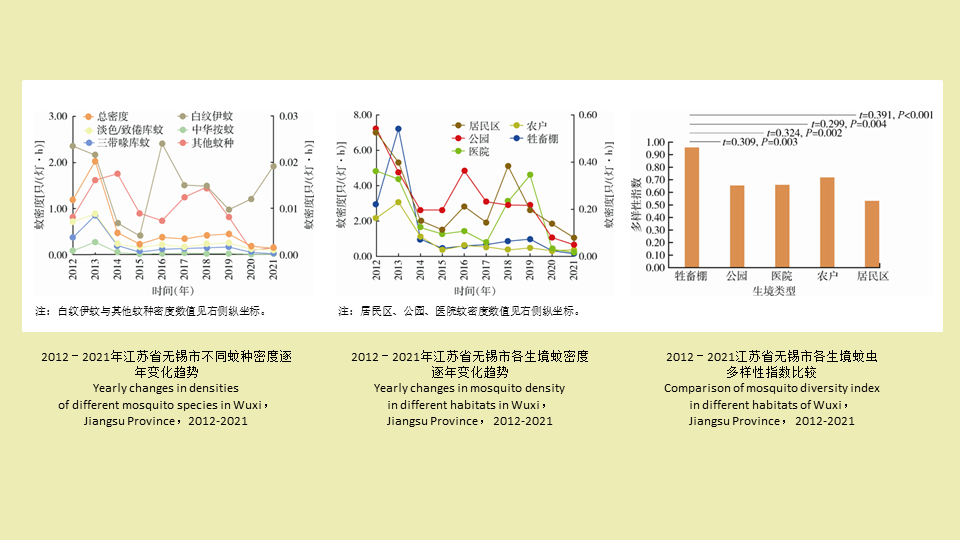
Objective: To investigate mosquito species composition and density fluctuation in a stable state of urbanization of Wuxi, Jiangsu Province, China, so as to provide a scientific basis for early warning of mosquito-borne infectious diseases. Methods: From March to November of 2012 to 2021, mosquitoes were monitored by lamp trapping in five habitats of urban residential areas, parks, hospitals, rural houses and livestock sheds in Wuxi. The species, densities, and seasonal fluctuations of mosquitoes in different environments were analyzed. An analysis of variance was performed on the similarity and diversity indices of mosquitoes in different years and habitats for annual trends. A linear regression analysis was used to analyze the relationship between mosquito density and the minimum mean temperature in the 5 days before monitoring (Tmin5), followed by testing with analysis of variance. Results: A total of 3 777 mosquito lamp traps were placed, capturing 27 158 female mosquitoes, with an average density of 0.60 mosquitoes/lamp·h. The dominant species were Culex pipiens pallens/quinquefasciatus and Cx. tritaeniorhynchus. The mosquito density decreased from 1.18 mosquitoes/lamp·h in 2012 to 0.13 mosquitoes/lamp·h in 2021. The seasonal fluctuation of the overall average mosquito density showed a bimodal pattern. The mosquito diversity index of livestock sheds was highest at 0.97, which was statistically higher than that of other habitats (all P < 0.05), followed by rural houses, urban residential areas, parks, and hospitals. There was no statistical difference in the diversity index of different habitats in different years (F=1.328, P=0.253). The similarity index was high between residential areas, parks, hospitals, and rural house but not livestock sheds. In all the years except 2012, mosquito density was linearly correlated with Tmin5 (all P < 0.05). Conclusions: The species composition of mosquito in different environments in Wuxi is different. The densities of dominant mosquito species in all the habitats showed a generally decreasing trend year by year. The density and diversity of mosquitoes in livestock sheds were highest, which should be a focus of mosquito control. The fluctuation of mosquito density was statistically correlated with temperature, and Tmin5 can be used as a potential risk indicator for mosquito density surveillance and early warning.
Key words: Mosquito; Density fluctuation; Composition ratio; Diversity; Similarity
Quan-chao LIU, Ding ZHU, Ya-ming ZOU, Ce-jie LAN, Hui JIN . An analysis of mosquito ecological surveillance results in Wuxi, Jiangsu Province, China, 2012-2021[J]. Chinese Journal of Vector Biology and Control, 2023 , 34(4) : 513 -517 . DOI: 10.11853/j.issn.1003.8280.2023.04.013
| 1 | Khader SZA, Ahmed SSZ, Venkatesh KP, et al. Larvicidal potential of selected indigenous lichens against three mosquito species- Culex quinquefasciatus, Aedes aegypti and Anopheles stephensi[J]. Chin Herb Med, 2018, 10 (2):152-156. |
| 2 | Petersen LR, Brault AC, Nasci RS. West Nile virus: Review of the literature[J]. JAMA, 2013, 310 (3):308-315. |
| 3 | Talapko J, ?krlec Ⅰ, Alebi? T, et al. Malaria: The past and the present[J]. Microorganisms, 2019, 7 (6):179. |
| 4 | Monteiro FJC, Mour?o FRP, Ribeiro ESD, et al. Prevalence of Dengue, Zika and Chikungunya viruses in Aedes (Stegomyia) aegypti (Diptera: Culicidae) in a medium-sized city, Amazon, Brazil[J]. Rev Inst Med Trop Sao Paulo, 2020, 62, e10. |
| 5 | 边长玲, 龚正达. 我国蚊类及其与蚊媒病关系的研究概况[J]. 中国病原生物学杂志, 2009, 4 (7):545-551. |
| 5 | Bian CL, Gong ZD. Mosquitoes and mosquito-borne diseases in China[J]. J Pathog Biol, 2009, 4 (7):545-551. |
| 6 | 刘起勇. 新时代媒介生物传染病形势及防控对策[J]. 中国媒介生物学及控制杂志, 2019, 30 (1):1-6, 11. |
| 6 | Liu QY. Epidemic profile of vector-borne diseases and vector control strategies in the new era[J]. Chin J Vector Biol Control, 2019, 30 (1):1-6, 11. |
| 7 | Liu BX, Mehmood K, Nabi F, et al. Mosquito-borne infectious diseases in China, 2019[J]. Travel Med Infect Dis, 2021, 41, 102050. |
| 8 | Aryaprema VS, Xue RD. Breteau index as a promising early warning signal for dengue fever outbreaks in the Colombo district, Sri Lanka[J]. Acta Trop, 2019, 199, 105155. |
| 9 | 沈元, 孙俊, 兰策介, 等. 不同土地利用方式对蚊虫群落的影响[J]. 生态学杂志, 2012, 31 (7):1751-1755. |
| 9 | Shen Y, Sun J, Lan CJ, et al. Effects of different land use types on mosquito community[J]. Chin J Ecol, 2012, 31 (7):1751-1755. |
| 10 | 无锡市统计局, 国家统计局无锡调查队. 无锡统计年鉴2022[M]. 北京: 中国统计出版社, 2022: 50. |
| 10 | Wuxi Bureau of Statistics, Wuxi Investigation Team of the National Bureau of Statistics. Wuxi statistical yearbook, 2022[M]. Beijing: China Statistics Press, 2022: 50. |
| 11 | 郭玉红, 刘京利, 鲁亮, 等. 诱蚊灯法与人工小时法捕蚊效果比较研究[J]. 中国媒介生物学及控制杂志, 2012, 23 (6):529-532. |
| 11 | Guo YH, Liu JL, Lu L, et al. Comparative study on mosquito-trapping effects of lamp trapping method and labor hour method[J]. Chin J Vector Biol Control, 2012, 23 (6):529-532. |
| 12 | Hernández L, Romero AG, Laundré JW, et al. Changes in rodent community structure in the Chihuahuan Desert México: Comparisons between two habitats[J]. J Arid Environ, 2005, 60 (2):239-257. |
| 13 | 孙立明, 阮朝良, 王洪, 等. 法定报告传染病的气象流行病学分析与探讨[J]. 医学综述, 2013, 19 (21):3944-3946. |
| 13 | Sun LM, Ruan CL, Wang H, et al. The meteorological epidemiological analysis and discussion of the notifiable infectious diseases[J]. Med Recapitulate, 2013, 19 (21):3944-3946. |
| 14 | 方精云, 沈泽昊, 唐志尧, 等. "中国山地植物物种多样性调查计划"及若干技术规范[J]. 生物多样性, 2004, 12 (1):5-9. |
| 14 | Fang JY, Shen ZH, Tang ZY, et al. The protocol for the survey plan for plant species diversity of China's mountains[J]. Biodiversity Sci, 2004, 12 (1):5-9. |
| 15 | 李慧蓉. 生物多样性和生态系统功能研究综述[J]. 生态学杂志, 2004, 23 (3):109-114. |
| 15 | Li HR. Review on study of biodiversity and ecosyste mfunctioning[J]. Chin J Ecol, 2004, 23 (3):109-114. |
| 16 | 孙燕群, 段金伟, 陈磊磊, 等. 南京市蚊虫群落结构分析[J]. 预防医学, 2019, 31 (10):1029-1031. |
| 16 | Sun YQ, Duan JW, Chen LL, et al. Analysis of mosquito community structure in Nanjing[J]. Prev Med, 2019, 31 (10):1029-1031. |
| 17 | 马桢红, 陈学良, 顾灯安. 江苏省苏州市2011-2015年蚊类群落结构及其分布特征[J]. 中国媒介生物学及控制杂志, 2018, 29 (3):271-273. |
| 17 | Ma ZH, Chen XL, Gu DA. Characteristics of community structure and species distribution of mosquitoes in Suzhou city of Jiangsu province, 2011-2015[J]. Chin J Vector Biol Control, 2018, 29 (3):271-273. |
| 18 | 林敏珍, 柯雪梅, 郭志南, 等. 2011-2016年厦门市蚊密度监测分析[J]. 中华卫生杀虫药械, 2019, 25 (3):235-237. |
| 18 | Lin MZ, Ke XM, Guo ZN, et al. Analysis on mosquito density in Xiamen from 2011 to 2016[J]. Chin J Hyg Insect Equip, 2019, 25 (3):235-237. |
| 19 | 吴海霞, 鲁亮, 孟凤霞, 等. 2006-2015年我国蚊虫监测报告[J]. 中国媒介生物学及控制杂志, 2017, 28 (5):409-415. |
| 19 | Wu HX, Lu L, Meng FX, et al. Reports on national surveillance of mosquitoes in China, 2006-2015[J]. Chin J Vector Biol Control, 2017, 28 (5):409-415. |
| 20 | 仲洁, 何隆华. 气象因素对蚊虫密度影响研究进展[J]. 中国媒介生物学及控制杂志, 2015, 26 (1):95-99. |
| 20 | Zhong J, He LH. Advances in research on impacts of meteorological factors on mosquito density[J]. Chin J Vector Biol Control, 2015, 26 (1):95-99. |
| 21 | 刘美德, 姜江, 佟颖, 等. 北京市居民区中蚊虫密度与气象因素关系的研究[J]. 寄生虫与医学昆虫学报, 2021, 28 (2):76-84. |
| 21 | Liu MD, Jiang J, Tong Y, et al. Relationship of meteorological factors to mosquito density in residential areas of Beijing[J]. Acta Parasitol Med Entomol Sin, 2021, 28 (2):76-84. |
| 22 | 谢博, 冯磊, 顾盈培, 等. 气候因素对浦东新区蚊虫密度影响的效应分析[J]. 中国媒介生物学及控制杂志, 2019, 30 (4):430-433. |
| 22 | Xie B, Feng L, Gu YP, et al. An analysis of the effect of climatic factors on mosquito density in Pudong New Area, Shanghai, China[J]. Chin J Vector Biol Control, 2019, 30 (4):430-433. |
/
| 〈 |
|
〉 |