

ISSN 1003-8280 CN 10-1522/R 中国疾病预防控制中心 主办
Chinese Journal of Vector Biology and Control >
Rodent and pathogen surveillance results in Zunyi, Guizhou Province, China, 2022
Received date: 2023-02-06
Online published: 2023-08-17
Supported by
The Plan Project of the Science and Technology in Guizhou Province(黔科合支撑〔2022〕一般178);The Scientific Research Team of Guizhou Provincial Infectious Disease Prevention and Control Talent Base, Center for Surveillance and Early Warning of Vectorial Organisms and Related Infectious Diseases(RCJD2107)
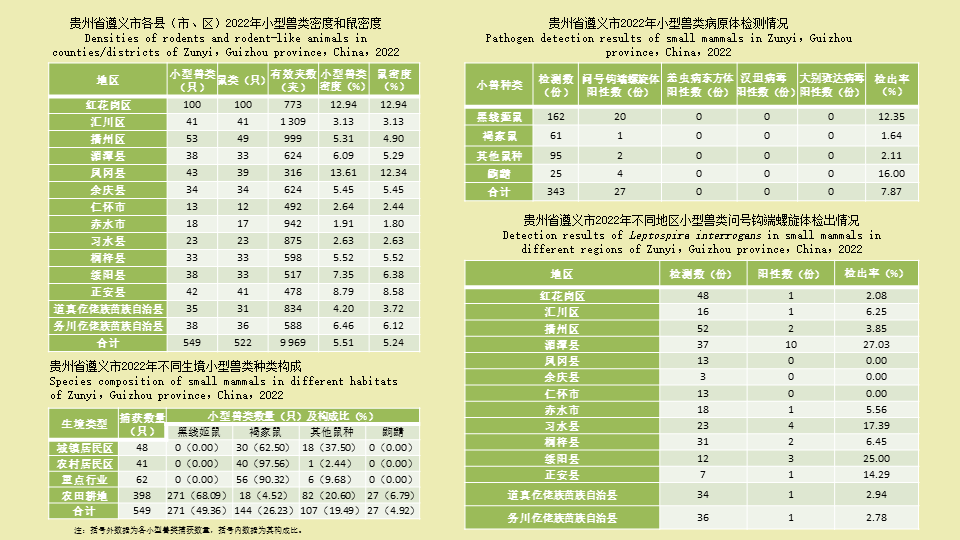
Objective: To investigate the rodents species, density, and pathogens they carry in Zunyi, Guizhou Province, China. Methods: A total of 70 sampling points were set in 14 counties/districts of Zunyi, with five points in the east, south, west, north, and center of each county/district. Small mammals were monitored through night trapping in Zunyi from October 2021 to October 2022, followed by species identification and pathogen detection. Excel 2021 was used for data organization. SPSS 26.0 was used to analyze the density, species, and pathogen-carrying status of small mammals through rate or constituent ratio comparison with the Chi-square test (P < 0.05 indicates a statistically significant difference). Results: A total of 9 969 effective traps were placed at all the surveillance points, capturing 549 small mammals in total, of which 522 were rodents. The total density of small mammals was 5.51%. The total density of rodents was 5.24%. The rodent density was highest in Honghuagang District (12.94%), followed by Fenggang County (12.34%), and lowest in Chishui City (1.80%). There was a statistical difference in rodent density between the counties/districts (χ2=195.619, P < 0.001). Rattus norvegicus was the dominant rodent species in urban residential areas, rural residential areas, and key industries, while Apodemus agrarius was the dominant species in farming areas. The composition of rodent species statistically differed in different regions (the center, north, east, and west) of Zunyi (χ2=117.357, P < 0.001). Each small mammal was examined for Leptospira interrogans and Orientia tsutsugamushi in the liver, spleen, and kidney; Dabie bandavirus in the liver, spleen, and lung; and Hantavirus in the lung. Among 343 samples tested, 27 were positive, all for L. interrogans, with a pathogen detection rate of 7.87%. Shrews had the highest detection rate (16.00%), followed by A. agrarius (12.35%), and R. norvegicus had the lowest detection rate (1.64%). There was a significant difference in the detection rates of different species of small mammals (χ2=14.372, P=0.002). The detection rate was 9.66% (26/269) in farming areas, which was highest, and 2.94% (1/34) in key industries, with negative detection results in urban and rural residential areas. There were no differences in detection rates between different habitats (χ2=5.171, P=0.160). The detection rate was 27.03% in Meitan County, followed by 25.00% in Suiyang County, and zero in Renhuai City, Fenggang County, and Yuqing County, with a statistical difference between different counties/cities/districts (χ2=35.409, P=0.001). Conclusions: The density of rodents was relatively high in Zunyi. The detection of L. interrogans should be a warning of the possibility of related diseases. Local authorities should strengthen rodent control in spring and autumn and take comprehensive control measures according to actual situation and dominant rodent species and pathogen detection status in different habitats, so as to reduce the density of rodents and prevent the occurrence of rodent-borne diseases.
Key words: Rodent surveillance; Rodent density; Small mammal; Species composition; Pathogen
De-yang ZHENG, Lin ZHU, Wen-qin LIANG, Jia HUANG, Wei-fang SHI, Kai RAO, Jing-zhu ZHOU, Cai-xia XIA . Rodent and pathogen surveillance results in Zunyi, Guizhou Province, China, 2022[J]. Chinese Journal of Vector Biology and Control, 2023 , 34(4) : 501 -507 . DOI: 10.11853/j.issn.1003.8280.2023.04.011
| 1 | 汪诚信, 李贵昌. 2000-2005年我国主要人鼠共患病的疫情和预防[J]. 科技导报, 2007, 25 (1):47-52. |
| 1 | Wang CX, Li GC. Epidemics and prevention of main rodent-borne diseases in China from 2000 to 2005[J]. Sci Technol Rev, 2007, 25 (1):47-52. |
| 2 | 周明浩, 褚宏亮. 常见病媒生物分类鉴定手册[M]. 苏州: 苏州大学出版社, 2019: 89-120. |
| 2 | Zhou MH, Chu HL. Handbook for classification and identification of main vectors[M]. Suzhou: Soochow University Press, 2019: 89-120. |
| 3 | 蒋志刚, 刘少英, 吴毅, 等. 中国哺乳动物多样性(第2版)[J]. 生物多样性, 2017, 25 (8):886-895. |
| 3 | Jiang ZG, Liu SY, Wu Y, et al. China's mammal diversity (2nd edition)[J]. Biodiv Sci, 2017, 25 (8):886-895. |
| 4 | 邹志辉, 韦薇, 林琳, 等. 深圳市龙岗城区鼠类监测情况分析[J]. 中国媒介生物学及控制杂志, 2012, 23 (3):242-243. |
| 4 | Zou ZH, Wei W, Lin L, et al. Surveillance analysis of rats in Longgang district of Shenzhen city[J]. Chin J Vector Biol Control, 2012, 23 (3):242-243. |
| 5 | 和汝凤, 段倩云, 陈舜弘, 等. 农田鼠害发生规律及防控对策研究[J]. 云南农业, 2021, (2):75-77. |
| 5 | He RF, Duan QY, Chen SH, et al. Research on the occurrence law and prevention and control countermeasures of farmland rats[J]. Yunnan Agric, 2021, (2):75-77. |
| 6 | 张家勇, 王纯玉, 白玉银, 等. 辽宁省2018-2020年鼠类种群密度与季节消长监测分析[J]. 中国媒介生物学及控制杂志, 2023, 34 (1):39-43. |
| 6 | Zhang JY, Wang CY, Bai YY, et al. Rodent density and seasonal fluctuation in Liaoning province, China, 2018-2020[J]. Chin J Vector Biol Control, 2023, 34 (1):39-43. |
| 7 | 杨再学, 谈孝凤. 贵州省TBS灭鼠技术规范及应用前景[J]. 山地农业生物学报, 2018, 37 (3):56-61. |
| 7 | Yang ZX, Tan XF. Technical specification and application prospect of trap barrier system for the management of rodents in Guizhou province[J]. J Mt Agric Biol, 2018, 37 (3):56-61. |
| 8 | 魏尊. 2019年和2020年咸宁市病媒生物监测[J]. 中华卫生杀虫药械, 2022, 28 (6):509-512. |
| 8 | Wei Z. Vector seillnce in Xianning city in 2019 and 2020[J]. Chin J Hyg Insect Equip, 2022, 28 (6):509-512. |
| 9 | 唐丽玲, 熊建伟, 梁文倪. 2017-2021年桂林市病媒生物种群密度与季节消长[J]. 中华卫生杀虫药械, 2022, 28 (2):148-151. |
| 9 | Tang LL, Xiong JW, Liang WN. Density and seasonality of vectors in Guilin city from 2017 to 2021[J]. Chin J Hyg Insect Equip, 2022, 28 (2):148-151. |
| 10 | 周博, 吴旭, 郎义, 等. 2015-2019年沈阳市鼠类种群密度及季节消长监测分析[J]. 中华卫生杀虫药械, 2022, 28 (1):53-55. |
| 10 | Zhou B, Wu X, Lang Y, et al. Monitoring and analysis of population density and seasonal fluctuation of rodents in Shenyang from 2015 to 2019[J]. Chin J Hyg Insect Equip, 2022, 28 (1):53-55. |
| 11 | 尹文书, 杨再学. 贵州息烽农田黑线姬鼠种群最适温度与降雨区间分析[J]. 中国植保导刊, 2020, 40 (8):35-39, 56. |
| 11 | Yin WS, Yang ZX. Effects of different meteorological factors on Apodemus agrarius population in farmland in Xifeng county, Guizhou province[J]. China Plant Prot, 2020, 40 (8):35-39, 56. |
| 12 | 刘英, 陈红, 李沛丽, 等. 贵州省钩端螺旋体血清群特异性PCR鉴定结果与分析[J]. 中国人兽共患病学报, 2015, 31 (12):1146-1150, 1156. |
| 12 | Liu Y, Chen H, Li PL, et al. Serogroup identification and analysis of Leptospira isolates using serogroup specific PCR in Guizhou province, China[J]. Chin J Zoonoses, 2015, 31 (12):1146-1150, 1156. |
| 13 | 刘维俊, 何嘉春, 肖方震, 等. 武平县2018-2020年鼠类感染钩端螺旋体监测结果分析[J]. 安徽预防医学杂志, 2022, 28 (5):368-371. |
| 13 | Liu WJ, He JC, Xiao FZ, et al. Investigation and analysis of Leptospira infection in rodents in Wuping county from 2018 to 2020[J]. Anhui J Prev Med, 2022, 28 (5):368-371. |
| 14 | 林辉. 非素食性毒饵在福州保税港对臭鼩鼱的控制效果[J]. 中华卫生杀虫药械, 2017, 23 (2):117-118. |
| 14 | Lin H. Control effect of non vegetarian baits against Suneus murinus in Fuzhou bonded port[J]. Chin J Hyg Insect Equip, 2017, 23 (2):117-118. |
| 15 | 陶晓颖, 陈飞, 何建军, 等. 重庆市沙坪坝区家栖鼠类及鼠传病原体感染状况调查[J]. 中国媒介生物学及控制杂志, 2022, 33 (5):727-731. |
| 15 | Tao XY, Chen F, He JJ, et al. Investigation of the domestic rodents and infection status of rodent-borne pathogens in Shapingba district of Chongqing, China[J]. Chin J Vector Biol Control, 2022, 33 (5):727-731. |
| 16 | 林勇, 郑剑勇, 黄秀敏, 等. 灭鼠工作长效管理机制的建立与探讨[J]. 中国卫生产业, 2015, 12 (7):14-15. |
| 16 | Lin Y, Zheng JY, Huang XM, et al. Establishment and analysis of long-term management mechanism of deratization[J]. China Health Ind, 2015, 12 (7):14-15. |
/
| 〈 |
|
〉 |