

ISSN 1003-8280 CN 10-1522/R 中国疾病预防控制中心 主办
Chinese Journal of Vector Biology and Control >
A comparative study based on gridded mosqito oviptrap method and human landing catch method monitoring Aedes mosquitoes
Received date: 2023-04-10
Online published: 2023-08-17
Supported by
Key Young Talents Training Program for Shanghai Disease Control and Prevention(21QNGG27)
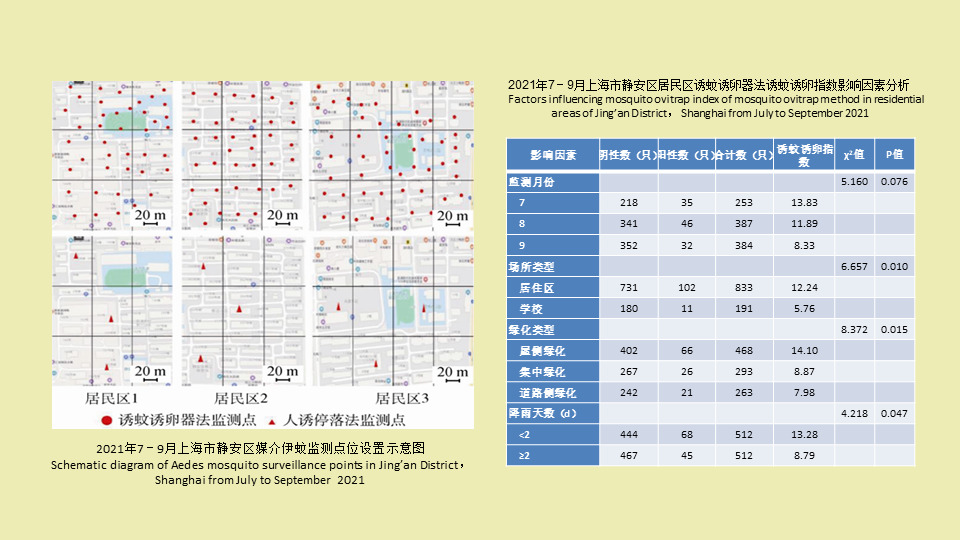
Objective: To explore the factors affecting Aedes surveillance by the mosquito ovitrap method in a grid mode, so as to provide a scientific basis for the surveillance and control of Aedes mosquitoes and related mosquito-borne infectious diseases. Methods: Three adjacent residential areas with similar areas, building ages, and greenery ratios were selected as surveillance points in Jing'an District, Shanghai, China. Each residential area was divided into secondary surveillance blocks (about 90 m × 60 m) in a 3×3-grid mode. On-site monitoring was conducted in each surveillance block using the mosquito ovitrap method and the human landing catch method, three times one month from July to September 2021. By comparing the surveillance results of different residential areas, different surveillance blocks, and different environmental characteristics, the factors influencing the positive rate of the mosquito ovitrap method were determined. Excel 2016 and SPSS 16.0 were used to process the data. The Kruskal-Wallis rank sum test, tow-way analysis of variance, and Spearman correlation analysis were performed. Results: A total of 30 secondary surveillance blocks were designated. Eight times of surveillance were completed, and 131 mosquito ovitraps were set each time. The mosquito ovitrap index (MOI) in residential areas 1, 2, and 3 were 8.71, 12.38, and 11.97, respectively, with no significant difference (χ2=2.750, P=0.253). There were significant differences in the MOI among different blocks of residential areas 1 and 2 (F=2.135, P=0.047; F=2.168, P=0.044). In residential areas, the positive rate was 12.24 in living areas and 5.76 in community school areas, with a significant difference (χ2=6.657, P=0.010). The MOI was 14.10 for green areas on the house side, 8.87 for concentrated green areas, and 7.98 for green areas on the road side, with a significant difference (χ2=8.372, P=0.015). During the surveillance period, the MOI was 13.28 when the days of rainfall was < 2 d, and 8.79 when the days of rainfall was ≥2 d, with a significant difference (χ2=4.218, P=0.047). In residential area 1, the average MOI was 8.69, and the average landing index was 3.33 mosquitoes/person·h. In residential area 2, the average MOI was 12.45, and the average landing index was 8.58 mosquitoes/person·h. In residential area 3, the average MOI was 11.88, and the average landing index was 6.50 mosquitoes/person·h. The ratio of the MOI to the landing index was distributed between 1∶1 and 3∶1. Pearson correlation analysis showed that the MOI was highly correlated with the human landing index in each block (r=0.549, P=0.005). Conclusions: The density of Aedes mosquitoes may differ greatly in different areas of large residential areas due to differences in greening types, functional zoning, and other factors. The mosquito ovitrap method has the advantages of simple operation and high specificity compared with other surveillance methods for Aedes mosquitoes, and it is highly consistent with the human landing catch method. The mosquito ovitrap method with grid-based surveillance point distribution can be used in actual practice, which can effectively avoid deviations caused by point selection and fully reflect the density of Aedes mosquitoes.
Hong CHEN, Zhou ZHOU, Hong-xia LIU . A comparative study based on gridded mosqito oviptrap method and human landing catch method monitoring Aedes mosquitoes[J]. Chinese Journal of Vector Biology and Control, 2023 , 34(4) : 451 -456 . DOI: 10.11853/j.issn.1003.8280.2023.04.002
| 1 | 王永亮, 钱成, 郭运生, 等. 全球登革热流行势态及其影响评述[J]. 口岸卫生控制, 2018, 23 (4):20-26. |
| 1 | Wang YL, Qian C, Guo YS, et al. Review on global dengue epidemiology with influence[J]. Port Health Control, 2018, 23 (4):20-26. |
| 2 | Schlagenhauf P, Weld L, Goorhuis A, et al. Travel-associated infection presenting in Europe (2008-12): An analysis of EuroTravNet longitudinal, surveillance data, and evaluation of the effect of the pre-travel consultation[J]. Lancet Infect Dis, 2015, 15 (1):55-64. |
| 3 | 汪圣强, 杨蒙蒙, 朱国鼎, 等. "一带一路"倡议下输入性蚊媒传染病的防控[J]. 中国血吸虫病防治杂志, 2018, 30 (1):9-13. |
| 3 | Wang SQ, Yang MM, Zhu GD, et al. Control of imported mosquito-borne diseases under the Belt and Road Initiative[J]. Chin J Schisto Control, 2018, 30 (1):9-13. |
| 4 | 牟笛, 何泱霓, 陈秋兰, 等. 我国2016年登革热输入和本地病例流行病学特征比较[J]. 疾病监测, 2017, 32 (3):184-189. |
| 4 | Mu D, He YN, Chen QL, et al. Comparison of epidemiological features between imported and indigenous dengue fever cases in China[J]. Dis Surveill, 2017, 32 (3):184-189. |
| 5 | Yue YJ, Sun JM, Liu XB, et al. Spatial analysis of dengue fever and exploration of its environmental and socio-economic risk factors using ordinary least squares: A case study in five districts of Guangzhou city, China, 2014[J]. Int J Infect Dis, 2018, 75, 39-48. |
| 6 | World Health Organization. Dengue: Guidelines, for diagnosis, treatment, prevention and control[R]. Geneva: WHO, 2009: 120-122. |
| 7 | Barreto E, Resende MC, Eiras AE, et al. Evaluation of the baited ovitrap with natural attractant for monitoring Aedes spp. in Dili, capital of East Timor[J]. Cien Saude Colet, 2020, 25 (2):665-672. |
| 8 | Iyaloo DP, Facknath S, Bheecarry A. Seasonal changes in the distribution and relative abundance of the dengue vector, Aedes albopictus in two villages in Mauritius: Implications for a sterile release programme[J]. Afr Entomol, 2019, 27 (1):218-227. |
| 9 | Mardiana, Wibowo A, Mahmudah. The difference existence of Aedes sp. larvae based on ovitrap locating in Samarinda city Indonesia[J]. Indian J Public Health Res Dev, 2018, 9 (12):1405-1409. |
| 10 | 闫冬明, 黄坤, 赵春春, 等. 常用蚊虫监测方法和技术研究进展[J]. 中国媒介生物学及控制杂志, 2020, 31 (1):108-112. |
| 10 | Yan DM, Huang K, Zhao CC, et al. Research advances in common methods and techniques for mosquito surveillance[J]. Chin J Vector Biol Control, 2020, 31 (1):108-112. |
| 11 | 茌静, 古文媚, 陈戊申, 等. 3种媒介伊蚊监测方法在登革热疫点中的应用及相关性研究[J]. 中国媒介生物学及控制杂志, 2015, 26 (5):495-497, 508. |
| 11 | Chi J, Gu WM, Chen WS, et al. Study on the correlation of three monitoring methods and application in epidemic area of dengue fever[J]. Chin J Vector Biol Control, 2015, 26 (5):495-497, 508. |
| 12 | 陈红, 黄瑾, 单宁. 上海市静安区媒介伊蚊网格化监测模式研究[J]. 中国媒介生物学及控制杂志, 2021, 32 (1):89-93. |
| 12 | Chen H, Huang J, Shan N. A study of grid-based model for Aedes vector surveillance in Jing'an district, Shanghai, China[J]. Chin J Vector Biol Control, 2021, 32 (1):89-93. |
| 13 | 陈红, 单宁, 滕志翔, 等. 上海市静安区不同类型场所白纹伊蚊孳生现况调查[J]. 中华卫生杀虫药械, 2018, 24 (4):377-380. |
| 13 | Chen H, Shan N, Teng ZX, et al. A study on the breeding of Aedes albopictus in different types of public places in Jing'an district of Shanghai[J]. Chin J Hyg Insect Equip, 2018, 24 (4):377-380. |
| 14 | 陈红, 吕敏, 邢莲弟, 等. 上海市静安区不同房屋类型白纹伊蚊孳生特点研究[J]. 中国媒介生物学及控制杂志, 2019, 30 (5):536-539. |
| 14 | Chen H, Lyu M, Xing LD, et al. A study of the breeding characteristics of Aedes albopictus in different housing types in Jing'an district of Shanghai, China[J]. Chin J Vector Biol Control, 2019, 30 (5):536-539. |
| 15 | 唐烨榕, 姜进勇, 杜龙飞, 等. 云南省景洪市城区登革热网格化管理效果评价[J]. 中国媒介生物学及控制杂志, 2020, 31 (3):254-258, 267. |
| 15 | Tang YR, Jiang JY, Du LF, et al. Effectiveness evaluation of the gridding management of dengue fever in the urban area of Jinghong, Yunnan province, China[J]. Chin J Vector Biol Control, 2020, 31 (3):254-258, 267. |
| 16 | 朱伟, 王现, 刘翔宇, 等. 上海市徐汇区白纹伊蚊诱卵器法监测分析[J]. 中华卫生杀虫药械, 2020, 26 (2):135-138. |
| 16 | Zhu W, Wang X, Liu XY, et al. Monitoring of Aedes albopictus with mosq-ovitraps in Xuhui district of Shanghai[J]. Chin J Hyg Insect Equip, 2020, 26 (2):135-138. |
| 17 | 张佳一, 周毅彬, 李彦玲, 等. 网格化诱蚊诱卵器监测方法研究[J]. 中国媒介生物学及控制杂志, 2021, 32 (2):208-212. |
| 17 | Zhang JY, Zhou YB, Li YL, et al. A study of grid monitoring method for mosquito ovitraps[J]. Chin J Vector Biol Control, 2021, 32 (2):208-212. |
| 18 | Marquetti MC, Valdés V, Aguilera L, et al. Entomological surveillance over Aedes (S) aegypti and other culicids in Ciudad de La Habana, Cuba 1991-1996[J]. Rev Cubana Med Trop, 2000, 52 (2):133-137. |
/
| 〈 |
|
〉 |