

ISSN 1003-8280 CN 10-1522/R 中国疾病预防控制中心 主办
Chinese Journal of Vector Biology and Control >
Attractive action of different chemical substances for Aedes albopictus
Received date: 2023-03-09
Online published: 2023-08-17
Supported by
Shanghai Municipal Health Commission(201940372);National Science and Technology Major Project of China(2017ZX10303404001006);Clinical Research Program for Health Industry of Shanghai Municipal Commission of Health(202240331)
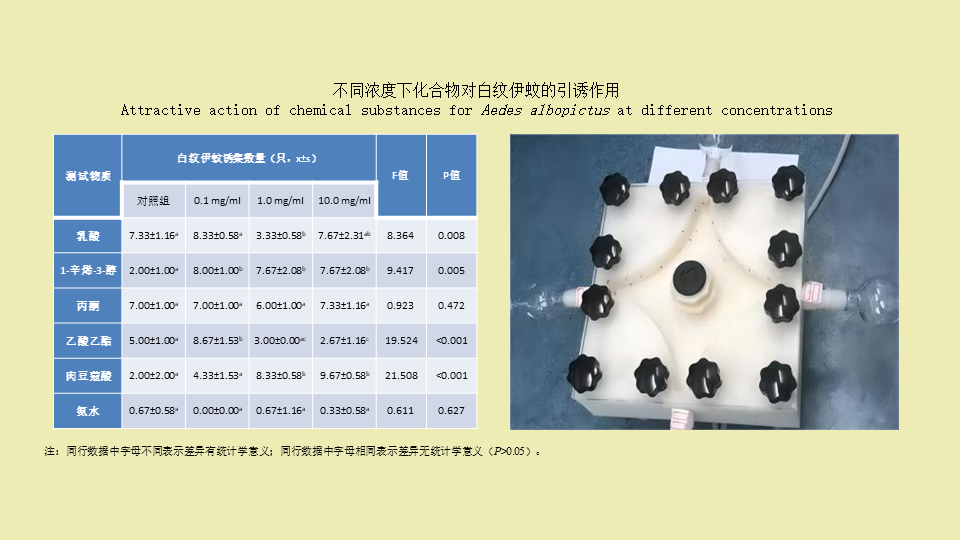
Objective: To select chemical substances with attractive effects on Aedes albopictus for on-field assessment, and to explore the preference of Ae. albopictus to six human odors. Methods: Under laboratory conditions, six chemical substances (1-octen-3-ol, lactic acid, myristic acid, ammonia, acetone, and ethyl acetate) were separately tested for their individual attracting effects on female Ae. albopictus at concentrations of 0.1, 1.0, and 10.0 mg/ml. The six substances were mixed in pairs (1∶1) at certain concentrations, and then the pairs were tested for attracting effects on female Ae. albopictus. The pair with good attractive effects was combined with lactic acid for testing. The attractant combination selected by laboratory experiments was tested for attractive action for Ae. albopictus in the field. The attracting effects of the substances or combinations on Ae. albopictus were compared using the t test and one-way analysis of variance. Results: Ae. albopictus mosquitoes were attracted to 1-octen-3-ol at 0.1, 1.0, and 10.0 mg/ml, myristic acid at 1.0 and 10.0 mg/ml, and ethyl acetate at 0.1 mg/ml, but not to the other three substances at any concentration. The pairs of 1-octen-3-ol+myristic acid, lactic acid+myristic acid, and lactic acid+1-octen-3-ol statistically attracted Ae. albopictus compared with the control group (t=8.102, P=0.001; t=4.696, P=0.009; t=5.127, P=0.007). The combination of lactic acid+1-octen-3-ol+myristic acid statistically attracted Ae. albopictus compared with the control group (F=86.841, P < 0.001). Field testing showed significant differences in the attracting effect between lactic acid+1-octen-3-ol+myristic acid and the control (day 1: t=7.462, P=0.014; day 2: t=20.500, P < 0.001; day3: t=9.383, P=0.001). Conclusion: The combination of lactic acid, 1-octen-3-ol, and myristic acid has attractive action for Ae. albopictus, which should be further researched in the field.
Key words: Aedes albopictus; Attractant compound; Attractive action
Fei WANG, Hao-di XU, Xin LI, Pei-en LENG, Hong-xia LIU . Attractive action of different chemical substances for Aedes albopictus[J]. Chinese Journal of Vector Biology and Control, 2023 , 34(4) : 447 -450, 496 . DOI: 10.11853/j.issn.1003.8280.2023.04.001
| 1 | 杨舒然, 刘起勇. 白纹伊蚊的全球分布及扩散趋势[J]. 中国媒介生物学及控制杂志, 2013, 24 (1):1-4. |
| 1 | Yang SR, Liu QY. Trend in global distribution and spread of Aedes albopictus[J]. Chin J Vector Biol Control, 2013, 24 (1):1-4. |
| 2 | 曾嘉庆, 李成辉, 张赫, 等. 蚊媒病毒病流行现状及病原学检测技术研究进展[J]. 中国病原生物学杂志, 2021, 16 (6):728-730. |
| 2 | Zeng JQ, Li CH, Zhang H, et al. The current status of outbreaks of mosquito-borne viral diseases and advances in the study of pathogen detection techniques[J]. J Parasit Biol, 2021, 16 (6):728-730. |
| 3 | 张时妙, 莫建初, 杨天赐, 等. 蚊虫宿主引诱物研究进展[J]. 中国媒介生物学及控制杂志, 2006, 17 (1):69-71. |
| 3 | Zhang SM, Mo JC, Yang TC, et al. Advances in mosquito host attractants[J]. Chin J Vector Biol Control, 2006, 17 (1):69-71. |
| 4 | 莫建初, 尉吉乾. 蚊虫引诱物研究方法[J]. 中华卫生杀虫药械, 2012, 18 (4):277-279. |
| 4 | Mo JC, Wei JQ. Methods for the study of attractive compounds to mosquitoes[J]. Chin J Hyg Insect Equip, 2012, 18 (4):277-279. |
| 5 | 邓天福, 莫建初, 程家安. 白纹伊蚊产卵引诱物研究[J]. 浙江大学学报(农业与生命科学版), 2009, 35 (5):532-536. |
| 5 | Deng TF, Mo JC, Cheng JA. Study on oviposition attractants to Aedes albopictus[J]. J Zhejiang Univ Agric Life Sci, 2009, 35 (5):532-536. |
| 6 | 余静, 王承珠, 王杰, 等. 脂肪酸类物质对白纹伊蚊的触角电生理影响及引诱作用[J]. 中华卫生杀虫药械, 2013, 19 (3):200-202. |
| 6 | Yu J, Wang CZ, Wang J, et al. Electrophysiological responses and attraction of Aedes albopictus to several fatty acids[J]. Chin J Hyg Insect Equip, 2013, 19 (3):200-202. |
| 7 | Xue RD, Qualls WA, Kline DL, et al. Evaluation of Lurex 3TM, octenol, and CO2 sachet as baits in mosquito Magnet? pro traps against floodwater mosquitoes[J]. J Am Mosq Control Assoc, 2010, 26 (3):344-345. |
| 8 | 忻伟隆, 王宗德, 韩招久, 等. 白纹伊蚊对几种引诱物的行为和触角电位反应[J]. 应用昆虫学报, 2015, 52 (4):890-895. |
| 8 | Xin WL, Wang ZD, Han ZJ, et al. Effects of several attractants on the behavior and electroantennograms of Aedes albopictus[J]. Chin J Appl Entomol, 2015, 52 (4):890-895. |
| 9 | Shirai Y, Kamimura K, Seki T, et al. L-lactic acid as a mosquito (Diptera: Culicidae) repellent on human and mouse skin[J]. J Med Entomol, 2001, 38 (1):51-54. |
| 10 | Bernier UR, Kline DL, Posey KH, et al. Synergistic attraction of Aedes aegypti (L.) to binary blends of L-lactic acid and acetone, dichloromethane, or dimethyl disulfide[J]. J Med Entomol, 2003, 40 (5):653-656. |
| 11 | Braks MAH, Meijerink J, Takken W. The response of the malaria mosquito, Anopheles gambiae, to two components of human sweat, ammonia and L-lactic acid, in an olfactometer[J]. Physiol Entomol, 2001, 26 (2):142-148. |
/
| 〈 |
|
〉 |