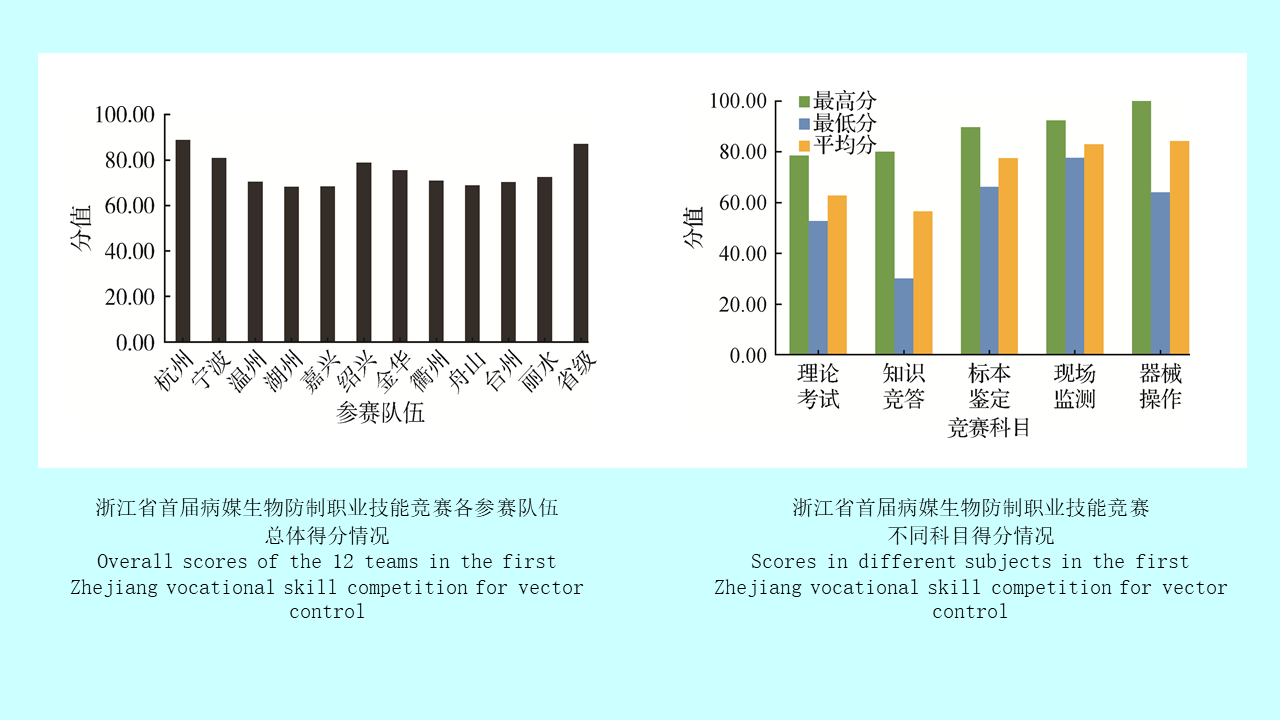
Objective To analyze the theoretical knowledge, on-site disposal, and comprehensive analysis capacity for vector control in professional technicians in Zhejiang disease control and prevention (disease control) institutions, China, and to provide a decision-making basis for strengthening the capacity building of teams in disease control institutions.Methods Based on the first Zhejiang vocational skill competition for vector control in 2019, the knowledge of vector control, average score, and loss of points in individual item in 36 contestants from eleven municipal and one provincial disease control institutions were evaluated, and the differences in scores in different regions, different competition subjects, different knowledge categories, theoretical knowledge, and on-site operation were analyzed. SPSS 25.0 was used for difference comparison and variance analysis.Results The results were converted and standardized according to 100 points. The average score of 12 teams was 75.01 (68.13-88.77) points. The analysis of five different subjects of theory test, knowledge quiz, specimen identification, monitoring technique, and device operation showed significant differences in the scores between the theory test and the other four subjects and between the knowledge quiz and the other four subjects (all P<0.05). There were significant differences in individual scores between the contestants with different job types (full-time and part-time) and between those from institutions with different structures and personnel allocations (F=11.897, P=0.002; F=14.737, P=0.001; F=10.627, P=0.003). The analysis of theory test and knowledge quiz according to different knowledge categories showed significant differences in the scores between drug and device use and the other three knowledge categories, and between comprehensive analysis and the other three knowledge categories in the theory test (all P<0.05); for the knowledge quiz, there were significant differences in the scores between the basic knowledge and monitoring evaluation, between the basic knowledge and disposal technique, between species identification and monitoring evaluation, between species identification and disposal technique, between monitoring evaluation and drug and device use, and between drug and device use and disposal technique (all P<0.05). The species identification showed that there were significant differences in the scores between mosquito feature description and the other three key assessment points, and between cockroach or fly feature description and the other three key assessment points (all P<0.05). There were significant differences in the scores between rodent monitoring records and the other key assessment points, and between fly monitoring records and the other key assessment points (all P<0.05). In the device operation subject, significant differences were observed in the scores between drug liquid preparation and personal protection, between drug liquid preparation and post-treatment, and between actual operation and post-treatment (all P<0.05).Conclusions The competition shows that the professional technicians from Zhejiang province’s disease control institutions are generally at a high level. However, there are still insufficient knowledge coverage of the contestants, certain differences in the mastery degree between regions. The vector control teams construction are weakened in the disease control institutions. There are shortcomings and weaknesses in some knowledge categories, especially species identification, basic knowledge, and drug and device use. It suggests that it is necessary to strengthen the systematic training of professionals, highlight basic knowledge and skills training such as on-site operation, and strengthen the construction of internal teams and personnel allocation, so as to improve the overall level of vector prevention and control in Zhejiang province.
[1] 张新卫,高奕. 公共环境病媒生物防制指南[M]. 杭州:浙江科学技术出版社,2021:2.Zhang XW,Gao Y. Guidelines for vector control in the public environment[M]. Hangzhou:Zhejiang Science and Technology Publishing House,2021:2. (in Chinese)
[2] 刘起勇,刘小波,常楠,等. 2012-2021我国媒介生物及相关传染病监测控制进展及成效[J]. 中国媒介生物学及控制杂志,2022,33(5):613-621. DOI:10.11853/j.issn.1003.8280. 2022.05.001.Liu QY,Liu XB,Chang N,et al. Advances and achievements in the surveillance and control of vectors and vector-borne diseases in China,2012-2021[J]. Chin J Vector Biol Control,2022,33(5):613-621. DOI:10.11853/j.issn.1003.8280.2022.05.001.(in Chinese)
[3] 龚震宇,张新卫,侯娟,等. 浙江省病媒生物防制工作实践、存在的问题及对策建议[J]. 中国媒介生物学及控制杂志,2020,31(2):121-125. DOI:10.11853/j.issn.1003.8280.2020.02.001.Gong ZY,Zhang XW,Hou J,et al. Practice,deficiencies,and countermeasures of vector control in Zhejiang province,China[J]. Chin J Vector Biol Control,2020,31(2):121-125. DOI:10.11853/j.issn.1003.8280.2020.02.001.(in Chinese)
[4] 刘起勇. 新时代媒介生物传染病形势及防控对策[J]. 中国媒介生物学及控制杂志,2019,30(1):1-6,11. DOI:10.11853/j.issn.1003.8280.2019.01.001.Liu QY. Epidemic profile of vector-borne diseases and vector control strategies in the new era[J]. Chin J Vector Biol Control,2019,30(1):1-6,11. DOI:10.11853/j.issn.1003.8280.2019. 01.001.(in Chinese)
[5] 龚震宇,刘钦梅,王金娜,等. 新时代中国特色爱国卫生运动增添新内涵:病媒生物预防控制浙江模式的探索[J]. 疾病监测,2021,36(4):312-317. DOI:10.3784/jbjc.202104010422.Gong ZY,Liu QM,Wang JN,et al. New connotations for patriotic health campaign with Chinese characteristics in new era:Exploration of vector prevention and control pattern in Zhejiang[J]. Dis Surveill,2021,36(4):312-317. DOI:10.3784/jbjc. 202104010422.(in Chinese)
[6] 龚震宇,刘钦梅. 新型冠状病毒肺炎疫情时代之疾病预防控制体系迎来发展新机遇[J]. 疾病监测,2021,36(8):756-761. DOI:10.3784/jbjc.202107030382.Gong,ZY,Liu QM. Discussion on the construction of disease prevention and control system in the post-COVID-19 epidemic era[J]. Dis Surveill,2021,36(8):756-761. DOI:10.3784/jbjc.202107030382.(in Chinese)
[7] 孔庆鑫,韦凌娅,丁华,等. 杭州市G20峰会病媒生物防制技术管理与实施机制探讨[J]. 中国媒介生物学及控制杂志,2017,28(5):440-443. DOI:10.11853/j.issn.1003.8280.2017. 05.007.Kong QX,Wei LY,Ding H,et al. Management and implementation mechanism of vector control technology during Hangzhou G20 Summit[J]. Chin J Vector Biol Control,2017,28(5):440-443. DOI:10.11853/j.issn.1003.8280.2017.05.007.(in Chinese)
[8] 夏蒙,贺宏斌,喻鑫玲,等. 2018年湖南省血防技术人员专业技能竞赛成绩分析[J]. 热带病与寄生虫学,2020,18(4):216-220. DOI:10.3969/j.issn.1672-2302.2020.04.006.Xia M,He HB,Yu XL,et al. Analysis on the skill competition results of schistosomiasis control professionals in Hunan province in 2018[J]. J Trop Dis Parasitol,2020,18(4):216-220. DOI:10.3969/j.issn.1672-2302.2020.04.006.(in Chinese)
[9] 高奕,汪垂章,张新卫. 浙江省病媒生物防制从业人员能力评估及培训需求分析[J]. 中国媒介生物学及控制杂志,2022,33(4):471-474. DOI:10.11853/j.issn.1003.8280.2022.04.005.Gao Y,Wang CZ,Zhang XW. Ability assessment and training demand analysis of vector control practitioners in Zhejiang province,China[J]. Chin J Vector Biol Control,2022,33(4):471- 474. DOI:10.11853/j.issn.1003.8280.2022.04.005.(in Chinese)
[10] 刘美德,张勇,钱坤,等. 病媒生物密度监测方法国家标准在疾病预防与控制机构实施情况的研究[J]. 中国媒介生物学及控制杂志,2017,28(5):416-421. DOI:10.11853/j.issn.1003. 8280.2017.05.002.Liu MD,Zhang Y,Qian K,et al. Study on the application of four vector surveillance standards in the center for disease control institutions[J]. Chin J Vector Biol Control,2017,28(5):416-421. DOI:10.11853/j.issn.1003.8280.2017.05.002.(in Chinese)
[11] 郭利娜,丁凡,席晶晶. 全国疾病预防控制机构人力资源发展现状分析[J]. 中国公共卫生管理,2020,36(2):158-161. DOI:10.19568/j.cnki.23-1318.2020.02.004.Guo LN,Ding F,Xi JJ. Analysis on the current situation of human resources development of centers for disease control and prevention in China[J]. Chin J Public Health Manage,2020,36(2):158-161. DOI:10.19568/j.cnki.23-1318.2020.02.004.(in Chinese)
[12] 鲜敏,郑寒君,陈加超. 深圳市各区疾控中心人力资源配置公平性研究[J]. 中国公共卫生管理,2022,38(4):466-469,474. DOI:10.19568/j.cnki.23-1318.2022.04.0009.Xian M,Zheng HJ,Chen JC. Research on the fairness of human resource allocation in district-level centers for disease control and prevention in Shenzhen city[J]. Chin J Public Health Manage,2022,38(4):466-469,474. DOI:10.19568/j.cnki.23-1318.2022.04.0009.(in Chinese)
[13] 陈艺平. 常态化疫情防控下基层疾病预防控制机构人力资源管理对策研究[J]. 中国公共卫生管理,2022,38(5):610-613. DOI:10.19568/j.cnki.23-1318.2022.05.0009.Chen YP. Countermeasures of human resource management in grass-roots disease control institutions under normalized epidemic prevention and control[J]. Chin J Public Health Manage,2022,38(5):610-613. DOI:10.19568/j.cnki.23-1318. 2022.05.0009.(in Chinese)
[14] 董莹,林慧波,陶毓敏,等. 疾控机构人力资源建设对提升科技创新能力的实践与思考[J]. 中国公共卫生管理,2019,35(6):844-847. DOI:10.19568/j.cnki.23-1318.2019.06.033.Dong Y,Lin HB,Tao YM,et al. Practice and reflection of human resource construction in CDC on the improvement of science and technology innovation ability[J]. Chin J Public Health Manage,2019,35(6):844-847. DOI:10.19568/j.cnki.23-1318.2019.06. 033.(in Chinese)
[15] 毛向群,彭广萍,董永海. 学科建设对疾病预防控制中心能力建设的作用探讨[J]. 现代预防医学,2014,41(22):4091-4092.Mao XQ,Peng GP,Dong YH. Exploration of the effect of discipline construction on capacity building of center for disease control and prevention[J]. Mod Prev Med,2014,41(22):4091-4092. (in Chinese)
[16] 杜真,卢金星. 疾病预防控制中心岗位设置管理的研究与思考:以中国疾病预防控制中心传染病预防控制所为例[J]. 中国公共卫生管理,2021,37(6):740-742. DOI:10.19568/j.cnki.23-1318.2021.06.0008.Du Z,Lu JX. Research and thinking on post setting management of CDC:Through taking the infectious disease institute as an example[J]. Chin J Public Health Manage,2021,37(6):740-742. DOI:10.19568/j.cnki.23-1318.2021.06.0008.(in Chinese)
[17] 张莉莉,蔡路,张雅明,等. 病媒生物应急能力模拟演练模式的探讨[J]. 中国媒介生物学及控制杂志,2016,27(4):416-417. DOI:10.11853/j.issn.1003.8280.2016.04.029.Zhang LL,Cai L,Zhang YM,et al. Discussion on the drill model of the emergency vector control[J]. Chin J Vector Biol Control,2016,27(4):416-417. DOI:10.11853/j.issn.1003.8280.2016. 04.029.(in Chinese)

