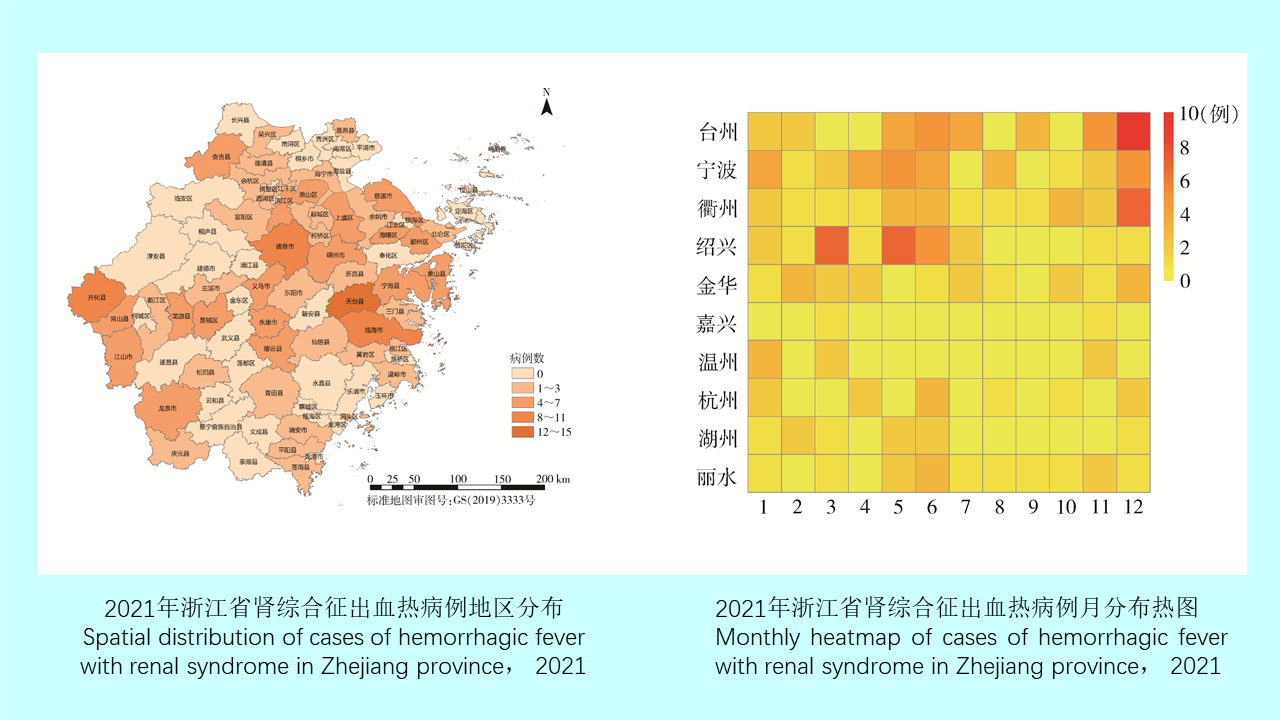
Objective To analyze the epidemic situation of hemorrhagic fever with renal syndrome (HFRS) and the populations distribution and Hantavirus infection status of the host animals in Zhejiang province, China in 2021, and to provide scientific evidence for establishing preventive measures.Methods Descriptive epidemiological methods were used to analyze HFRS case data and host surveillance data, which were online reported in the Communicable Disease Surveillance Information Reporting and Management System of Zhejiang province in 2021. The Chi-square test was used for rate comparison.Results A total of 180 HFRS cases were reported in Zhejiang province in 2021, with a mean annual incidence rate of 0.29/100 000. Most cases were observed in Taizhou, Ningbo, Shaoxing, and Quzhou. The cases distributed throughout the year, peaking during May to June in summer and December in winter at similar levels. The high-incidence group aged over 40 years old, accounting for 76.67% (138/180) of the total cases. The main occupation was farmers, accounting for 61.67%. A total of 11 921 effective traps were set in the five surveillance sites in Zhejiang province, capturing 660 small mammals, with an average capture rate of 5.54%. A total of 660 serum samples of small mammal were detected, among which 35 (5.30%) were antibody-positive. Hantavirus was positive in 15 of 660 (2.27%) small mammal lung samples. There were statistical differences in capture rate (χ2=16.161, P<0.05), the positive rate of HFRS antibody (χ2=14.957, P=0.005), and the virus infection rate of small mammals (χ2=8.413, P=0.048) among the five surveillance sites.Conclusions HFRS was sporadic at a low level and distributed in extensive areas in Zhejiang province in 2021. The surveillance sites had generally high small mammal densities and fluctuating virus infection rates in small mammals, requiring scientific rodent control-based comprehensive prevention and control measures.
SU Fan, SUN Ji-min, LING Feng, ZHANG Rong, LIU Ying, WANG Zhen
. Epidemiological characteristics of hemorrhagic fever with renal syndrome and host animal surveillance in Zhejiang province, China, 2021[J]. Chinese Journal of Vector Biology and Control, 2023
, 34(3)
: 378
-382
.
DOI: 10.11853/j.issn.1003.8280.2023.03.016
[1] Schmaljohn C,Hjelle B. Hantaviruses:A global disease problem[J]. Emerg Infect Dis,1997,3(2):95-104. DOI:10.3201/eid0302.970202.
[2] Zhang R,Mao ZY,Yang J,et al. The changing epidemiology of hemorrhagic fever with renal syndrome in Southeastern China during 1963-2020:A retrospective analysis of surveillance data[J]. PLoS Negl Trop Dis,2021,15(8):e0009673. DOI:10.1371/journal.pntd.0009673.
[3] 中华人民共和国卫生部. 全国肾综合征出血热监测方案(试行)[Z]. 北京:中华人民共和国卫生部,2005.Ministry of Health of the People's Republic of China. National surveillance programme of hemorrhagic fever with renal syndrome in China (Trial)[Z]. Beijing:Ministry of Health of the People's Republic of China,2005. (in Chinese)
[4] Cheng XQ,Hu JL,Luo L,et al. Impact of interventions on the incidence of natural focal diseases during the outbreak of COVID-19 in Jiangsu province,China[J]. Parasit Vectors,2021,14(1):483. DOI:10.1186/s13071-021-04986-x.
[5] 庞卫龙,郑翔,葛君华,等. 浙江省天台县1984-2018年肾综合征出血热监测分析[J]. 中国媒介生物学及控制杂志,2020,31(2):158-163. DOI:10.11853/j.issn.1003.8280.2020.02.008.Pang WL,Zheng X,Ge JH,et al. Surveillance of hemorrhagic fever with renal syndrome in Tiantai county of Zhejiang province,China,from 1984 to 2018[J]. Chin J Vector Biol Control,2020,31(2):158-163. DOI:10.11853/j.issn.1003.8280.2020.02.008.(in Chinese)
[6] 刘菁,陈阳,林代华,等. 福建省2016-2018年肾综合征出血热流行特征和宿主动物监测分析[J]. 中国媒介生物学及控制杂志,2021,32(3):329-333. DOI:10.11853/j.issn.1003.8280. 2021.03.014.Liu J,Chen Y,Lin DH,et al. Epidemiological characteristics and host animal monitoring of hemorrhagic fever with renal syndrome in Fujian province,China,2016-2018[J]. Chin J Vector Biol Control,2021,32(3):329-333. DOI:10.11853/j.issn.1003. 8280.2021.03.014.(in Chinese)
[7] 张蓉,张宁,凌锋,等. 浙江省2005-2020年肾综合征出血热流行趋势分析[J]. 中华流行病学杂志,2021,42(11):2030-2036. DOI:10.3760/cma.j.cn112338-20210528-00435.Zhang R,Zhang N,Ling F,et al. Study on epidemic trend of hemorrhagic fever with renal syndrome in Zhejiang province,2005-2020[J]. Chin J Epidemiol,2021,42(11):2030-2036. DOI:10.3760/cma.j.cn112338-20210528-00435.(in Chinese)
[8] 王芹,李建东,张全福,等. 2014年全国肾综合征出血热监测总结和疫情分析[J]. 疾病监测,2016,31(3):192-199. DOI:10.3784/j.issn.1003-9961.2016.03.005.Wang Q,Li JD,Zhang QF,et al. Surveillance for hemorrhagic fever with renal syndrome in China,2014[J]. Dis Surveill,2016,31(3):192-199. DOI:10.3784/j.issn.1003-9961.2016.03.005.(in Chinese)
[9] 张蓉,张宁,凌锋,等. 2016-2020年浙江省肾综合征出血热监测分析[J]. 疾病监测,2021,36(9):915-919. DOI:10.3784/jbjc.202106220354.Zhang R,Zhang N,Ling F,et al. Surveillance for hemorrhagic fever with renal syndrome in Zhejiang,2016-2020[J]. Dis Surveill,2021,36(9):915-919. DOI:10.3784/jbjc. 202106220354.(in Chinese)
[10] 王金娜,凌锋,孙继民,等. 浙江省鼠密度对肾综合征出血热发病率的影响[J]. 中国媒介生物学及控制杂志,2016,27(3):241-243,247. DOI:10.11853/j.issn.1003.8280.2016.03.007.Wang JN,Ling F,Sun JM,et al. The impact of the rodent density on the incidence of hemorrhagic fever with renal syndrome in Zhejiang province[J]. Chin J Vector Biol Control,2016,27(3):241-243,247. DOI:10.11853/j.issn.1003.8280.2016.03.007.(in Chinese)
[11] Jiang FC,Wang L,Wang S,et al. Meteorological factors affect the epidemiology of hemorrhagic fever with renal syndrome via altering the breeding and hantavirus-carrying states of rodents and mites:A 9 years' longitudinal study[J]. Emerg Microbes Infect,2017,6(1):e104. DOI:10.1038/emi.2017.92.

