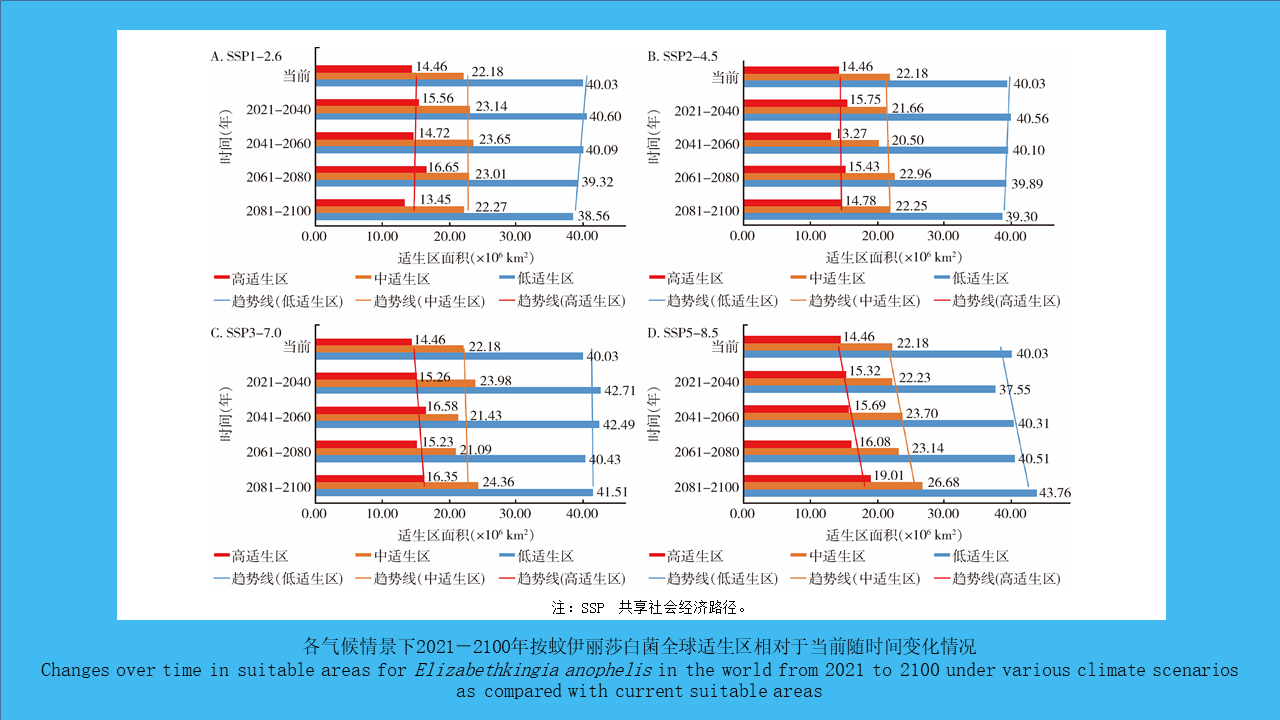
Objective To determine the current and future suitable areas of Elizabethkingia anophelis, and to provide a reference for preventing its outbreak and spread in China. Methods With 21 pieces of information on the geographical distribution of E. anophelis and data on 56 climatic factors, a MaxEnt model was used to estimate the suitable areas of E. anophelis in the world and China. R 4.2.2 software was used to adjust model parameters, and construct the receiver operating characteristic curve. The area under the curve was calculated to evaluate the accuracy of the model. The results were visualized using ArcGIS 10.5 software. Results Annual precipitation (bio12, 27.0%) and the minimum temperature in January (tmin01, 22.2%) contributed most to the distribution of E. anophelis. Under current climatic conditions, the highly suitable areas for E. anophelis were mainly distributed in the southeastern United States, northern South America, western Europe, central Africa, and parts of southeastern Asia; in China, they were mainly distributed in the wet regions south of the Qinling-Huaihe Line. Under future climatic conditions, climate changes of varying intensities generally promoted the suitable areas of E. anophelis in the world and China, especially under high radiative forcing. Conclusions There are large suitable areas for E. anophelis in the world and China under both current and future climate conditions, which are expected to be promoted with the change of climate in the future. Authorities should take measures to control greenhouse gas emissions to limit the increase of E. anophelis’ suitable areas. Provinces with its highly suitable areas should strengthen surveillance, risk assessment and response.
[1] Tiedje JM,Bruns MA,Casadevall A,et al. Microbes and climate change:A research prospectus for the future[J]. MBio,2022,13(3):e0080022. DOI:10.1128/mbio.00800-22.
[2] 王蕾蕾,郭庆兰,杨帆. 伊丽莎白菌属细菌生物学特征及耐药性研究进展[J]. 中国感染与化疗杂志,2020,20(6):711-715. DOI:10.16718/j.1009-7708.2020.06.025.Wang LL,Guo QL,Yang F. Research advances on biological characteristics and drug resistance pattern of Elizabethkingia[J]. J Infect Chemother,2020,20(6):711-715. DOI:10.16718/j.1009-7708.2020.06.025.(in Chinese)
[3] King EO. Studies on a group of previously unclassified bacteria associated with meningitis in infants[J]. Am J Clin Pathol,1959,31(3):241-247. DOI:10.1093/ajcp/31.3.241.
[4] Kämpfer P,Matthews H,Glaeser SP,et al. Elizabethkingia anophelis sp. nov.,isolated from the midgut of the mosquito Anopheles gambiae[J]. Int J Syst Evol Microbiol,2011,61(11):2670-2675. DOI:10.1099/ijs.0.026393-0.
[5] Frank T,Gody JC,Nguyen LBL,et al. First case of Elizabethkingia anophelis meningitis in the Central African Republic[J]. Lancet,2013,381(9880):1876. DOI:10.1016/S0140-6736(13)60318-9.
[6] Lau SKP,Chow WN,Foo CH,et al. Elizabethkingia anophelis bacteremia is associated with clinically significant infections and high mortality[J]. Sci Rep,2016,6(1):26045. DOI:10.1038/srep26045.
[7] Teo J,Tan SYY,Tay M,et al. First case of Elizabethkingia anophelis outbreak in an intensive-care unit[J]. Lancet,2013,382(9895):855-856. DOI:10.1016/S0140-6736(13)61858-9.
[8] Perrin A,Larsonneur E,Nicholson AC,et al. Evolutionary dynamics and genomic features of the Elizabethkingia anophelis 2015 to 2016 Wisconsin outbreak strain[J]. Nat Commun,2017,8(1):15483. DOI:10.1038/ncomms15483.
[9] Janda JM,Lopez DL. Mini review:New pathogen profiles:Elizabethkingia anophelis[J]. Diagn Microbiol Infect Dis,2017,88(2):201-205. DOI:10.1016/j.diagmicrobio.2017.03.007.
[10] Kukutla P,Lindberg BG,Pei D,et al. Insights from the genome annotation of Elizabethkingia anophelis from the malaria vector Anopheles gambiae[J]. PLoS One,2014,9(5):e97715. DOI:10.1371/journal.pone.0097715.
[11] Chen SC,Bagdasarian M,Walker ED. Elizabethkingia anophelis:Molecular manipulation and interactions with mosquito hosts[J]. Appl Environ Microbiol,2015,81(6):2233-2243. DOI:10.1128/AEM.03733-14.
[12] 李文玉,李浩宇,孙万万,等. 明永冰川垂直气候带中可培养低温细菌多样性分析[J]. 基因组学与应用生物学,2019,38(5):2070-2077. DOI:10.13417/j.gab.038.002070.Li WY,Li HY,Sun WW,et al. Diversity of culturable low-temperature bacteria in vertical climate zones of mingyong glacier[J]. Genomics Appl Biol,2019,38(5):2070-2077. DOI:10.13417/j.gab.038.002070.(in Chinese)
[13] 常彦斌. 按蚊伊丽莎白菌菌种鉴定、感染临床特征以及耐药机制的实验研究[D]. 重庆:重庆医科大学,2021. DOI:10.27674/d.cnki.gcyku.2021.001343.Chang YB. Species identification,clinical features and resistance mechanisms of Elizabethkingia anophelis clinical isolates[D]. Chongqing:Chongqing Medical University,2021. DOI:10.27674/d.cnki.gcyku.2021.001343.(in Chinese)
[14] Peterson AT. Predicting the geography of species' invasions via ecological niche modeling[J]. Quart Rev Biol,2003,78(4):419-433. DOI:10.1086/378926.
[15] Thuiller W,Richardson DM,Pyšek P,et al. Niche-based modelling as a tool for predicting the risk of alien plant invasions at a global scale[J]. Glob Chang Biol,2005,11(12):2234-2250. DOI:10.1111/j.1365-2486.2005.001018.x.
[16] Duan RY,Kong XQ,Huang MY,et al. The predictive performance and stability of six species distribution models[J]. PLoS One,2014,9(11):e112764. DOI:10.1371/journal.pone.0112764.
[17] Burnard D,Gore L,Henderson A,et al. Comparative genomics and antimicrobial resistance profiling of Elizabethkingia isolates reveal nosocomial transmission and in vitro susceptibility to fluoroquinolones,tetracyclines,and trimethoprim-sulfamethoxazole[J]. J Clin Microbiol,2020,58(9):e00730-20. DOI:10.1128/JCM.00730-20.
[18] Wang BB,Cheng R,Feng Y,et al. Elizabethkingia anophelis:An important emerging cause of neonatal sepsis and meningitis in China[J]. Pediatr Infect Dis J,2022,41(5):e228-e232. DOI:10.1097/INF.0000000000003464.
[19] Breurec S,Criscuolo A,Diancourt L,et al. Genomic epidemiology and global diversity of the emerging bacterial pathogen Elizabethkingia anophelis[J]. Sci Rep,2016,6:30379. DOI:10.1038/srep30379.
[20] Yung CF,Maiwald M,Loo LH,et al. Elizabethkingia anophelis and association with tap water and handwashing,Singapore[J]. Emerg Infect Dis,2018,24(9):1730-1733. DOI:10.3201/eid2409.171843.
[21] Moore LSP,Owens DS,Jepson A,et al. Waterborne Elizabethkingia meningoseptica in adult critical care[J]. Emerg Infect Dis,2016,22(1):9-17. DOI:10.3201/eid2201.150139.
[22] Kyritsi MA,Mouchtouri VA,Pournaras S,et al. First reported isolation of an emerging opportunistic pathogen (Elizabethkingia anophelis) from hospital water systems in greece[J]. J Water Health,2018,16(1):164-170. DOI:10.2166/wh.2017.184.
[23] Onyango MG,Lange R,Bialosuknia S,et al. Zika virus and temperature modulate Elizabethkingia anophelis in Aedes albopictus[J]. Parasit Vectors,2021,14(1):573. DOI:10.1186/s13071-021-05069-7.
[24] 朱耿平,原雪姣,范靖宇,等. MaxEnt模型参数设置对其所模拟物种地理分布和生态位的影响:以茶翅蝽为例[J]. 生物安全学报,2018,27(2):118-123.Zhu GP,Yuan XJ,Fan JY,et al. Effects of model parameters in MaxEnt modeling of ecological niche and geographic distribution:Case study of the brown marmorated stink bug,Halyomorpha haly[J]. J Biosafety,2018,27(2):118-123. (in Chinese)
[25] Hu SH,Xu H,Meng XH,et al. Population genomics of emerging Elizabethkingia anophelis pathogens reveals potential outbreak and rapid global dissemination[J]. Emerg Microbes Infect,2022,11(1):2590-2599. DOI:10.1080/22221751.2022.2132880.
[26] Guerpillon B,Fangous MS,Le Breton E,et al. Elizabethkingia anophelis outbreak in France[J]. Infect Dis Now,2022,52(5):299-303. DOI:10.1016/j.idnow.2022.05.005.
[27] Choi MH,Kim M,Jeong SJ,et al. Risk factors for Elizabethkingia acquisition and clinical characteristics of patients,South Korea[J]. Emerg Infect Dis,2019,25(1):42-51. DOI:10.3201/eid2501.171985.
[28] 鲁峰. 浅析秦岭-淮河线[J]. 治淮,2000(8):37-38.Lu F. Analysis of Qinling-Huaihe river line[J]. Harnessing Huaihe River,2000(8):37-38. (in Chinese)

