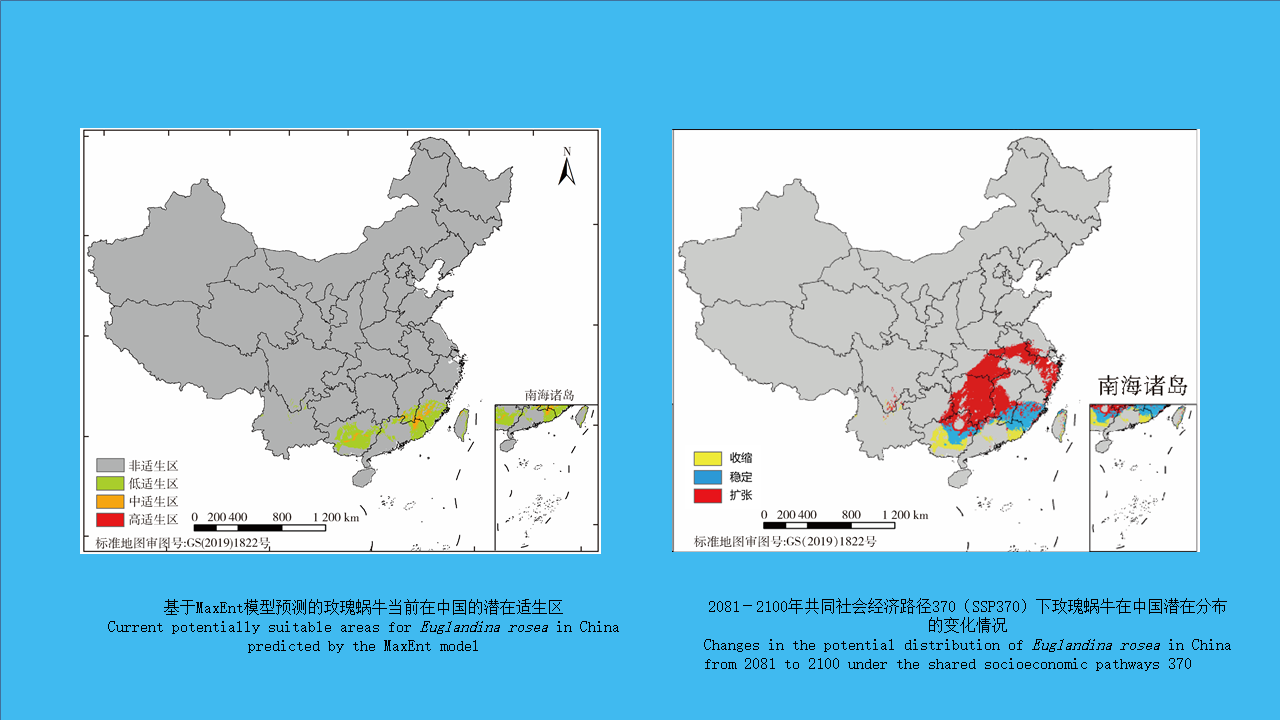
Objective To predict the potential distribution of Euglandina rosea in China under current and future climatic conditions via an optimized maximum entropy (MaxEnt) model, and to provide a theoretical basis for the prevention and control of invasion of E. rosea in China. Methods The global occurrence records of E. rosea were collected and screened using ENMtool. Maxent 3.4.1 and GraphPad Prism 8 were used to screen environmental variables according to the contribution rate of environmental variables, the jackknife method, and the correlation analysis of variables. The "kuenm" package was run in R 4.0.4 software to calculate and adjust the model parameters by means of regularization multipliers and feature combinations. The optimized MaxEnt model was used to predict the potential distribution of E. rosea in China under current and future climate scenarios. ArcGIS 10.7 was used to process the results and map the images. Results A total of 780 E. rosea occurrence records were identified, and four environmental variables were used to construct the MaxEnt model. The area under the curve (AUC) of the model was 0.963. The most influential environmental factors on the distribution of E. rosea were precipitation of the driest quarter and the highest temperature in February. The MaxEnt model predicted that the current potential areas of E. rosea were distributed in the southeast of China, concentrated in Fujian province, Guangdong province, and central Guangxi Zhuang Autonomous Region. It would gradually expand northward to Hunan province, Jiangxi province, central Anhui province, eastern Hubei province, and some areas of Zhejiang province in the future. Conclusions E. rosea has potential distribution in China. With global warming, its potential habitat areas will gradually expand, while at lower latitudes in the southeast they will slightly shrink. As a result, the overall center of potential areas shifts northward.
YIN Ying-xuan, XU An-yuan, PAN Xiao-wen, HE Qing, WU Yin-juan, LI Xue-rong
. Predicting the potential distribution of Euglandina rosea in China using an optimized MaxEnt model[J]. Chinese Journal of Vector Biology and Control, 2023
, 34(2)
: 137
-144
.
DOI: 10.11853/j.issn.1003.8280.2023.02.002
[1] Davis EC,Perez KE,Bennett DJ. Euglandina rosea (Férussac,1821) is found on the ground and in trees in Florida[J]. Nautilus,2004,118(3):127-128.
[2] Gargominy O. Beyond the alien invasion:A recently discovered radiation of Nesopupinae (Gastropoda:Pulmonata:Vertiginidae) from the summits of Tahiti (Society Islands,French Polynesia)[J]. J Onchol,2008,39(5):517-536.
[3] 朱崧琪,梁柱伟,汪绍文. 《中华人民共和国进境植物检疫性有害生物名录》更新项目简介[J]. 中国海关,2021(7):54.Zhu SQ,Liang ZW,Wang SW. Brief introduction to the update project of the "List of plant quarantine pests entering the People's Republic of China"[J]. China Customs,2021(7):54. (in Chinese)
[4] 周卫川. 玫瑰蜗牛[J]. 植物检疫,2012,26(6):38-40.Zhou WC. Euglandina rosea[J]. Plant Quar,2012,26(6):38-40. (in Chinese)
[5] Clarke B,Murray J,Johnson MS. The extinction of endemic species by a program of biological control[J]. Pac Sci,1984,38(2):97-104.
[6] Coote T,Loève É. From 61 species to five:Endemic tree snails of the Society Islands fall prey to an ill-judged biological control programme[J]. Oryx,2003,37(1):91-96. DOI:10.1017/S0030605303000176.
[7] Hadfield MG,Miller SE,Carwile AH. The decimation of endemic Hawai'ian tree snails by alien predators[J]. Am Zool,1993,33(6):610-622. DOI:10.1093/icb/33.6.610.
[8] Christensen CC,Cowie RH,Yeung NW,et al. Biological control of pest non-marine molluscs:A pacific perspective on risks to non-target organisms[J]. Insects,2021,12(7):583. DOI:10.3390/insects12070583.
[9] Campbell BG,Little MD. The finding of Angiostrongylus cantonensis in rats in New Orleans[J]. Am J Trop Med Hyg,1988,38(3):568-573. DOI:10.4269/ajtmh.1988.38.568.
[10] 王沛,胡美玲,肖颖,等. 玫瑰蜗牛入侵中国的风险评估[J]. 中国口岸科学技术,2020(9):31-36. DOI:10.3969/j.issn.1002-4689.2020.09.006.Wang P,Hu ML,Xiao Y,et al. Risk assessment of Euglandina rosea (Ferussac,1821) invasion into China[J]. China Port Sci Technol,2020(9):31-36. DOI:10.3969/j.issn.1002-4689.2020. 09.006.(in Chinese)
[11] Phillips SJ,Anderson RP,Schapire RE. Maximum entropy modeling of species geographic distributions[J]. Ecol Modell,2006,190(3/4):231-259. DOI:10.1016/j.ecolmodel.2005. 03.026.
[12] Merow C,Smith MJ,Silander JA. A practical guide to MaxEnt for modeling species' distributions:What it does,and why inputs and settings matter[J]. Ecography,2013,36(10):1058-1069. DOI:10.1111/j.1600-0587.2013.07872.x.
[13] Adhikari D,Barik SK,Upadhaya K. Habitat distribution modelling for reintroduction of Ilex khasiana Purk.,a critically endangered tree species of northeastern India[J]. Ecol Eng,2012,40:37-43. DOI:10.1016/j.ecoleng.2011.12.004.
[14] Fick SE,Hijmans RJ. WorldClim 2:New 1-km spatial resolution climate surfaces for global land areas[J]. Int J Climatol,2017,37(12):4302-4315. DOI:10.1002/joc.5086.
[15] Yang H,Jiang ZH,Li L. Biases and improvements in three dynamical downscaling climate simulations over China[J]. Climate Dyn,2016,47(9/10):3235-3251. DOI:10.1007/s00382-016-3023-9.
[16] Liu CR,White M,Newell G. Selecting thresholds for the prediction of species occurrence with presence-only data[J]. J Biogeogr,2013,40(4):778-789. DOI:10.1111/jbi.12058.
[17] Freeman EA,Moisen GG. A comparison of the performance of threshold criteria for binary classification in terms of predicted prevalence and kappa[J]. Ecol Modell,2008,217(1/2):48-58. DOI:10.1016/j.ecolmodel.2008.05.015.
[18] Cobos ME,Peterson AT,Barve N,et al. Kuenm:An R package for detailed development of ecological niche models using MaxEnt[J]. PeerJ,2019,7:e6281. DOI:10.7717/peerj.6281.
[19] Muscarella R,Galante PJ,Soley-Guardia M,et al. ENMeval:An R package for conducting spatially independent evaluations and estimating optimal model complexity for MaxEnt ecological niche models[J]. Methods Ecol Evol,2014,5(11):1198-1205. DOI:10.1111/2041-210X.12261.
[20] Zeng YW,Low BW,Yeo DCJ. Novel methods to select environmental variables in MaxEnt:A case study using invasive crayfish[J]. Ecol Modell,2016,341:5-13. DOI:10.1016/j.ecolmodel.2016.09.019.
[21] Radosavljevic A,Anderson RP. Making better MaxEnt models of species distributions:Complexity,overfitting and evaluation[J]. J Biogeogr,2014,41(4):629-643. DOI:10.1111/jbi.12227.
[22] Chiu SC,Chou KC. Observations on the biology of the carnivorous snail Euglandina rosea Ferussac[J]. Bull Inst Zool Acad Sin,1962,1(1):17-24.
[23] 齐庆华. 未来气候情景下中国东部极端降水和气温的危险性特征[J]. 气象与减灾研究,2020,43(4):256-266. DOI:10.12013/qxyjzyj2020-037.Qi QH. Risk characteristics of precipitation and temperature extremes over eastern China under future climatic scenario[J]. Meteorol Disaster Reduct Res,2020,43(4):256-266. DOI:10.12013/qxyjzyj2020-037.(in Chinese)
[24] Suo H,Guan XX,Wu SL,et al. Energy performance assessment of the container housing in subtropical region of China upon future climate scenarios[J]. Energies,2023,16(1):503. DOI:10.3390/en16010503.
[25] Hubricht L. The distributions of the native land mollusks of the eastern United States[M]. Chicago:Field Museum of Natural History,1985:175-186. DOI:10.5962/bhl.title.3329.
[26] United States Department of Agriculture. New pest response guidelines:Giant African snails:Snail pests in the family Achatinidae[R]. Washington:United States Department of Agriculture,2007.
[27] Phillips SJ,Dudík M,Elith J,et al. Sample selection bias and presence-only distribution models:Implications for background and pseudo-absence data[J]. Ecol Appl,2009,19(1):181-197. DOI:10.1890/07-2153.1.
[28] Kramer-Schadt S,Niedballa J,Pilgrim JD,et al. The importance of correcting for sampling bias in MaxEnt species distribution models[J]. Divers Distrib,2013,19(11):1366-1379. DOI:10.1111/ddi.12096.
[29] Cieplok A,Spyra A. The roles of spatial and environmental variables in the appearance of a globally invasive Physa acuta in water bodies created due to human activity[J]. Sci Total Environ,2020,744:140928. DOI:10.1016/j.scitotenv.2020.140928.

