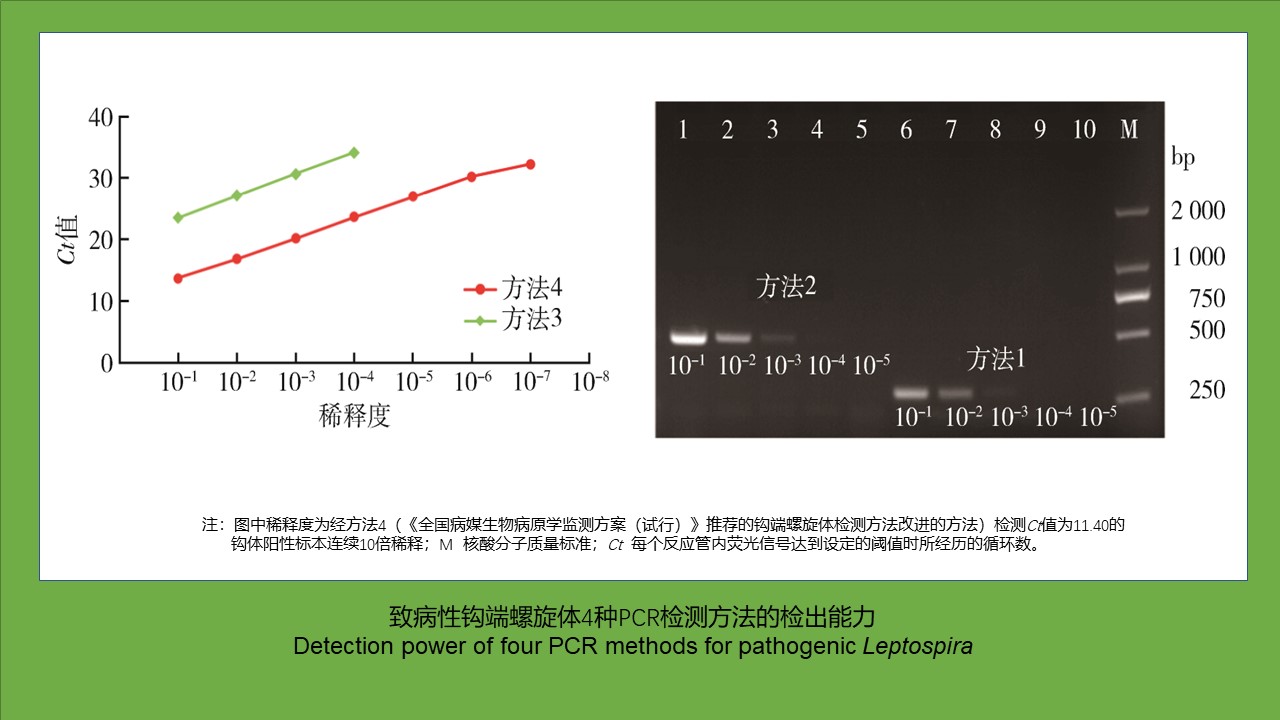
Objective To compare and evaluate the detection effect between an improved polymerase chain reaction (PCR) method and three current standard methods for pathogenic Leptospira, and to provide an improved method in early diagnosis of patients and host animal monitoring. Methods A step of reverse transcription process was added to the recommended pathogenic Leptospira detection method (method 3) in National Vector Etiology Surveillance Program (Trial), without changing the primers and probes, to form an improved method (method 4). Four PCR methods, i.e., Method 4, the recommended method of Industry Standards for Health Care (method 1), the recommended method of Industry Standards for Inspection and Quarantine (method 2), and method 3, were used to detect Leptospira positive samples with series dilutions, early serum samples of patients, and rodent kidney specimens in parallel, and to evaluate the detection effect. Results The sensitivity of method 4 was 10 000 times that of methods 1 and 2, and 1 000 times that of method 3. Leptospira nucleic acids in early serum of patients were only detected by method 4. The detection rates of Leptospira in 100 rodent kidney specimens were 2.00%, 4.00%, 8.00%, and 40.00% by the four methods, respectively. There was a significant difference in the positive detection rate between method 4 and methods 1, 2, and 3 (all P<0.001) and no significant difference between methods 1, 2, and 3 (P>0.05). Conclusion The improved method has a superior detection effect to the other three current standard methods in the early diagnosis of patients with leptospirosis and the rodent kidney.
Rong WANG, Min MA, Zhong-fa WANG, Ji-luo LIU
. Evaluation of an improved PCR assay in detection of pathogenic Leptospira[J]. Chinese Journal of Vector Biology and Control, 2023
, 34(1)
: 77
-81
.
DOI: 10.11853/j.issn.1003.8280.2023.01.014
[1] 张翠彩, 张汀兰, 徐建民, 等. 2016-2018年江西省钩端螺旋体病鼠类动物流行病学调查与分离菌株鉴定[J]. 中国人兽共患病学报, 2019, 35(12):1080-1084. DOI:10.3969/j.issn.1002-2694.2019.00.185. Zhang CC, Zhang TL, Xu JM, et al. Epidemiological survey and identification of pathogenic Leptospira isolated from rats in Jiangxi province during 2016-2018[J]. Chin J Zoonoses, 2019, 35(12):1080-1084. DOI:10.3969/j.issn.1002-2694.2019.00. 185.(in Chinese)
[2] 李喆, 徐颖华, 辛晓芳. 我国钩端螺旋体分子分型研究进展[J]. 疾病监测, 2022, 37(4):512-516. DOI:10.3784/jbjc. 202109130500. Li Z, Xu YH, Xin XF. Progress in research of molecular typing of Leptospira in China[J]. Dis Surveill, 2022, 37(4):512-516. DOI:10.3784/jbjc.202109130500.(in Chinese)
[3] 中华人民共和国卫生部. WS 290-2008钩端螺旋体病诊断标准[S]. 北京:人民卫生出版社, 2008. Ministry of Health of the People's Republic of China. WS 290-2008 Diagnostic criteria for leptospirosis[S]. Beijing:People's Medical Publishing House, 2008. (in Chinese)
[4] 中国疾病预防控制中心. 全国病媒生物病原学监测方案(试行)[Z]. 北京:中国疾病预防控制中心, 2020. Chinese Center for Disease Control and Prevention. National vector etiology surveillance program (Trial)[Z]. Beijing:Chinese Center for Disease Control and Prevention, 2020. (in Chinese)
[5] 国家质量监督检验检疫总局. SN/T 3741.1-2013国境口岸鼠类携带病原体检测方法第1部分:致病性钩端螺旋体PCR检测方法[S]. 北京:中国标准出版社, 2014. General Administration of Quality Supervision, Inspection and Quarantine of the People's Republic of China. SN/T 3741.1-2013 Detection for pathogens of rodents at frontier ports-Part 1:Detection for pathogenic Leptospira[S]. Beijing:Standards Press of China, 2014. (in Chinese)
[6] 张翠彩, 李秀文, 聂一新, 等. 致病性钩端螺旋体TaqMan real-time PCR检测技术的建立及其应用[J]. 中华流行病学杂志, 2011, 32(10):1018-1021. DOI:10.3760/cma.j.issn.0254-6450.2011.10.015. Zhang CC, Li XW, Nie YX, et al. Establishment and application of TaqMan real-time PCR for the detection of pathogenic Leptospira species[J]. Chin J Epidemiol, 2011, 32(10):1018-1021. DOI:10.3760/cma.j.issn.0254-6450.2011.10.015.(in Chinese)
[7] Smythe LD, Smith IL, Smith GA, et al. A quantitative PCR (TaqMan) assay for pathogenic Leptospira spp.[J]. BMC Infect Dis, 2002, 2:13. DOI:10.1186/1471-2334-2-13.
[8] 伍卫华, 戴保民. 钩端螺旋体16S rRNA逆转录聚合酶链反应[J]. 华西医科大学学报, 1994, 25(2):166-169. Wu WH, Dai BM. 16S rRNA reverse transcription-polymerase chain reaction of leptospires[J]. J West China Univ Med Sci, 1994, 25(2):166-169. (in Chinese)
[9] 赵明惠, 徐铁龙, 张强, 等. 江西口岸及国检监管区鼠类感染钩端螺旋体的检测及基因序列分析[J]. 中国人兽共患病学报, 2016, 32(7):674-678. DOI:10.3969/j.issn.1002-2694. 2016.07.017. Zhao MH, Xu TL, Zhang Q, et al. Detection and sequencing analysis of Leptospira carried by rats from Jiangxi port and entry-exit inspection and quarantine Bureau's supervision areas[J]. Chin J Zoonoses, 2016, 32(7):674-678. DOI:10.3760/cma.j.issn.0254-6450.2011.10.015.(in Chinese)
[10] 胡群, 马思杰, 邹春颖, 等. 鼠类感染钩端螺旋体的PCR检测和基因序列分析[J]. 中国病原生物学杂志, 2015, 10(5):427-429, 434. DOI:10.13350/j.cjpb.150511. Hu Q, Ma SJ, Zou CY, et al. Detection and phylogenetic analysis of Leptospira spp. carried by rodents[J]. J Pathog Biol, 2015, 10(5):427-429, 434. DOI:10.13350/j.cjpb.150511.(in Chinese)

