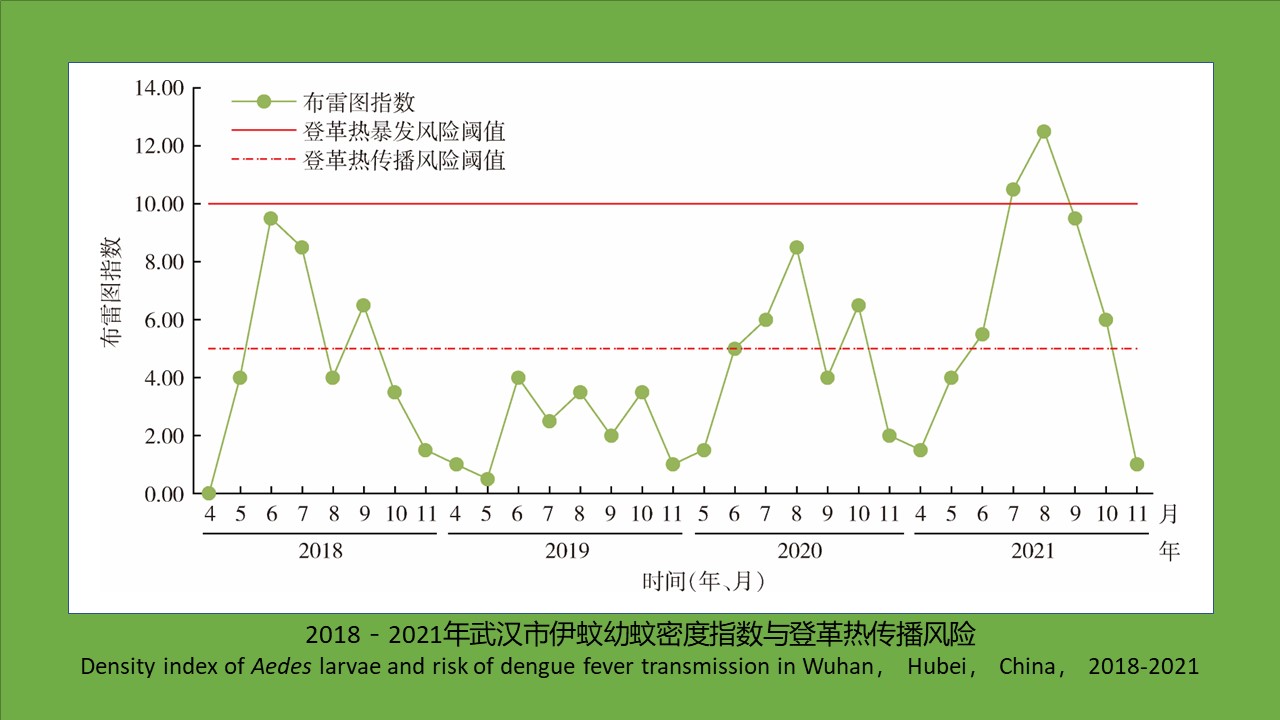
Objective To analyze the ecological monitoring data of Aedes vector in Wuhan, China, 2018-2021, and to provide a scientific basis for effective prevention and control of dengue fever. Methods The Breteau index (BI) and double layered mosquito net methods were used for ecological monitoring of Aedes larvae and adults, respectively. All data were collected by Excel 2010 and statistically analyzed by SPSS 20.0 software. Differences in BI at different time points were analyzed by Chi-square test, and differences in net trap index between different habitats at different time points by analysis of variance or Kruskal-Wallis test; the risk of dengue fever transmission was assessed. Results In 2018-2021, the mean BI was 4.50, and the net trap index was 2.44 mosquitoes/net·h. The density index of Aedes fell to the lowest level in 2019 and showed an upward trend in 2020-2021. Meanwhile, the net trap index in residential areas was higher than that in waste tire stacking sites (H=29.468, P<0.001). The seasonal fluctuation was not completely consistent in different years; the peak BI value was observed from June to August, and the peak net trap index was observed in July and August. In 2018-2021, 64.52% (20/31) of the monitored months presented a risk of dengue fever transmission, and the BI value reached the risk threshold of dengue fever outbreak in July and August in 2021. Conclusion The fluctuation trend of vector Aedes mosquito density is on the rise in Wuhan, and the risk of dengue fever transmission has increased. Aedes vector control measures should be strengthened and improved.
[1] Lwande OW, Obanda V, Lindström A, et al. Globe-trotting Aedes aegypti and Ae. albopictus:Risk factors for arbovirus pandemics[J]. Vector Borne Zoonotic Dis, 2020, 20(2):71-81. DOI:10.1089/vbz.2019.2486.
[2] Tsheten T, Gray DJ, Clements ACA, et al. Epidemiology and challenges of dengue surveillance in the WHO south-east Asia region[J]. Trans R Soc Trop Med Hyg, 2021, 115(6):583-599. DOI:10.1093/trstmh/traa158.
[3] Messina JP, Brady OJ, Golding N, et al. The current and future global distribution and population at risk of dengue[J]. Nat Microbiol, 2019, 4(9):1508-1515. DOI:10.1038/s41564-019-0476-8.
[4] 戴本南, 王芬, 潘洁, 等. 湖北省首起输入性登革热引起本地暴发流行的特征及处置效果分析[J]. 公共卫生与预防医学, 2020, 31(4):62-65. DOI:10.3969/j.issn.1006-2483.2020. 04.015. Dai BN, Wang F, Pan J, et al. Epidemic characteristics and treatment effect of the first dengue fever outbreak in Hubei province[J]. J Public Health Prev Med, 2020, 31(4):62-65. DOI:10.3969/j.issn.1006-2483.2020.04.015.(in Chinese)
[5] 罗超, 陈琼, 谭仕碧, 等. 重庆市万州区2019年登革热暴发疫情流行特征及相关因素[J]. 中国热带医学, 2021, 21(7):654-657, 662. DOI:10.13604/j.cnki.46-1064/r.2021.07.08. Luo C, Chen Q, Tan SB, et al. Epidemic characteristics and influential factors of dengue fever in Wanzhou, Chongqing, 2019[J]. China Trop Med, 2021, 21(7):654-657, 662. DOI:10.13604/j.cnki.46-1064/r.2021.07.08.(in Chinese)
[6] 刘牧文, 孙昼, 考庆君, 等. 2017-2019年浙江省杭州市登革热流行特征和时空聚集性分析[J]. 疾病监测, 2022, 37(4):481-486. DOI:10.3784/jbjc.202106300379. Liu MW, Sun Z, Kao QJ, et al. Spatiotemporal distribution of dengue fever in Hangzhou, Zhejiang, 2017-2019[J]. Dis Surveill, 2022, 37(4):481-486. DOI:10.3784/jbjc. 202106300379. (in Chinese)
[7] 刘小波, 岳玉娟, 贾清臣, 等. 2020-2021年我国12省份媒介伊蚊生态学调查[J]. 中国媒介生物学及控制杂志, 2022, 33(1):8-15. DOI:10.11853/j.issn.1003.8280.2022.01.002. Liu XB, Yue YJ, Jia QC, et al. Ecological investigation of Aedes vector in 12 provinces of China in 2020-2021[J]. Chin J Vector Biol Control, 2022, 33(1):8-15. DOI:10.11853/j.issn. 1003. 8280.2022.01.002.(in Chinese)
[8] 牟笛, 崔金朝, 殷文武, 等. 2015-2018年我国登革热暴发流行病学特征分析[J]. 中华流行病学杂志, 2020, 41(5):685-689. DOI:10.3760/cma.j.cn112338-20190715-00523. Mu D, Cui JZ, Yin WW, et al. Epidemiological characteristics of dengue fever outbreaks in China, 2015-2018[J]. Chin J Epidemiol, 2020, 41(5):685-689. DOI:10.3760/cma.j.cn112338-20190715-00523.(in Chinese)
[9] 刘起勇. 我国登革热流行新趋势、防控挑战及策略分析[J]. 中国媒介生物学及控制杂志, 2020, 31(1):1-6. DOI:10.11853/j.issn.1003.8280.2020.01.001. Liu QY. Dengue fever in China:New epidemical trend, challenges and strategies for prevention and control[J]. Chin J Vector Biol Control, 2020, 31(1):1-6. DOI:10.11853/j.issn.1003.8280.2020.01.001.(in Chinese)
[10] 耿梦杰, 任翔, 彭质斌, 等. 2021年我国夏季重点传染病疫情形势分析[J]. 疾病监测, 2021, 36(8):811-817. DOI:10.3784/jbjc.202106170344. Geng MJ, Ren X, Peng ZB, et al. Incidence of key infectious diseases in summer of 2021, China[J]. Dis Surveill, 2021, 36(8):811-817. DOI:10.3784/jbjc.202106170344.(in Chinese)
[11] Fansiri T, Buddhari D, Pathawong N, et al. Entomological risk assessment for dengue virus transmission during 2016-2020 in Kamphaeng Phet, Thailand[J]. Pathogens, 2021, 10(10):1234. DOI:10.3390/pathogens10101234.
[12] Ong SQ, Ahmad H, Ngesom AMM. Implications of the COVID-19 lockdown on dengue transmission in Malaysia[J]. Infect Dis Rep, 2021, 13(1):148-160. DOI:10.3390/idr13010016.
[13] Harapan H, Ryan M, Yohan B, et al. Covid-19 and dengue:Double punches for dengue-endemic countries in Asia[J]. Rev Med Virol, 2021, 31(2):e2161. DOI:10.1002/rmv.2161.
[14] Chang FS, Tseng YT, Hsu PS, et al. Re-assess vector indices threshold as an early warning tool for predicting dengue epidemic in a dengue non-endemic country[J]. PLoS Negl Trop Dis, 2015, 9(9):e0004043. DOI:10.1371/journal.pntd.0004043.
[15] Fustec B, Phanitchat T, Aromseree S, et al. Serological biomarker for assessing human exposure to Aedes mosquito bites during a randomized vector control intervention trial in northeastern Thailand[J]. PLoS Negl Trop Dis, 2021, 15(5):e0009440. DOI:10.1371/journal.pntd.0009440.
[16] Bowman LR, Runge-Ranzinger S, McCall PJ. Assessing the relationship between vector indices and dengue transmission:A systematic review of the evidence[J]. PLoS Negl Trop Dis, 2014, 8(5):e2848. DOI:10.1371/journal.pntd.0002848.
[17] 陈秋梅, 王热勤, 吴海霞, 等. 甘肃省天水市2017-2020年两种重要媒介蚊虫监测结果分析[J]. 中国媒介生物学及控制杂志, 2021, 32(4):456-460. DOI:10.11853/j.issn.1003.8280. 2021.04.014. Chen QM, Wang RQ, Wu HX, et al. Surveillance results of two important vector mosquitoes in Tianshui, Gansu, China, 2017-2020[J]. Chin J Vector Biol Control, 2021, 32(4):456-460. DOI:10.11853/j.issn.1003.8280.2021.04.014.(in Chinese)
[18] 魏超, 马海芳, 廖宁, 等. 广西壮族自治区2020-2021年登革热媒介伊蚊密度专项调查结果分析[J]. 中国媒介生物学及控制杂志, 2022, 33(1):25-29. DOI:10.11853/j.issn.1003.8280. 2022.01.005. Wei C, Ma HF, Liao N, et al. An analysis of special investigation results of dengue vector Aedes density in Guangxi Zhuang Autonomous Region, China, 2020-2021[J]. Chin J Vector Biol Control, 2022, 33(1):25-29. DOI:10.11853/j.issn.1003.8280. 2022.01.005.(in Chinese)

