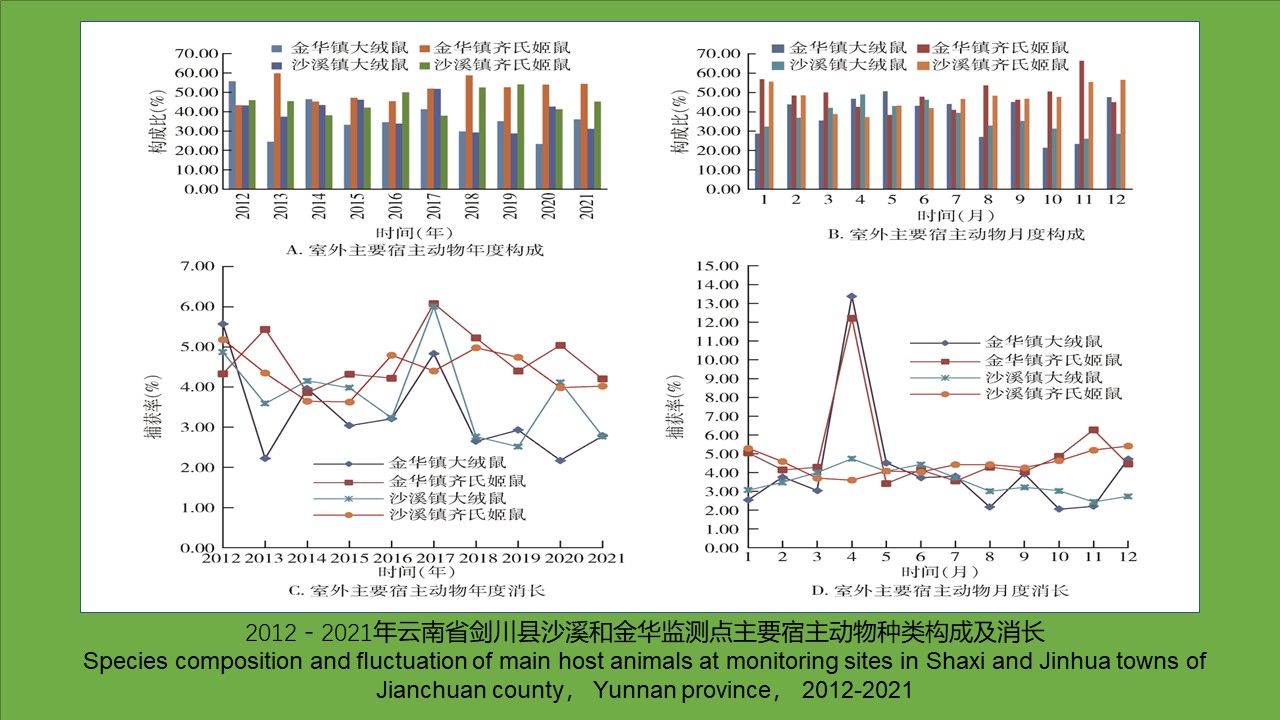
Objective To analyze the species composition and interannual and seasonal fluctuations of main host animals and flea vectors at historical and new plague foci in Jianchuan county, Yunnan province, China, and to explore the relationship between the population characteristics of hosts and vectors and plague epidemics. Methods Plague surveillance data were collected from Shaxi town surveillance point (historical) and Jinhua town surveillance point (new) in Jianchuan county, Yunnan province from 2012 to 2021. Descriptive and correlation methods were used to analyze the population characteristics of major host animals and fleas. Results The host animals found at Shaxi town surveillance point involved 22 species, 19 genera, 7 families, and 6 orders (outdoors:20 species, 18 genera, 7 families, and 6 orders; indoors:5 species, 4 genera, 2 orders, and 2 families). The host animals found at Jinhua town surveillance point involved 21 species, 17 genera, 6 families, and 5 orders (outdoors:20 species, 17 genera, 6 families, and 5 orders; indoors:10 species, 8 genera, 5 families, and 3 orders). The dominant species were Eothenomys miletus and Apodemus chevrieri at both monitoring sites, accounting for 37.73% and 45.90% in Shaxi town and 35.86% and 51.43% in Jinhua town, respectively. The fleas collected at the two surveillance sites involved 8 species, 8 genera, and 3 families (rodent body fleas:8 species, 8 genera, and 3 families; nest fleas:4 species, 4 genera, and 2 families). In Shaxi town, the body flea infestation rate was 28.91% (3 693/12 772), and the total flea index was 0.79 (10 144/12 772). In Jinhua town, the body flea infestation rate was 29.39% (959/3 263), and the total flea index was 0.71 (2 321/3 263). Frontopsylla spadix and Neopsylla specialis were the dominant species at both monitoring sites, accounting for 33.20% and 16.30% in Shaxi town and 36.49% and 19.09% in Jinhua town, respectively. Conclusion By comparing the population characteristics of main host animals and flea vectors at historical and new plague foci in Jianchuan county, it is indicated that the population characteristics of A. chevrieri and ectoparasitic F. spadix and N. specialis are more closely related to plague epidemics.
Biao DUAN, Si-xiang ZHANG, Cai-feng ZHAO, Mei HONG, Li-qiong SU, Wen-hong ZHAO, Zhi-ming YANG, Liang LU
. Comparative analysis of main host animals and flea vectors at historical and new plague foci in Jianchuan county, Yunnan province, China[J]. Chinese Journal of Vector Biology and Control, 2023
, 34(1)
: 31
-38
.
DOI: 10.11853/j.issn.1003.8280.2023.01.006
[1] 田杰. 剑川鼠疫自然疫源地鼠蚤群落结构研究[J]. 地方病通报, 1995, 10(1):29-36. Tian J. Study on the community of rodents and fleas in natural plague foci of Jianchuan[J]. Endem Dis Bull, 1995, 10(1):29-36. (in Chinese)
[2] 方喜业, 杨瑞馥, 刘起勇, 等. 中国鼠疫自然疫源地分型研究Ⅱ. 鼠疫自然疫源地分型方法研究[J]. 中华流行病学杂志, 2012, 33(2):234-238. DOI:10.3760/cma.j.issn.0254-6450. 2012.02.024. Fang XY, Yang RF, Liu QY, et al. A novel method for typing natural plague foci in China Ⅱ. Research on the typing methods for natural plague foci[J]. Chin J Epidemiol, 2012, 33(2):234-238. DOI:10.3760/cma.j.issn.0254-6450.2012.02.024.(in Chinese)
[3] 秦长育, 许磊, 张荣祖, 等. 中国鼠疫自然疫源地分型研究Ⅴ. 鼠疫宿主生物学特征[J]. 中华流行病学杂志, 2012, 33(7):692-697. DOI:10.3760/cma.j.issn.0254-6450.2012.07.011. Qin CY, Xu L, Zhang RZ, et al. Ecological-geographic landscapes of natural plague foci in China Ⅴ. Biological characteristics of major natural reservoirs of Yesinia pestis[J]. Chin J Epidemiol, 2012, 33(7):692-697. DOI:10.3760/cma.j.issn.0254-6450.2012.07.011.(in Chinese)
[4] 龚正达, 于心, 刘起勇, 等. 中国鼠疫自然疫源地分型研究Ⅵ. 鼠疫媒介生物学特征[J]. 中华流行病学杂志, 2012, 33(8):818-822. DOI:10.3760/cma.j.issn.0254-6450.2012.08.014. Gong ZD, Yu X, Liu QY, et al. Ecological-geographic landscapes of natural plague foci in China Ⅵ. Biological characteristics of natural vectors of Yesinia pestis[J]. Chin J Epidemiol, 2012, 33(8):818-822. DOI:10.3760/cma.j.issn.0254-6450.2012.08.014.(in Chinese)
[5] 张晓雪. 有关中国跳蚤与鼠疫菌关系研究的进展[J]. 地方病译丛, 1994, 15(2):1-4. Zhang XX. Development of relationship between flea and Yersinia pestis in China[J]. Endem Translat, 1994, 15(2):l-4. (in Chinese)
[6] 方喜业. 中国鼠疫自然疫源地[M]. 北京:人民卫生出版社, 1990:258-279. Fang XY. Natural focuses of plague in China[M]. Beijing:People's Medical Publishing House, 1990:258-279. (in Chinese)
[7] 张贵, 张贵军, 王身荣, 等. 我国鼠疫自然疫源地及疫情概况[J]. 中国地方病防治杂志, 2002, 17(2):101-103. DOI:10.3969/j.issn.1001-1889.2002.02.013 Zhang G, Zhang GJ, Wang SR, et al. Survey of natural focuses of plague and epidemic situations in China[J]. Chin J Ctrl Endem Dis, 2002, 17(2):101-103. DOI:10.3969/j.issn.1001-1889. 2002.02.013.(in Chinese)
[8] 刘启胜, 段勇军, 杨军, 等. 2011-2012年石渠县青海田鼠巢蚤调查分析[J]. 预防医学情报杂志, 2015, 31(3):229-231. Liu QS, Duan YJ, Yang J, et al. Investigation of nest fleas of Microtus fuscus in Shiqu county[J]. J Prev Med Inf, 2015, 31(3):229-231. (in Chinese)
[9] 叶超, 古丽阿依·包开西, 柳园园, 等. 准噶尔盆地鼠疫自然疫源地东部区域大沙鼠体蚤群落结构分析[J]. 疾病预防控制通报, 2017, 32(3):1-4. DOI:10.13215/j.cnki.jbyfkztb.1703015. Ye C, Baokaixi GLAY, Liu YY, et al. Community structure of parasitic fleas on Rhombomys opimus in eastern area of the Junggar Basin plague focus[J]. Bull Dis Control Prev, 2017, 32(3):1-4. DOI:10.13215/j.cnki.jbyfkztb.1703015.(in Chinese)
[10] 俞东征. 鼠疫动物流行病学[M]. 北京:科学出版社, 2009:28-85. Yu DZ. Epizootiology of plague[M]. Beijing:Science Press, 2009:28-85. (in Chinese)
[11] 张家勇, 丁俊, 白玉银, 等. 辽宁省2006-2015年鼠类密度及种群结构分析[J]. 中国媒介生物学及控制杂志, 2017, 28(1):51-55. DOI:10.11853/j.issn.1003.8280.2017.01.014. Zhang JY, Ding J, Bai YY, et al. Analysis of rodent density and constituent in Liaoning province, China, during 2006-2015[J]. Chin J Vector Biol Control, 2017, 28(1):51-55. DOI:10.11853/j.issn.1003.8280.2017.01.014.(in Chinese)
[12] 李胜, 杨建国, 冯建萍, 等. 青海省2006-2015年鼠疫流行病学分析[J]. 中国地方病防治杂志, 2016, 31(10):1095-1096. Li S, Yang JG, Feng JP, et al. Epidemiological analysis on plague in Qinghai province from 2006 to 2015[J]. Chin J Ctrl Endem Dis, 2016, 31(10):1095-1096. (in Chinese)
[13] 张渝疆, 阿布力克木, 王诚, 等. 新疆维吾尔自治区准噶尔盆地2007-2016年鼠疫流行态势分析[J]. 中华流行病学杂志, 2017, 38(10):1394-1398. DOI:10.3760/cma.j.issn.0254-6450. 2017.10.020. Zhang YJ, Abulikemu, Wang C, et al. Epidemics and risk factors of plague in Junggar Basin, Xinjiang Uygur Autonomous Region, 2007-2016[J]. Chin J Epidemiol, 2017, 38(10):1394-1398. DOI:10.3760/cma.j.issn.0254-6450.2017.10.020.(in Chinese)
[14] 张涛, 李丽, 卢世堂, 等. 甘宁黄土高原鼠疫自然疫源地50年防控概述[J]. 疾病预防控制通报, 2014, 29(2):4-6. DOI:10.13215/j.cnki.jbyfkztb.1309018. Zhang T, Li L, Lu ST, et al. Overview of prevention and control in Loess Plateau plague natural foci in Gansu and Ningxia for 50 years[J]. Bull Dis Control Prev, 2014, 29(2):4-6. DOI:10.13215/j.cnki.jbyfkztb.1309018.(in Chinese)
[15] 闫东, 史献明, 王再山, 等. 河北省鼠疫疫源地宿主动物种群结构研究[J]. 中华卫生杀虫药械, 2016, 22(4):381-384. DOI:10.19821/j.1671-2781.2016.04.024. Yan D, Shi XM, Wang ZS, et al. Research on the population structure of plague host animals in plague foci in Hebei province[J]. Chin J Hyg Insect Equip, 2016, 22(4):381-384. DOI:10.19821/j.1671-2781.2016.04.024.(in Chinese)

