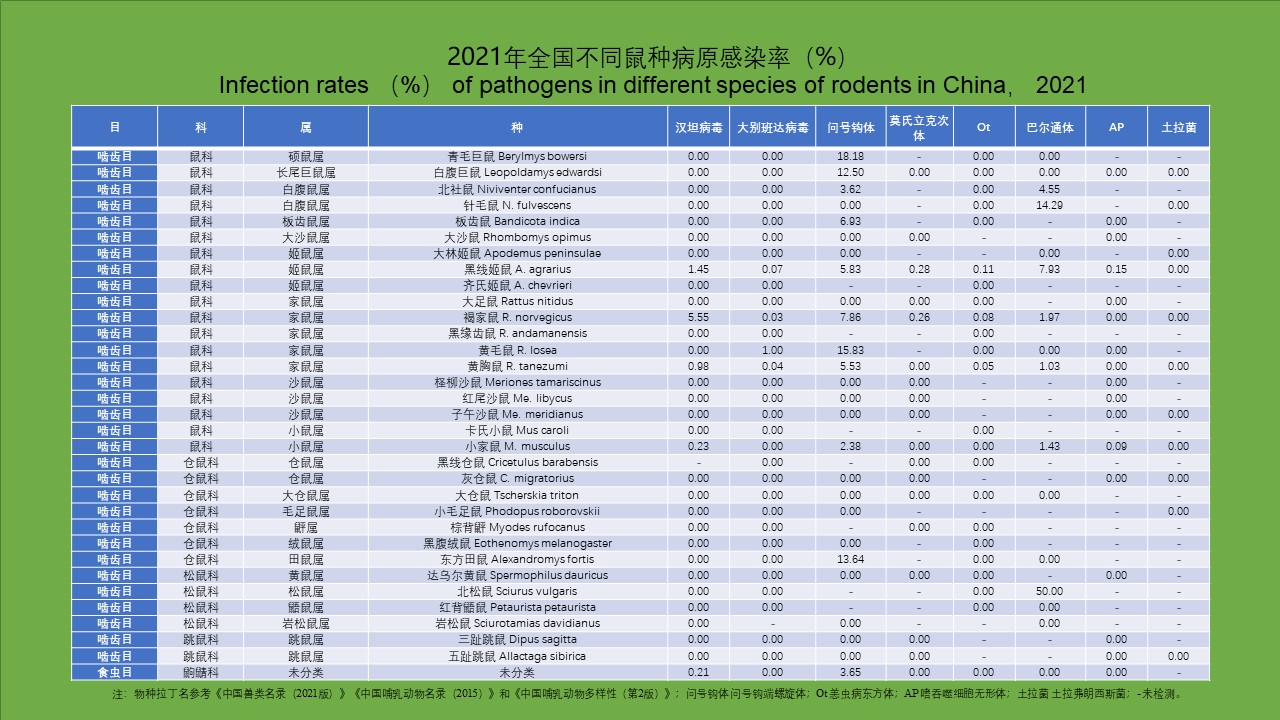
In 2021, the national surveillance of rodent-borne pathogens of disease vectors had been started up, and a total of 123 prefectures were selected as national surveillance sites. Sampling was completed at 95 surveillance sites. A total of 17 910 rodent specimens were collected, and 16 891 of them were tested. The completion rate of pathogen detection was 94.31%. The overall infection rate of eight monitored rodent-borne pathogens around China was 2.43% (407/16 716) for Hantavirus, 0.02% (4/16 154) for Dabie bandavirus (i.e., severe fever with thrombocytopenia syndrome virus), 5.75% (624/10 850) for Leptospira interrogans, 0.11% (5/4 470) for Rickettsia mooseri, 0.05% (5/10 790) for Orientia tsutsugamushi, 2.39% (75/3 136) for Bartonella, and 0.04% (2/5 075) for Anaplasma phagocytophilum. Francisella tularensis was not detected. More than ten species of rodents were found to be infected with different pathogens in 18 provinces across China. The infection rates of pathogens in rodents in southern regions were relatively high, and the positive rates of pathogens carried by various rodents differed. Rattus norvegicus and Apodemus agrarius were the species in which the most pathogens were detected.
National Vector Surveillance System, Chinese Center for Disease Control and Prevention
. National surveillance report on rodent-borne pathogens of disease vectors in 2021[J]. Chinese Journal of Vector Biology and Control, 2023
, 34(1)
: 1
-8
.
DOI: 10.11853/j.issn.1003.8280.2023.01.001
[1] 李贵昌, 王玉姣, 鲁亮, 等. 2019年全国鼠类监测报告[J]. 中国媒介生物学及控制杂志, 2020, 31(4):389-394. DOI:10.11853/j.issn.1003.8280.2020.04.002. Li GC, Wang YJ, Lu L, et al. National surveillance report on rodents in China, 2019[J]. Chin J Vector Biol Control, 2020, 31(4):389-394. DOI:10.11853/j.issn.1003.8280.2020.04.002.(in Chinese)
[2] 蒋志刚, 马勇, 吴毅, 等. 中国哺乳动物多样性[J]. 生物多样性, 2015, 23(3):351-364. DOI:10.17520/biods.2014202. Jiang ZG, Ma Y, Wu Y, et al. China's mammalian diversity[J]. Biodiv Sci, 2015, 23(3):351-364. DOI:10.17520/biods. 2014202.(in Chinese)
[3] 魏辅文, 杨奇森, 吴毅, 等. 中国兽类名录(2021版)[J]. 兽类学报, 2021, 41(5):487-501. DOI:10.16829/j.slxb.150595. Wei FW, Yang QS, Wu Y, et al. Catalogue of mammals in China (2021)[J]. Acta Theriol Sin, 2021, 41(5):487-501. DOI:10.16829/j.slxb.150595.(in Chinese)
[4] 蒋志刚, 刘少英, 吴毅, 等. 中国哺乳动物多样性(第2版)[J]. 生物多样性, 2017, 25(8):886-895. DOI:10.17520/biods. 2017098. Jiang ZG, Liu SY, Wu Y, et al. China's mammal diversity (2nd edition)[J]. Biodiv Sci, 2017, 25(8):886-895. DOI:10.17520/biods.2017098.(in Chinese)
[5] 谭静, 黄晓玲, 黄平, 等. 广东省2015-2021年肾综合征出血热流行特征及其与气象因素的关系研究[J]. 中国全科医学, 2022, 25(17):2096-2101, 2109. DOI:10.12114/j.issn.1007-9572.2022.0289. Tan J, Huang XL, Huang P, et al. Epidemiological characteristics of hemorrhagic fever with renal syndrome and its relationship with meteorological factors in Guangdong from 2015 to 2021[J]. Chin Gen Pract, 2022, 25(17):2096-2101, 2109. DOI:10.12114/j.issn.1007-9572.2022.0289.(in Chinese)
[6] 刘天, 童叶青, 刘漫, 等. 2004-2017年全国肾综合征出血热变化趋势分析[J]. 中国人兽共患病学报, 2022, 38(6):515-522, 547. DOI:10.3969/j.issn.1002-2694.2022.00.067. Liu T, Tong YQ, Liu M, et al. Analysis of the trend of hemorrhagic fever with renal syndrome in China from 2004 to 2017[J]. Chin J Zoonoses, 2022, 38(6):515-522, 547. DOI:10.3969/j.issn.1002-2694.2022.00.067.(in Chinese)
[7] 苗美荣, 潘坤, 曹磊, 等. 2012-2018年陕西省渭南市肾综合征出血热流行特征及时空分布[J]. 中国人兽共患病学报, 2020, 36(2):141-145. DOI:10.3969/j.issn.1002-2694.2020. 00.022. Miao MR, Pan K, Cao L, et al. Epidemic characteristics and spatial and temporal distribution of hemorrhagic fever with renal syndrome in Weinan city, Shaanxi province from 2012 to 2018[J]. Chin J Zoonoses, 2020, 36(2):141-145. DOI:10.3969/j.issn.1002-2694.2020.00.022.(in Chinese)
[8] 张晓婷, 汪春娟, 关鸿志, 等. 新型布尼亚病毒脑炎一例[J]. 中华神经科杂志, 2018, 51(8):627-629. DOI:10.3760/cma.j.issn.1006-7876.2018.08.013. Zhang XT, Wang CJ, Guan HZ, et al. A case of severe fever with thrombocytopenia syndrome virus related encephalitis[J]. Chin J Neurol, 2018, 51(8):627-629. DOI:10.3760/cma.j.issn.1006-7876.2018.08.013.(in Chinese)
[9] 徐瑞瑞, 李军, 朱传龙. 新型布尼亚病毒感染研究进展[J]. 内科急危重症杂志, 2019, 25(3):177-180. Xu RR, Li J, Zhu CL. Advances in severe fever with thrombocytopenia syndrome bunyavirus infection[J]. J Crit Care Intern Med, 2019, 25(3):177-180. (in Chinese)
[10] 马慧, 曹玮民. 传染病病原监测网络研究现状及对策建议[J]. 解放军预防医学杂志, 2016, 34(5):639-641. DOI:10.13704/j.cnki.jyyx.2016.05.003. Ma H, Cao WM. Improvement of surveillance networks for infectious disease pathogens[J]. J Prev Med Chin PLA, 2016, 34(5):639-641. DOI:10.13704/j.cnki.jyyx.2016.05.003.(in Chinese)
[11] 吴海霞, 刘小波, 刘起勇. 我国病媒生物防控现状及面临的问题[J]. 首都公共卫生, 2018, 12(1):4-6. Wu HX, Liu XB, Liu QY. Current status and problem of vector prevention and control in China[J]. Capital J Public Health, 2018, 12(1):4-6. (in Chinese)<

