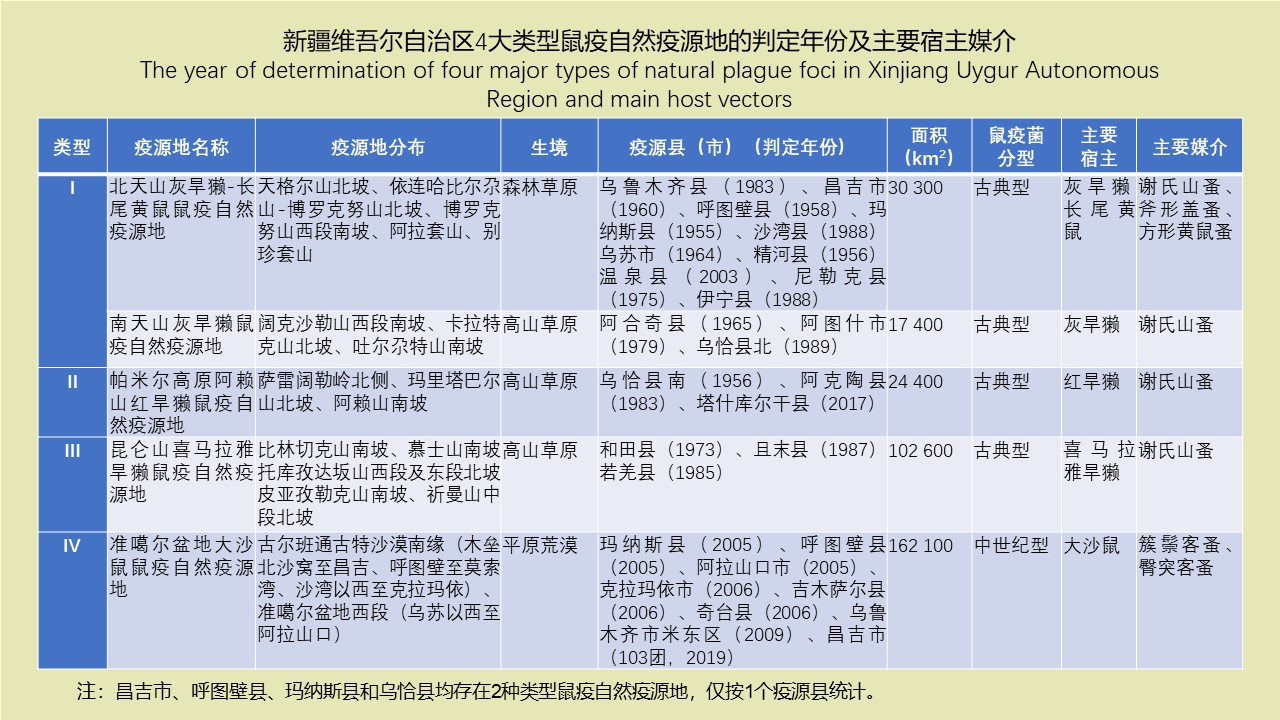
Objective To retrospectively analyze the prevalence and control of plague in Xinjiang Uygur Autonomous Region (Xinjiang), China from1901 to 2020, and to provide a reference for future plague control. Methods Through consulting the literature, collecting archives and monitoring data from the Xinjiang Center for Disease Control and Prevention, and using retrospective epidemiological methods, the epidemic pattern and prevention of human plague and animal plague in Xinjiang were analyzed. Results Before the founding of new China, there were 12 human plague outbreaks, causing over 100 000 deaths. After the founding of new China, there were 12 human plague outbreaks, with 47 plague cases, causing 28 deaths, with a fatality rate of 59.57%. Up to now, four major types of natural plague foci have been found in Xinjiang (330 000 km2), distributed in 25 counties/cities/districts. Seventy-five species of 34 genera of 10 families of rodents were discovered, and 2 058 strains of Yersinia pestis were isolated from rodents. Conclusion The natural plague foci in Xinjiang cover a large area, and the animal plague is persistently prevalent. In order to effectively control and rapidly cope with the plague epidemic and ensure the smooth implementation of the Belt and Road Initiative, the construction of plague prevention and control system should be strengthened.
GUI You-jun, WANG Xin-hui, WANG Qi-guo, ZHANG Xiao-bing, WANG Cheng, LI Bing, BAOKAIXI Guliayi, LUO Yong-jun, WANG Xiao-jun
. A retrospective analysis of plague prevalence and control in Xinjiang Uygur Autonomous Region, China, 1901-2020[J]. Chinese Journal of Vector Biology and Control, 2022
, 33(6)
: 843
-848
.
DOI: 10.11853/j.issn.1003.8280.2022.06.015
[1] 贵有军,雒涛,王启果,等. 新疆鼠疫防治70年回顾与展望[J]. 疾病预防控制通报,2020,35(4):85-88,91. DOI:10.13215/j.cnki.jbyfkztb.2004022. Gui YJ,Luo T,Wang QG,et al. Review and prospect of plague prevention and control in Xinjiang in the past 70 years[J]. Bull Dis Control Prev (China),2020,35(4):85-88,91. DOI:10.13215/j.cnki.jbyfkztb.2004022.(in Chinese)
[2] 贵有军,崔燕,古丽阿依·包开西,等. 丝绸之路经济带建设中新疆鼠疫风险及防控对策[J]. 中国媒介生物学及控制杂志,2019,30(5):593-596. DOI:10.11853/j.issn.1003.8280.2019. 05.028. Gui YJ,Cui Y,Baokaixi G,et al. The risk of plague and its prevention and control strategies in Xinjiang during the development of the Silk Road Economic Belt[J]. Chin J Vector Biol Control,2019,30(5):593-596. DOI:10.11853/j.issn.1003. 8280.2019.05.028.(in Chinese)
[3] 王思博,杨赣源. 新疆啮齿动物志[M]. 乌鲁木齐:新疆人民出版社,1983:8-20. Wang SB,Yang GY. Rodent fauna of Xinjiang[M]. Urumqi:People's Publishing House of Xinjiang,1983:8-20. (in Chinese)
[4] 伍连德,陈永汉,伯力士,等. 鼠疫概论[M]. 上海:上海海港检疫所,1937:33. Wu LD,Chen YH,Bo LS,et al. Introduction to plague[M]. Shanghai:Shanghai Port Quarantine Office,1937:33. (in Chinese)
[5] 刘锦增. 清末民国边疆地区疫情的治理与反思:以新疆鼠疫为中心[J]. 青海民族研究,2020,31(4):137-142. DOI:10.15899/j.cnki.1005-5681.2020.04.022. Liu JZ. The management and reflection of the frontier epidemic in the Late Qing dynasty and the republic of China-focus on plague in Xinjiang[J]. Qinghai J Ethnol,2020,31(4):137-142. DOI:10.15899/j.cnki.1005-5681.2020.04.022.(in Chinese)
[6] 贾秀慧. 试析新疆民国时期疫病的流行与防治[J]. 昌吉学院学报,2010(2):28-32. DOI:10.3969/j.issn.1671-6469.2010. 02.007. Jia XH. An analysis of epidemic prevalence and prevention in Xinjiang during the period of ROC[J]. J Changji Univ,2010(2):28-32. DOI:10.3969/j.issn.1671-6469.2010.02.007.(in Chinese)
[7] 郑智民,姜志宽,陈安国. 啮齿动物学[M]. 上海:上海交通大学出版社,2008:35-139. Zheng ZM,Jiang ZK,Chen AG. Zoology of rodents[M]. Shanghai:Shanghai Jiao Tong University Press,2008:35-139. (in Chinese)
[8] 贵有军,史深,罗勇军,等. 新疆啮齿动物区系构成及地理分布[J]. 中华卫生杀虫药械,2021,27(6):557-564. DOI:10.19821/j.1671-2781.2021.06.021. Gui YJ,Shi S,Luo YJ,et al. The fauna and geographical distribution of rodents in Xinjiang[J]. Chin J Hyg Insect Equip,2021,27(6):557-564. DOI:10.19821/j.1671-2781.2021.06.021.(in Chinese)
[9] 林跃勤,郑雪平,米军. 重大公共卫生突发事件对"一带一路"的影响与应对[J]. 南京社会科学,2020(7):7-17. DOI:10.15937/j.cnki.issn1001-8263.2020.07.002. Lin YQ,Zheng XP,Mi J. Rethinking major public health emergencies' impact on the belt and road initiative and how to respond[J]. Nanjing J Soc Sci,2020(7):7-17. DOI:10.15937/j.cnki.issn1001-8263.2020.07.002.(in Chinese)
[10] 王金龙,王立立,宋渝丹,等. "一带一路"倡议下加强公共卫生国际合作的探讨[J]. 中国公共卫生管理,2021,37(1):110-114. DOI:10.19568/j.cnki.23-1318.2021.01.0028. Wang JL,Wang LL,Song YD,et al. Exploration of strengthening international cooperation in public health under the "Belt and Road" Initiative[J]. Chin J Public Health Manage,2021,37(1):110-114. DOI:10.19568/j.cnki.23-1318.2021.01.0028.(in Chinese)
[11] Fan HJ,Gao HW,Ding H,et al. The Ebola threat:China's response to the West African epidemic and national development of prevention and control policies and infrastructure[J]. Disaster Med Public Health Prep,2015,9(1):64-65. DOI:10.1017/dmp.2014.152.
[12] Wang Q,Zhou WM,Zhang Y,et al. Good laboratory practices guarantee biosafety in the Sierra Leone-China friendship biosafety laboratory[J]. Infect Dis Poverty,2016,5(1):62. DOI:10.1186/s40249-016-0154-5.
[13] Zhu S,Zhu WJ,Qian WJ,et al. A China-Vietnam collaboration for public health care:A preliminary study[J]. Glob Health Res Policy,2019,4:23. DOI:10.1186/s41256-019-0116-0.
[14] Poowin B. The lancang-mekong cooperation (LMC) viewed in light of the potential regional leader theory[J]. J Mekong Societ,2016,12(3):49-64.

