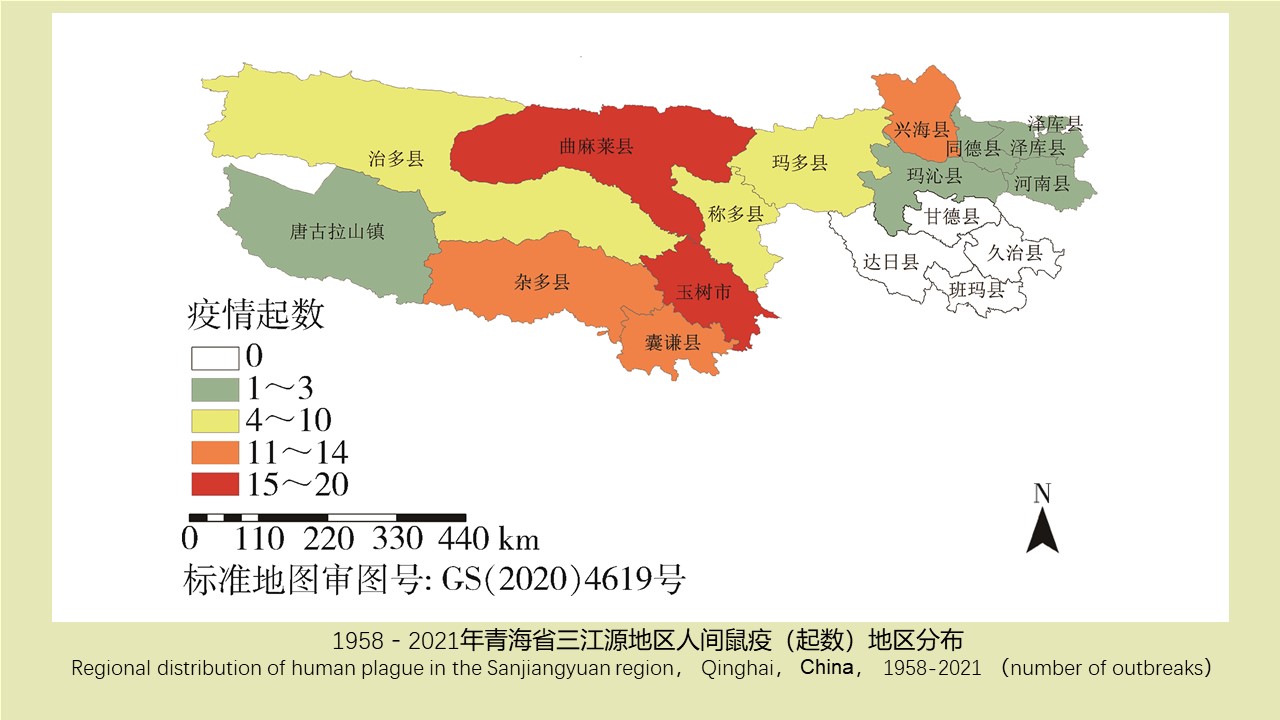
Objective To analyze the situation and characteristics of human plague epidemics in the Sanjiangyuan region, Qinghai province, China from 1958 to 2021, and to provide a scientific basis for formulating practical preventive measures against plague. Methods The data on human plague cases in the Sanjiangyuan region were collected from the human plague database of Qinghai Institute for Endemic Disease Control and Prevention. With Excel 2010, SPSS 26.0, and ArcMap 10.2 softwares, descriptive epidemiological methods were used to analyze the annual change, epidemic trend, seasonal distribution, regional distribution, population distribution, source of infection, route of transmission, and type of human plague in the Sanjiangyuan region. Results From 1958 to 2021, there were a total of 90 human plague epidemics in the Sanjiangyuan region, involving 253 cases and 138 deaths, with a mortality rate of 54.55% (138/253). There were 164 males and 89 females in all cases. Excluding four cases of unknown age, among the remaining 249 cases, young adults aged 16-30 years accounted for the highest proportion, which was 39.76% (99/249). The majority of the cases were Tibetan (205 cases). In occupational distribution, pastoralists accounted for 80.20% of the total cases. Human plague occurred during May to November, peaking in August. In the past 64 years of the Sanjiangyuan region, the situation of human plague was most serious in Yushu Tibetan Autonomous Prefecture, where Qumalai county had 15 outbreaks (48 cases), Yushu city had 15 outbreaks (41 cases), and Nangqian county had 12 outbreaks (37 cases). First cases were mainly caused by exposure to marmot infection through butchering and eating, followed by flea bites. Most first cases were bubonic plague (71 cases). Among all cases, pneumonic plague was the most common type, involving 161 cases (128 primary and 33 secondary cases). Conclusion The human plague situation in the Sanjiangyuan region remains unfavorable, which requires multiple preventive measures to effectively control human plague epidemics.
[1] 王丽,李超,杨永海,等. 青海"三江源"地区鼠疫血清流行病学调查分析[J]. 中国病原生物学杂志,2008,3(6):462-463. DOI:10.13350/j.cjpb.2008.06.024. Wang L,Li C,Yang YH,et al. Seroepidemiology analysis of plague in "Three River Sources" area of Qinghai,China[J]. J Pathog Biol,2008,3(6):462-463. DOI:10.13350/j.cjpb.2008. 06.024.(in Chinese)
[2] 王雪,李千,魏有文,等. 1996-2015年青海省三江源地区鼠疫流行病学分析[J]. 中国人兽共患病学报,2017,33(2):178-183. DOI:10.3969/j.issn.1002-2694.2017.02.016. Wang X,Li Q,Wei YW,et al. Plague epidemiology in the Three Rivers Source Region,Qinghai province,China,1996 to 2015[J]. Chin J Zoonoses,2017,33(2):178-183. DOI:10.3969/j.issn.1002-2694.2017.02.016.(in Chinese)
[3] 王兆芬,赵霞,王祖郧,等. 青海省人间鼠疫流行特点分析[J]. 中国地方病防治杂志,2015,30(2):84-86. Wang ZF,Zhao X,Wang ZY,et al. Epidemic features of human plague in Qinghai province[J]. Chin J Ctrl Endem Dis,2015,30(2):84-86. (in Chinese)
[4] 宋成玺,王元甲,熊浩明,等. 2004-2013年青海省玉树州鼠疫流行病学特征分析[J]. 中华地方病学杂志,2016,35(4):296-298. DOI:10.3760/cma.j.issn.2095-4255.2016.04.016. Song CX,Wang YJ,Xiong HM,et al. Epidemic characteristics of the plague in Yushu Tibetan Autonomous Prefecture of Qinghai province from 2004 to 2013[J]. Chin J Endemiol,2016,35(4):296-298. DOI:10.3760/cma.j.issn.2095-4255.2016.04.016.(in Chinese)
[5] 熊浩明,杨晓艳,何建,等. 玉树藏族自治州藏系绵羊鼠疫生态流行病学特征分析[J]. 中国病原生物学杂志,2016,11(10):893-896. DOI:10.13350/j.cjpb.161006. Xiong HM,Yang XY,He J,et al. A study on the ecological epidemiology of the Tibetan sheep plague in Yushu,Qinghai[J]. J Pathog Biol,2016,11(10):893-896. DOI:10.13350/j.cjpb. 161006.(in Chinese)
[6] 郑谊,张爱萍,李千,等. 青海省人间鼠疫流行病学分析[J]. 首都公共卫生,2017,11(2):50-52. DOI:10.16760/j.cnki.sdggws. 2017.02.002. Zheng Y,Zhang AP,Li Q,et al. Epidemiological characteristics of human plague in Qinghai province[J]. Cap J Public Health,2017,11(2):50-52. DOI:10.16760/j.cnki.sdggws.2017.02.002.(in Chinese)
[7] 郑谊,李超,魏绍振,等. 青海省三江源自然保护区蚤类区系分布[J]. 中国媒介生物学及控制杂志,2010,21(2):124-127. Zheng Y,Li C,Wei SZ,et al. Flea fauna and distribution in Three Rivers' Headwaters Nature Reserve in Qinghai province[J]. Chin J Vector Biol Control,2010,21(2):124-127. (in Chinese)
[8] 罗军,宋志忠,郑谊. 青海省三江源地区2012年鼠形动物及寄生蚤调查[J]. 中国媒介生物学及控制杂志,2014,25(4):361-363,366. DOI:10.11853/j.issn.1003.4692.2014.04.022. Luo J,Song ZZ,Zheng Y. Survey on wild rodents and their parasitic fleas in Three Rivers Headwaters region of Qinghai,China in 2012[J]. Chin J Vector Biol Control,2014,25(4):361-363,366. DOI:10.11853/j.issn.1003.4692.2014.04.022.(in Chinese)
[9] 甄雪刚. 三江源国家公园运行体系构建的影响因素分析[J]. 改革与开放,2017(6):23-24. DOI:10.16653/j.cnki.32-1034/f.2017.06.010. Zhen XG. Analysis of influencing factors in the construction of operation system of Three-River-Source National Park[J]. Reform Openning,2017(6):23-24. DOI:10.16653/j.cnki.32-1034/f.2017.06.010.(in Chinese)
[10] 张爱萍,魏荣杰,熊浩明,等. 气候因素对鼠疫分布影响的研究进展[J]. 中华预防医学杂志,2016,50(5):459-462. DOI:10.3760/cma.j.issn.0253-9624.2016.05.015. Zhang AP,Wei RJ,Xiong HM,et al. Advance to the research of the climate factor effect on the distribution of plague[J]. Chin J Prev Med,2016,50(5):459-462. DOI:10.3760/cma.j.issn.0253-9624.2016.05.015.(in Chinese)
[11] Xu L,Stige LC,Leirs H,et al. Historical and genomic data reveal the influencing factors on global transmission velocity of plague during the Third Pandemic[J]. Proc Natl Acad Sci USA,2019,116(24):11833-11838. DOI:10.1073/pnas.1901366116.
[12] 孟宪红,陈昊,李照国,等. 三江源区气候变化及其环境影响研究综述[J]. 高原气象,2020,39(6):1133-1143. DOI:10.7522/j.issn.1000-0534.2019.00144. Meng XH,Chen H,Li ZG,et al. Review of climate change and its environmental influence on the Three-River regions[J]. Plateau Meteor,2020,39(6):1133-1143. DOI:10.7522/j.issn.1000-0534.2019.00144.(in Chinese)
[13] 徐丹丹,尹家祥. 气候变化对鼠疫流行的影响[J]. 热带医学杂志,2018,18(1):111-113,121. DOI:10.3969/j.issn.1672-3619. 2018.01.030. Xu DD,Yin JX. Impact of climate change on the epidemic of plague[J]. J Trop Med,2018,18(1):111-113,121. DOI:10.3969/j.issn.1672-3619.2018.01.030.(in Chinese)
[14] 王梦迪,周芸,徐丹丹,等. 云南省玉龙鼠疫疫源地野外鼠形动物寄生蚤丰盛度影响因素分析[J]. 昆虫学报,2019,62(9):1109-1116. DOI:10.16380/j.kcxb.2019.09.012. Wang MD,Zhou Y,Xu DD,et al. Analysis of factors affecting the abundance of parasitic fleas on wild myomorph rodents in the Yulong plague focus of Yunnan province,southwestern China[J]. Acta Entomol Sin,2019,62(9):1109-1116. DOI:10.16380/j.kcxb.2019.09.012.(in Chinese)
[15] Russell RE,Abbott RC,Tripp DW,et al. Local factors associated with on-host flea distributions on prairie dog colonies[J]. Ecol Evol,2018,8(17):8951-8972. DOI:10.1002/ece3.4390.
[16] Hammond TT,Hendrickson CI,Maxwell TL,et al. Host biology and environmental variables differentially predict flea abundances for two rodent hosts in a plague-relevant system[J]. Int J Parasitol:Parasites Wildl,2019,9:174-183. DOI:10.1016/j.ijppaw.2019.04.011.
[17] 刘起勇. 气候变化对中国媒介生物传染病的影响及应对:重大研究发现及未来研究建议[J]. 中国媒介生物学及控制杂志,2021,32(1):1-11. DOI:10.11853/j.issn.1003.8280.2021. 01.001. Liu QY. Impact of climate change on vector-borne diseases and related response strategies in China:Major research findings and recommendations for future research[J]. Chin J Vector Biol Control,2021,32(1):1-11. DOI:10.11853/j.issn.1003.8280. 2021.01.001.(in Chinese)
[18] 王芝兰,张飞民,王澄海,等. 1980-2019年青藏高原积雪深度时空差异性分析[J]. 冰川冻土,2022,44(3):810-821. Wang ZL,Zhang FM,Wang CH,et al. Analysis on spatial and temporal difference of snow depth over the Tibetan Plateau from 1980 to 2019[J]. J Glaciol Geocryol,2022,44(3):810-821. (in Chinese)
[19] Sun Z,Xu L,Schmid BV,et al. Human plague system associated with rodent diversity and other environmental factors[J]. Roy Soc Open Sci,2019,6(6):190216. DOI:10.1098/rsos.190216.
[20] 郭文涛,加洛,冯建萍,等. 青海省旅游与鼠疫防控措施探讨[J]. 中国媒介生物学及控制杂志,2020,31(5):630-632. DOI:10.11853/j.issn.1003.8280.2020.05.026. Guo WT,Jia L,Feng JP,et al. Discussion on Qinghai tourism and plague prevention and control[J]. Chin J Vector Biol Control,2020,31(5):630-632. DOI:10.11853/j.issn.1003.8280.2020. 05.026.(in Chinese)

