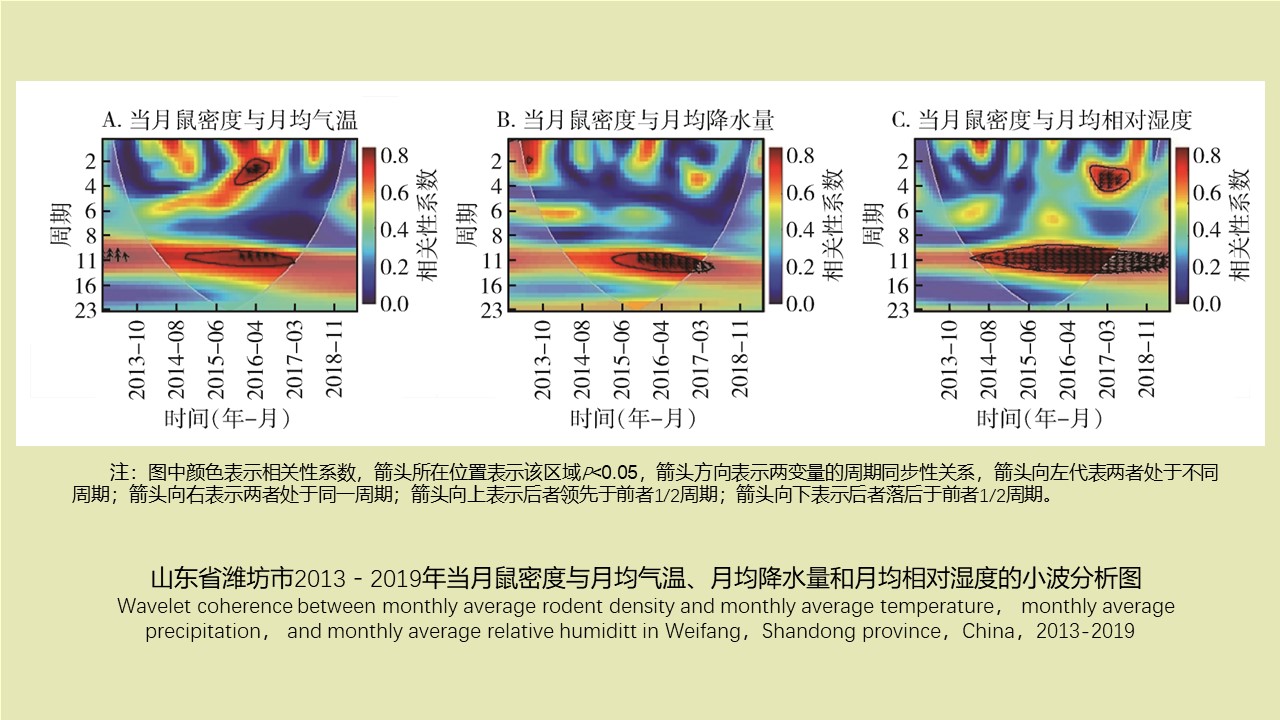
Objective To analyze ecological characteristics of rodents of rodent population density, seasonal fluctuation, interannual variation and habitat differences, and their correlation with meteorological factors by rodent monitoring data of 2013-2019 in Weifang, Shandong province, China, and to provide a scientific basis for effective prevention and control of rodent-borne diseases in Weifang. Methods The rodent density was monitored monthly using the night trapping method in selected urban residential areas, special industries, and rural villages across Weifang. SPSS 26.0 and R 4.2.1 were used for statistical analysis. Results A total of 301 rodents were captured in Weifang from 2013 to 2019. Rattus norvegicus was the dominant species, accounting for 61.13% of the total catches, and Mus musculus accounted for 35.22%, with an overall rodent density of 0.64%. Among the three habitats, rodents were more frequently captured in rural villages, accounting for 54.49% of the total catches. The rodent density peaked during January to March in each year, and the densities of R. norvegicus and M. musculus peaked in February. The wavelet analysis showed that monthly rodent density had wavelet correlations with monthly average temperature, monthly average precipitation, and monthly average relative humidity, with a negative correlation with monthly average relative humidity. Conclusion Rodent control measures should be based on the inhabiting habits and activity patterns of different rodent species, to effectively reduce rodent density and control rodent-borne diseases.
WANG Hong-yu, ZHAO Wan-ying, SHI Hao-ning, YANG Yan-qing, HUO Xi-yuan, LIU Guo-jun, HOU Xiang, TANG Yun-feng, LI Jing
. Ecological characteristics of rodents and their correlation with meteorological factors in Weifang, Shandong province, 2013-2019[J]. Chinese Journal of Vector Biology and Control, 2022
, 33(6)
: 834
-837
.
DOI: 10.11853/j.issn.1003.8280.2022.06.013
[1] 秦彩明,刘芸,姚文清,等. 辽宁省国家监测点肾综合征出血热监测分析[J]. 疾病监测,2007,22(3):162-164. DOI:10.3784/j.issn.1003-9961.2007.03.008. Qin CM,Liu Y,Yao WQ,et al. Study on the surveillance of hemorrhagic fever with renal syndrome in national surveillance sites in Liaoning[J]. Dis Surveill,2007,22(3):162-164. DOI:10.3784/j.issn.1003-9961.2007.03.008.(in Chinese)
[2] 周健,郭雪艳,孙琳,等. 潍坊市肾综合征出血热流行规律及发病特征分析[J]. 现代预防医学,2015,42(21):3999-4001,4021. Zhou J,Guo XY,Sun L,et al. Analysis on the epidemiological rule and incidence characteristics of hemorrhagic fever of renal syndrome (HFRS),Weifang city[J]. Mod Prev Med,2015,42(21):3999-4001,4021. (in Chinese)
[3] 李贵昌,王玉姣,鲁亮,等. 2019年全国鼠类监测报告[J]. 中国媒介生物学及控制杂志,2020,31(4):389-394. Li GC,Wang YJ,Lu L,et al. National surveillance report on rodents in China,2019[J]. Chin J Vector Biol Control,2020,31(4):389-394. (in Chinese)
[4] 霍锡元,宋明明,孙坚毅,等. 潍坊市2012-2015年鼠密度监测分析[J]. 中华卫生杀虫药械,2016,22(5):483-484. DOI:10.19821/j.1671-2781.2016.05.021. Huo XY,Song MM,Sun JY,et al. Rodent surveillance from 2012 to 2015 in Weifang city[J]. Chin J Hyg Insect Equip,2016,22(5):483-484. DOI:10.19821/j.1671-2781.2016.05.021.(in Chinese)
[5] 王学军,孙钦同,韩英男,等. 2010-2018年山东省国家级鼠类监测点监测报告[J]. 中国媒介生物学及控制杂志,2020,31(3):300-304. DOI:10.11853/j.issn.1003.8280.2020.03.011. Wang XJ,Sun QT,Han YN,et al. Surveillance report of national rodent surveillance sites in Shandong province,China,2010-2018[J]. Chin J Vector Biol Control,2020,31(3):300-304. DOI:10.11853/j.issn.1003.8280.2020.03.011.(in Chinese)
[6] 王纯玉,张家勇,白玉银,等. 辽宁省2020年主要病媒生物监测结果分析[J]. 中国媒介生物学及控制杂志,2022,33(1):76-82. DOI:10.11853/j.issn.1003.8280.2022.01.014. Wang CY,Zhang JY,Bai YY,et al. Surveillance results of the main vectors in Liaoning province of China in 2020[J]. Chin J Vector Biol Control,2022,33(1):76-82. DOI:10.11853/j.issn.1003.8280.2022.01.014.(in Chinese)
[7] 李广帅,庞松涛,雷晓岗,等. 西安市2015-2018年鼠类监测结果分析[J]. 中国媒介生物学及控制杂志,2020,31(3):373-375. DOI:10.11853/j.issn.1003.8280.2020.03.027. Li GS,Pang ST,Lei XG,et al. An analysis of the rodent surveillance results in Xi'an,China,2015-2018[J]. Chin J Vector Biol Control,2020,31(3):373-375. DOI:10.11853/j.issn.1003.8280.2020.03.027.(in Chinese)
[8] 李旭龙,杨培荣,张宝芳,等. 宝鸡市2012-2018年鼠密度监测[J]. 中华卫生杀虫药械,2019,25(5):445-448. DOI:10.19821/j.1671-2781.2019.05.014. Li XL,Yang PR,Zhang BF,et al. Monitoring of rodent density in Baoji city from 2012 to 2018[J]. Chin J Hyg Insect Equip,2019,25(5):445-448. DOI:10.19821/j.1671-2781.2019.05.014.(in Chinese)
[9] 张家林. 安徽省鼠类密度及种群结构分析[J]. 中华卫生杀虫药械,2021,27(2):132-135. DOI:10.19821/j.1671-2781.2021. 02.011. Zhang JL. Analysis of rodent density and constituent in Anhui province[J]. Chin J Hyg Insect Equip,2021,27(2):132-135. DOI:10.19821/j.1671-2781.2021.02.011.(in Chinese)
[10] 司晓艳,白国辉,宋利桃,等. 内蒙古自治区人居环境2017-2019年鼠类监测数据分析[J]. 中国媒介生物学及控制杂志,2021,32(5):586-589. DOI:10.11853/j.issn.1003.8280.2021. 05.015. Si XY,Bai GH,Song LT,et al. An analysis of rodent surveillance data in human settlements of Inner Mongolia,China,in 2017-2019[J]. Chin J Vector Biol Control,2021,32(5):586-589. DOI:10.11853/j.issn.1003.8280.2021.05.015. (in Chinese)
[11] 张雨,郑方,谢秀美,等. 2011-2018年上海市奉贤区鼠类监测资料分析[J]. 中华卫生杀虫药械,2021,27(1):26-29. DOI:10.19821/j.1671-2781.2021.01.007. Zhang Y,Zheng F,Xie XM,et al. Analysis of rodent surveillance data in Fengxian district of Shanghai from 2011 to 2018[J]. Chin J Hyg Insect Equip,2021,27(1):26-29. DOI:10.19821/j.1671-2781.2021.01.007.(in Chinese)

