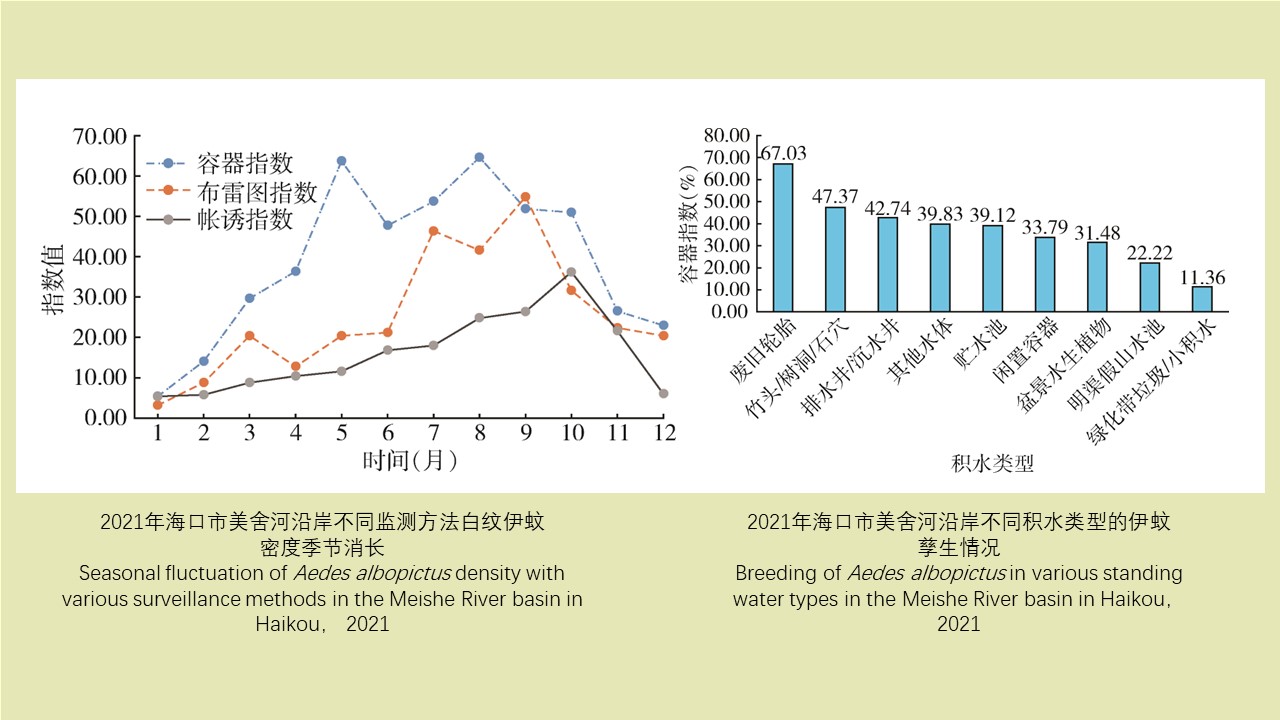
Objective To investigate the density changes of larvae and adults of dengue vector Aedes albopictus in the Meishe River basin in Haikou, Hainan province, China, and to provide scientific suggestions for the prevention and control measures of dengue fever. Methods Five surveillance sites were selected from densely populated regions of the Meishe River basin in Haikou. The Breteau index (BI) method and the double-layered mosquito net method were used to monitor the dengue vector Ae. albopictus throughout the year of 2021. WPS 2020 software was used to summarize and collate the surveillance results. SPSS 17.0 software was used to analyze the correlation between BI, container index (CI), and net trap index. The Chi-square test was used for comparison of rates. Results The mean BI was 25.33 and CI was 38.31% in 2021. There was a statistical difference in CI between the five surveillance sites (χ2=45.911, P<0.001). The net trap index of adult Ae. albopictus was 15.98 mosquitoes/net·hour. The density of mosquitoes in different habitats was in the following order: rural-urban fringe areas>residential areas>parks. The peak of Ae. albopictus density occurred from May to November. BI reached its peak in September, and the density of adult mosquitoes reached its peak in October. BI was positively correlated with CI and net trap index in the same period (r=0.720, P=0.008; r=0.709, P=0.010); CI was positively correlated with net trap index (r=0.623, P=0.030). The CI of temporary water containers and fixed water containers were 37.91% and 40.54%, respectively, with no statistical difference (χ2=0.735, P=0.391). There was a statistical difference in CI between the nine types of breeding sites (χ2=95.097, P<0.001). Specifically, waste tires had the highest CI (67.03%). Conclusion The density of Ae. albopictus in the Meishe River basin is relatively high. Once dengue cases occur, there is a risk of local epidemic. Comprehensive environmental management should be strengthened to eliminate mosquito breeding sites to prevent mosquito infestation.
YANG Xin-yan, ZHONG Wen-bing, LIN Yi, CAI Fang, LIU Yi, KUANG Zhi-zheng
. Surveillance and analysis of dengue vector Aedes albopictus in the Meishe River basin in Haikou, Hainan province, China, 2021[J]. Chinese Journal of Vector Biology and Control, 2022
, 33(6)
: 823
-827
.
DOI: 10.11853/j.issn.1003.8280.2022.06.011
[1] 刘起勇. 新时代媒介生物传染病形势及防控对策[J]. 中国媒介生物学及控制杂志,2019,30(1):1-6,11. DOI:10.11853/j.issn.1003.8280.2019.01.001. Liu QY. Epidemic profile of vector-borne diseases and vector control strategies in the new era[J]. Chin J Vector Biol Control,2019,30(1):1-6,11. DOI:10.11853/j.issn.1003.8280.2019.01. 001.(in Chinese)
[2] Du J,Zhang LY,Hu XY,et al. Phylogenetic analysis of the Dengue virus strains causing the 2019 dengue fever outbreak in Hainan,China[J]. Virol Sin,2021,36:636-643. DOI:10.1007/s12250-020-00335-x.
[3] 曾小平,陈琴,林春燕. 海口市2010-2020年输入性登革热流行病学特征[J]. 中国热带医学,2021,21(9):828-832. DOI:10.13604/j.cnki.46-1064/r.2021.09.03. Zeng XP,Chen Q,Lin CY. Epidemiological characteristics of imported dengue fever in Haikou,2010-2020[J]. China Trop Med,2021,21(9):828-832. DOI:10.13604/j.cnki.46-1064/r.2021.09.03.(in Chinese)
[4] 曾小平,陈琴,王明昌,等. 海口市2019年登革热本地和输入病例流行病学特征比较[J]. 中国热带医学,2021,21(8):779-783. DOI:10.13604/j.cnki.46-1064/r.2021.08.13. Zeng XP,Chen Q,Wang MC,et al. Comparison of epidemiological characteristics of local and imported cases of dengue fever in Haikou,2019[J]. China Trop Med,2021,21(8):779-783. DOI:10.13604/j.cnki.46-1064/r.2021.08.13.(in Chinese)
[5] 雷金睿,冯勇,钱军,等. 海口城市湿地公园景观格局分析:以美舍河国家湿地公园和五源河国家湿地公园为例[J]. 湿地科学与管理,2019,15(3):53-56. DOI:10.3969/j.issn.1673-3290.2019.03.12. Lei JR,Feng Y,Qian J,et al. Landscape patterns of urban wetland parks in Haikou:A case study of Meishe River national wetland park and Wuyuan River national wetland park[J]. Wetland Sci Manage,2019,15(3):53-56. DOI:10.3969/j.issn. 1673-3290.2019.03.12.(in Chinese)
[6] 刘小波,岳玉娟,贾清臣,等. 2020-2021年我国12省份媒介伊蚊生态学调查[J]. 中国媒介生物学及控制杂志,2022,33(1):8-15. DOI:10.11853/j.issn.1003.8280.2022.01.002. Liu XB,Yue YJ,Jia QC,et al. Ecological investigation of Aedes vector in 12 provinces of China in 2020-2021[J]. Chin J Vector Biol Control,2022,33(1):8-15. DOI:10.11853/j.issn.1003. 8280.2022.01.002.(in Chinese)
[7] 朱庆,林志文,符绩超,等. 海口市登革热媒介分布与控制的研究[J]. 中国媒介生物学及控制杂志,2008,19(6):553-556. Zhu Q,Lin ZW,Fu JC,et al. Study on the distribution and control of dengue fever vector in Haikou city[J]. Chin J Vector Biol Control,2008,19(6):553-556. (in Chinese)
[8] 苏露,张子武,栾荣生,等. 2010-2012年成都市城区气象因素对白纹伊蚊密度影响研究[J]. 预防医学情报杂志,2015,31(11):859-862. Su L,Zhang ZW,Luan RS,et al. Influence of meteorological factors on Aedes albopictus density in Chengdu urban area,2010-2012[J]. J Prev Med Inf,2015,31(11):859-862. (in Chinese)
[9] 李菊林,朱国鼎,周华云,等. 不同温度下白纹伊蚊发育情况的观察[J]. 中国血吸虫病防治杂志,2015,27(1):59-61. DOI:10.16250/j.32.1374.2014078. Li JL,Zhu GD,Zhou HY,et al. Effect of different temperatures on development of Aedes albopictus[J]. Chin J Schisto Control,2015,27(1):59-61. DOI:10.16250/j.32.1374.2014078.(in Chinese)
[10] Jia PF,Chen X,Chen J,et al. How does the dengue vector mosquito Aedes albopictus respond to global warming?[J]. Parasit Vectors,2017,10(1):140. DOI:10.1186/s13071-017-2071-2.
[11] 黎祖秋,汤洪洋,屈志强,等. 2015-2018年南宁市登革热媒介伊蚊监测结果分析和登革热风险评估[J]. 应用预防医学,2018,24(6):415-420. DOI:10.3969/j.issn.1673-758X.2018.06.001. Li ZQ,Tang HY,Qu ZQ,et al. Analysis of surveillance results of dengue vector Aedes mosquitoes and assessment the risk of dengue fever in Nanning in 2015-2018[J]. Appl Prev Med,2018,24(6):415-420. DOI:10.3969/j.issn.1673-758X.2018.06.001.(in Chinese)
[12] Chen CW,Zhang HQ,Liu QY,et al. Comparison of Aedes albopictus monitoring methods and dengue risk assessment in Central China[J]. Nanosci Nanotechnol Lett,2020,12(4):446-454. DOI:10.1166/nnl.2020.3133.
[13] 江毅民,严子锵. 我国亚热带地区登革热发生机制[J]. 中国媒介生物学及控制杂志,2008,19(1):80-81. DOI:10.3969/j.issn.1003-4692.2008.01.038. Jiang YM,Yan ZQ. The mechanism of dengue fever in subtropical area in China[J]. Chin J Vector Biol Control,2008,19(1):80-81. DOI:10.3969/j.issn.1003-4692.2008.01.038.(in Chinese)
[14] Schaffner F,Mathis A. Dengue and dengue vectors in the WHO European region:Past,present,and scenarios for the future[J]. Lancet Infect Dise,2014,14(12):1271-1280.DOI:10.1016/S1473-3099(14)70834-5.

