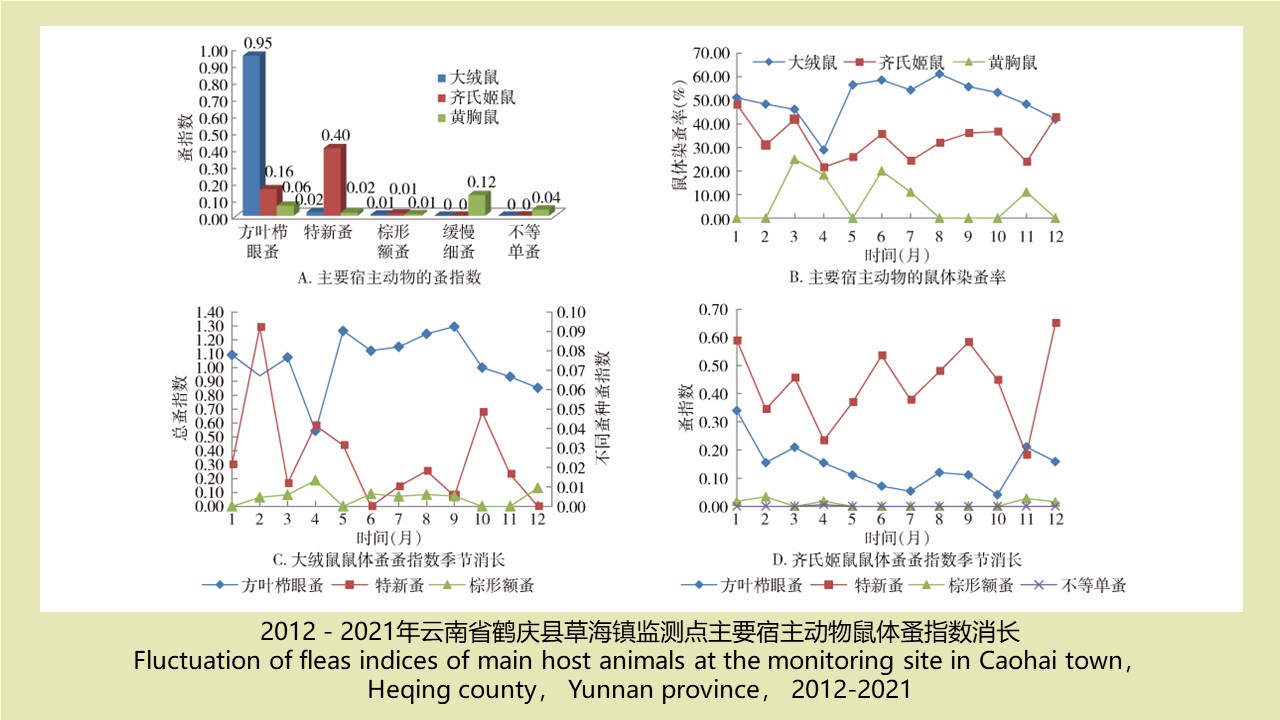
Objective To analyze the species composition, distribution, and fluctuation trend of main host animals and parasitic fleas on the body surface in an emerging field rodent plague focus in Yunnan province, China, to explore the relationship between the population ecological characteristics and the plague epidemic, and to provide a scientific basis for formulating plague prevention and control programs. Methods The surveillance data of plague hosts and vector fleas were collected at the monitoring site in Machang Village Committee, Heqing county, Yunnan province, 2012-2021. The descriptive statistical method was used to analyze the composition ratio and variation characteristics of the main host animals and vector fleas. Results During the survey period, 13 species of small mammals belonging to 11 genera, 6 families, 4 orders were discovered. There were 86 681 outdoor cages, and 3 618 small mammals were captured, with a capture rate of 4.17%, including 73.52% (2 660/3 618) of Eothenomys miletus and 18.71% (677/3 618) of Apodemus chevrieri. The main host animals and dominant species were E. miletus and A. chevrieri. A total of 3 082 fleas were discovered in 7 species belonging to 7 genera, 4 families. A total of 3 010 fleas were collected on the body surface of E. miletus and A. chevrieri, including 87.87% (2 645/3 010) of Ctenophthalmus quadratus, 11.20% (337/3 010) of Neopsylla specialis and 0.86% (26/3 010) of Frontopsylla spadix. N. specialis and F. spadix were the main vector fleas, and C. quadratus were the dominant species and the secondary vector fleas. Conclusion In the emerging plague focus in Heqing county, the population ecological characteristics of main host animals and vector fleas, such as the composition and fluctuation trend, were closely related to the plague epidemic. It is of great significance for the prediction and early warning of plague epidemic by monitoring and analyzing the population ecological characteristics of main host animals and vector fleas.
DUAN Biao, ZHANG Xue-hua, ZHAO Cai-feng, HONG Mei, SU Li-qiong, YANG Zhi-ming, PU Dan-ya
. Species composition and population ecological characteristics of main host animals and vector fleas in an emerging field rodent plague focus in Yunnan province, China[J]. Chinese Journal of Vector Biology and Control, 2022
, 33(6)
: 809
-814
.
DOI: 10.11853/j.issn.1003.8280.2022.06.008
[1] Qian Q,Zhao J,Fang LQ,et al. Mapping risk of plague in Qinghai-Tibetan Plateau,China[J]. BMC Infect Dis,2014,14:382. DOI:10.1186/1471-2334-14-382.
[2] 宋志忠,夏连续,梁云,等. 云南玉龙及古城区鼠疫自然疫源地判定及初步研究[J]. 中国地方病防治杂志,2008,23(1):3-7. DOI:10.3969/j.issn.1001-1889.2008.01.002. Song ZZ,Xia LX,Liang Y,et al. Confirmation and study of plague natural foci for Yulong county and Guchengqu in Yunnan province[J]. Chin J Ctrl Endem Dis,2008,23(1):3-7. DOI:10.3969/j.issn.1001-1889.2008.01.002.(in Chinese)
[3] Liang SY,Linthicum KJ,Gaydos JC. Climate change and the monitoring of vector-borne disease[J]. JAMA,2002,287(17):2286. DOI:10.1001/jama.287.17.2286-JMS0501-5-1.
[4] Patz JA,Frumkin H,Holloway T,et al. Climate change:Challenges and opportunities for global health[J]. JAMA,2014,312(15):1565-1580. DOI:10.1001/jama.2014.13186.
[5] Woodward A,Smith KR,Campbell-Lendrum D,et al. Climate change and health:On the latest IPCC report[J]. Lancet,2014,383(9924):1185-1189. DOI:10.1016/S0140-6736(14)60576-6.
[6] Xu L,Liu QY,Stige LC,et al. Nonlinear effect of climate on plague during the third pandemic in China[J]. Proc Natl Acad Sci USA,2011,108(25):10214-10219. DOI:10.1073/pnas. 1019486108.
[7] Xiang JJ,Hansen A,Liu QY,et al. Impact of meteorological factors on hemorrhagic fever with renal syndrome in 19 cities in China,2005-2014[J]. Sci Total Environ,2018,636:1249-1256. DOI:10.1016/j.scitotenv.2018.04.407.
[8] Liu QY,Xu WB,Lu S,et al. Landscape of emerging and re-emerging infectious diseases in China:Impact of ecology,climate,and behavior[J]. Front Med,2018,12(1):3-22. DOI:10.1007/s11684-017-0605-9.
[9] 俞东征. 鼠疫动物流行病学[M]. 北京:科学出版社,2009:28-85. Yu DZ. Epizootiology of plague[M]. Beijing:Science Press,2009:28-85. (in Chinese)
[10] 叶超,古丽阿依·包开西,柳园园,等. 准噶尔盆地鼠疫自然疫源地东部区域大沙鼠体蚤群落结构分析[J]. 疾病预防控制通报,2017,32(3):1-4. DOI:10.13215/j.cnki.jbyfkztb.1703015. Ye C,Baokaixi G,Liu YY,et al. Community structure of parasitic fleas on Rhombomys opimus in eastern area of the Junggar Basin plague focus[J]. Bull Dis Control Prev,2017,32(3):1-4. DOI:10.13215/j.cnki.jbyfkztb.1703015.(in Chinese)
[11] 王鼎盛,徐大琴,格鹏飞,等. 阿拉善黄鼠寄生蚤数量与宿主数量和气象因素的关系[J]. 中华地方病学杂志,2018,37(12):965-968. DOI:10.3760/cma.j.issn.2095-4255.2018.12.004. Wang DS,Xu DQ,Ge PF,et al. The relationship between fleas density of Spermophilus alaschanicue and host density and meteorological factors[J]. Chin J Endemiol,2018,37(12):965-968. DOI:10.3760/cma.j.issn.2095-4255.2018.12.004.(in Chinese)
[12] 闫东,史献明,王再山,等. 河北省鼠疫疫源地宿主动物种群结构研究[J]. 中华卫生杀虫药械,2016,22(4):381-384. DOI:10.19821/j.1671-2781.2016.04.024. Yan D,Shi XM,Wang ZS,et al. Research on the population structure of plague host animals in plague foci in Hebei province[J]. Chin J Hyg Insect Equip,2016,22(4):381-384. DOI:10.19821/j.1671-2781.2016.04.024.(in Chinese)
[13] 张涛,李丽,卢世堂,等. 甘宁黄土高原鼠疫自然疫源地50年防控概述[J]. 疾病预防控制通报,2014,29(2):4-6. DOI:10.13215/j.cnki.jbyfkztb.1309018. Zhang T,Li L,Lu ST,et al. Overview of prevention and control in Loess Plateau plague natural foci in Gansu and Ningxia for 50 years[J]. Bull Dis Control Prev,2014,29(2):4-6. DOI:10.13215/j.cnki.jbyfkztb.1309018.(in Chinese)
[14] 李胜,杨建国,冯建萍,等. 青海省2006-2015年鼠疫流行病学分析[J]. 中国地方病防治杂志,2016,31(10):1095-1096. Li S,Yang JG,Feng JP,et al. Epidemiological analysis on plague in Qinghai province from 2006 to 2015[J]. Chin J Ctrl Endem Dis,2016,31(10):1095-1096. (in Chinese)
[15] 张渝疆,阿布力克木,王诚,等. 新疆维吾尔自治区准噶尔盆地2007-2016年鼠疫流行态势分析[J]. 中华流行病学杂志,2017,38(10):1394-1398. DOI:10.3760/cma.j.issn.0254-6450. 2017.10.020. Zhang YJ,Abulikemu,Wang C,et al. Epidemics and risk factors of plague in Junggar Basin,Xinjiang Uygur Autonomous Region,2007-2016[J]. Chin J Epidemiol,2017,38(10):1394-1398. DOI:10.3760/cma.j.issn.0254-6450.2017.10.020.(in Chinese)
[16] 张家勇,丁俊,白玉银,等. 辽宁省2006-2015年鼠类密度及种群结构分析[J]. 中国媒介生物学及控制杂志,2017,28(1):51-55. DOI:10.11853/j.issn.1003.8280.2017.01.014. Zhang JY,Ding J,Bai YY,et al. Analysis of rodent density and constituent in Liaoning province,China,during 2006-2015[J]. Chin J Vector Biol Control,2017,28(1):51-55. DOI:10.11853/j.issn.1003.8280.2017.01.014.(in Chinese)

