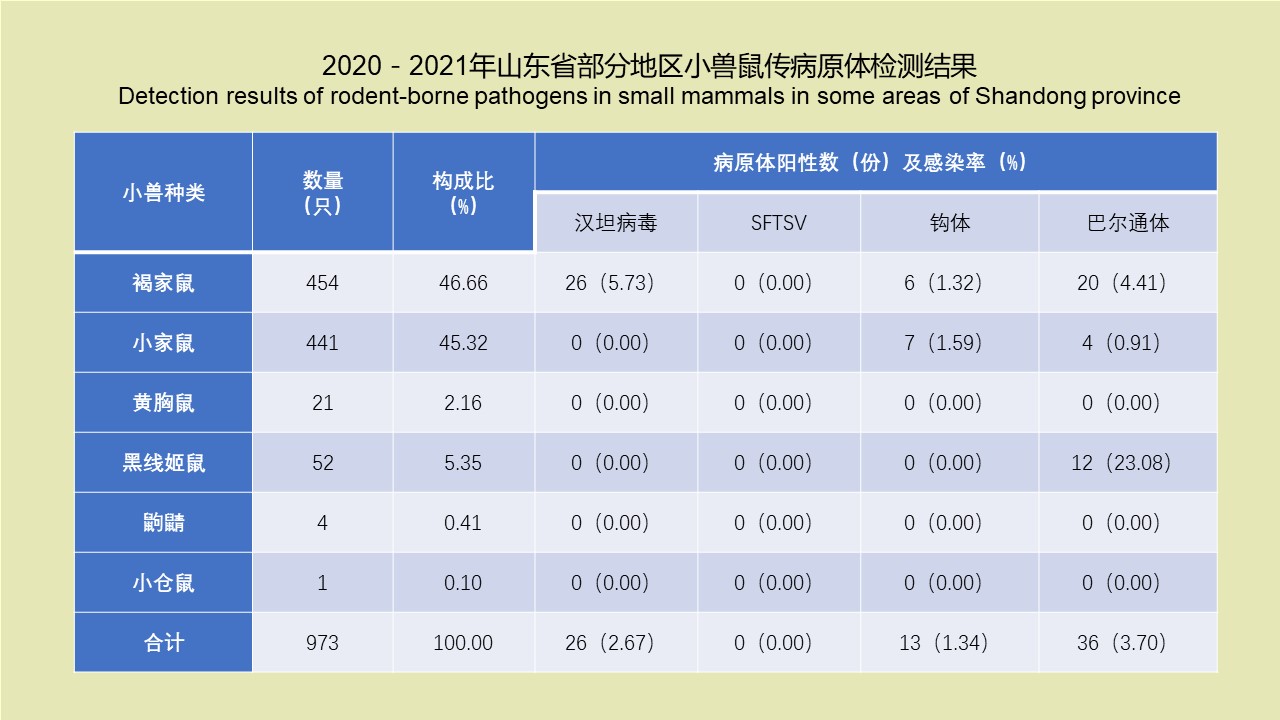
Objective To investigate the prevalence of 4 rodent-borne pathogens in small mammals in some areas of Shandong province, China, and to provide a scientific basis for the prevention and control of rodent-borne diseases. Methods From 2020 to 2021, small mammals’ liver, kidney, spleen, and lung samples were collected in Dongying, Weifang, Weihai, Linyi, Binzhou, and Heze of Shandong province. TaqMan fluorescent probe-based real-time polymerase chain reaction (PCR) was used to detect Leptospira and Bartonella. TaqMan fluorescent probe-based real-time reverse transcription PCR (RT-qPCR) was used to detect hantavirus and severe fever with thrombocytopenia syndrome virus (SFTSV). Excel 2016 and SPSS 20.0 softwares were used for statistical analysis. Results A total of 973 small mammals were collected, including 454 Rattus norvegicus, 441 Mus musculus, 21 R. tanezumi, 52 Apodemus agrarius, 4 Sorex spp., and 1 species of Cricetulus. The assay of lung tissues showed that 26 (2.67%) were positive for hantavirus. The assay of liver, spleen, and kidney tissues showed that 13 (1.34%) were positive for Leptospira and 36 (3.70%) were positive for Bartonella. No SFTSV was detected. The co-infection rate with hantavirus and Bartonella was 0.62% in R. norvegicus. Conclusion Small mammals in Shandong province carry a variety of pathogens including hantavirus, Leptospira, and Bartonella. It is necessary to strengthen the rodent-borne pathogen surveillance in small mammals and optimize the prevention and control of rodent-borne diseases to reduce the risk of human infection.
[1] 赵玉强,程鹏,公茂庆,等. 鼠传播疾病及鼠类的防制概述[J]. 中国病原生物学杂志,2010,5(5):378-380. DOI:10.13350/j.cjpb.2010.05.005. Zhao YQ,Cheng P,Gong MQ,et al. Summary of mouse-spread diseases and measures to control them[J]. J Parasit Biol,2010,5(5):378-380. DOI:10.13350/j.cjpb.2010.05.005.(in Chinese)
[2] 康殿民,王志强,王雨露,等. 啮齿类宿主动物与人感染汉坦病毒相关性[J]. 中国公共卫生,2005,21(11):1348-1349. DOI:10.3321/j.issn:1001-0580.2005.11.031. Kang DM,Wang ZQ,Wang YL,et al. Study on Hantavirus infection in rodents and people and their relationship in Shandong province[J]. Chin J Public Health,2005,21(11):1348-1349. DOI:10.3321/j.issn:1001-0580.2005.11.031.(in Chinese)
[3] 王丽娟,崔嵩,陈志林,等. 山东省1964-2006年钩端螺旋体病流行病学分析[J]. 中国公共卫生,2007,23(9):1100-1101. DOI:10.11847/zgggws2007-23-09-37. Wang LJ,Cui S,Chen ZL,et al. Epidemiological analysis on leptospirosis from 1964 to 2006 in Shandong province[J]. Chin J Public Health,2007,23(9):1100-1101. DOI:10.11847/zgggws 2007-23-09-37.(in Chinese)
[4] 栗冬梅,孟凤霞,秦增军,等. 山东省家猫检出汉赛巴尔通体[J]. 中国媒介生物学及控制杂志,2005,16(6):452. DOI:10.3969/j.issn.1003-4692.2005.06.023. Li DM,Meng FX,Qin ZJ,et al. Bartonella henselae was detected in domestic cats in Shandong province[J]. Chin J Vector Biol Control,2005,16(6):452. DOI:10.3969/j.issn.1003-4692. 2005.06.023.(in Chinese)
[5] 杨小冉,刘起勇,崔步云,等. 河南、山东部分地区家猫汉赛巴尔通体感染情况调查[J]. 疾病监测,2007,22(8):544-546. DOI:10.3784/j.issn.1003-9961.2007.08.015. Yang XR,Liu QY,Cui BY,et al. Investigation on the Bartonella henselae infection of domestic cats in some regions of Henan and Shandong provinces of China[J]. Dis Surveill,2007,22(8):544-546. DOI:10.3784/j.issn.1003-9961.2007.08.015.(in Chinese)
[6] 栗冬梅,孟凤霞,宋秀平,等. 从山东省家犬血液中分离出致病性巴尔通体:文森巴尔通体伯格霍夫亚种[J]. 中华流行病学杂志,2006,27(4):333-338. DOI:10.3760/j.issn:0254-6450. 2006.04.013. Li DM,Meng FX,Song XP,et al. Study on Bartonella vinsonii berkhoffii isolated from blood of native dogs in China[J]. Chin J Epidemiol,2006,27(4):333-338. DOI:10.3760/j.issn:0254-6450.2006.04.013.(in Chinese)
[7] Qin XR,Liu JW,Yu H,et al. Bartonella species detected in rodents from eastern China[J]. Vector-Borne Zoonotic Dis,2019,19(11):810-814. DOI:10.1089/vbz.2018.2410.
[8] 中国疾病预防控制中心. 全国病媒生物病原学监测方案(试行)[Z]. 北京:中国疾病预防控制中心,2020. Chinese Center for Disease Control and Prevention. National vector etiology surveillance program (Trial)[Z]. Beijing:Chinese Center for Disease Control and Prevention,2020. (in Chinese)
[9] 王学军,孙钦同,韩英男,等. 2010-2018年山东省国家级鼠类监测点监测报告[J]. 中国媒介生物学及控制杂志,2020,31(3):300-304. DOI:10.11853/j.issn.1003.8280.2020.03.011. Wang XJ,Sun QT,Han YN,et al. Surveillance report of national rodent surveillance sites in Shandong province,China,2010-2018[J]. Chin J Vector Biol Control,2020,31(3):300-304. DOI:10.11853/j.issn.1003.8280.2020.03.011.(in Chinese)
[10] 杨军,鞠文东,焦丹,等. 黑龙江省逊克县火山熔岩地区啮齿动物携带病原体调查[J]. 中国媒介生物学及控制杂志,2015,26(3):238-241. DOI:10.11853/j.issn.1003.4692.2015.03.005. Yang J,Ju WD,Jiao D,et al. Investigation on rodent-borne pathogens in volcano lava areas of Xunke county,Heilongjiang,China[J]. Chin J Vector Biol Control,2015,26(3):238-241. DOI:10.11853/j.issn.1003.4692.2015.03.005.(in Chinese)
[11] 肖方震,陈美宝,韩腾伟,等. 三明市鼠类携带蜱传病原体的混合感染研究[J]. 中国病原生物学杂志,2019,14(7):811-813,818. DOI:10.13350/j.cjpb.190714. Xiao FZ,Chen MB,Han TW,et al. Research on coinfection with multiple tick-borne pathogens in rodents in the Sanming region of Fujian province[J]. J Parasit Biol,2019,14(7):811-813,818. DOI:10.13350/j.cjpb.190714.(in Chinese)
[12] 赵怡双,吴瑜燕,周海慧,等. 浙江省台州市农村地区鼠形动物自然感染4种病原体的调查[J]. 疾病监测,2021,36(9):894-897. DOI:10.3784/jbjc.202105310292. Zhao YS,Wu YY,Zhou HH,et al. Investigation of natural infection of four pathogens in rodents in rural area of Taizhou,Zhejiang[J]. Dis Surveill,2021,36(9):894-897. DOI:10.3784/jbjc.202105310292.(in Chinese)
[13] Telfer S,Lambin X,Birtles R,et al. Species interactions in a parasite community drive infection risk in a wildlife population[J]. Science,2010,330(6001):243-246. DOI:10.1126/science. 1190333.
[14] Fang LZ,Zhao L,Wen HL,et al. Reservoir host expansion of hantavirus,China[J]. Emerg Infect Dis,2015,21(1):170-171. DOI:10.3201/eid2101.140960.
[15] 郑兆磊,王珮竹,许勤勤,等. 山东省2010-2016年肾综合征出血热流行与时空分布特征分析[J]. 中华流行病学杂志,2018,39(1):58-62. DOI:10.3760/cma.j.issn.0254-6450.2018. 01.012. Zheng ZL,Wang PZ,Xu QQ,et al. Analysis on epidemiological and temporal-spatial distribution characteristics of hemorrhagic fever with renal syndrome in Shandong province,2010-2016[J]. Chin J Epidemiol,2018,39(1):58-62. DOI:10.3760/cma.j.issn.0254-6450.2018.01.012.(in Chinese)
[16] 栗冬梅,徐兆楠,朱彩英,等. 应用TaqMan探针实时荧光定量PCR法调查北京市部分城郊区鼠传病原体流行状况[J]. 中国媒介生物学及控制杂志,2019,30(1):12-17. DOI:10.11853/j.issn.1003.8280.2019.01.003. Li DM,Xu ZN,Zhu CY,et al. An epidemiologic investigation of rodent-borne pathogens in some suburban areas of Beijing,China[J]. Chin J Vector Biol Control,2019,30(1):12-17. DOI:10.11853/j.issn.1003.8280.2019.01.003.(in Chinese)

