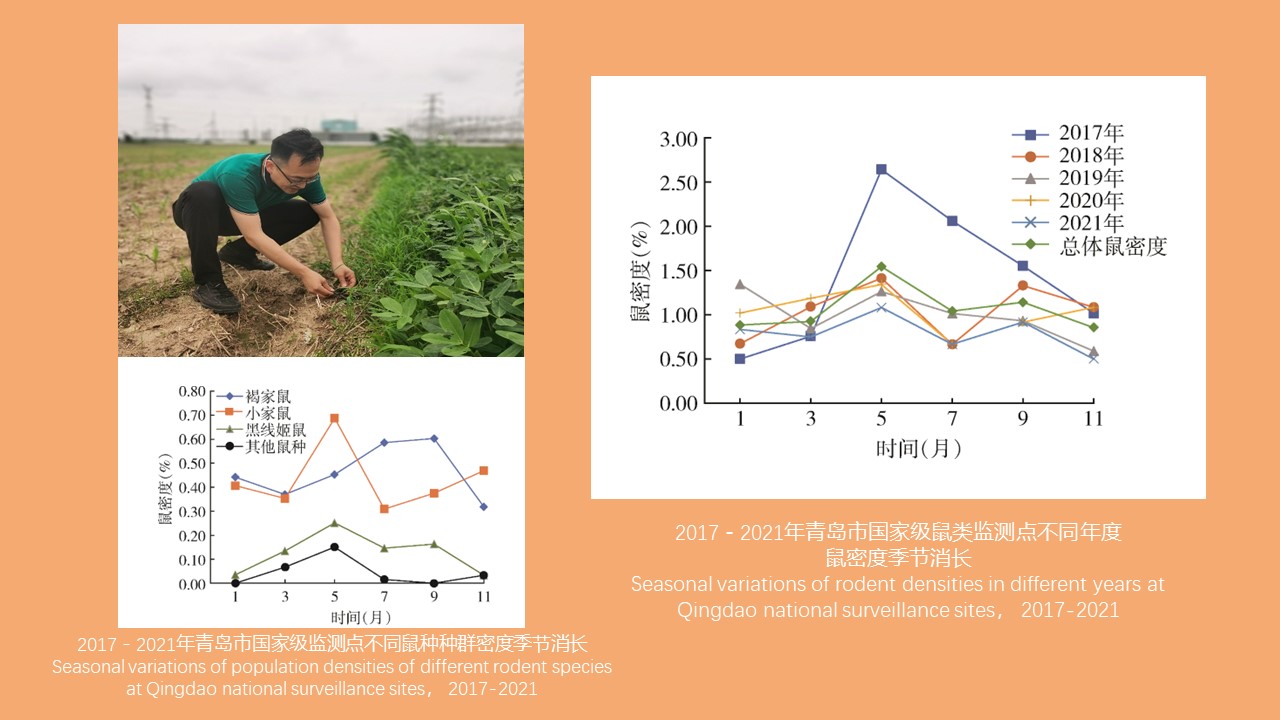
Objective To investigate the species composition,population density,habitat distribution,and seasonal variation of rodents at national surveillance sites of Qingdao,Shandong province,China,and to provide a scientific basis for rodent control.Methods From 2017 to 2021,the trap-at-night method was used to monitor rodents once every two months (in the middle period of odd months) in urban residential areas,key industry areas,and rural residential areas of Qingdao,and no less than 200 effective traps were placed at each habitats.Excel 2010 and SPSS 19.0 softwares were used for statistical analysis of surveillance data,and the Chi-square test was used for comparison of rodent density.Results A total of 382 rodents were captured from 2017 to 2021.The overall rodent density was 1.07%.Except for a slight increase in 2020,the overall rodent density showed a downward trend,with a significant difference in the rodent densities in different years (χ2=15.141, P=0.004).Rattus norvegicus,Mus musculus,and Apodemus agrarius accounted for 43.45%,40.58%,and 11.78%,respectively.The rodent density was 0.87% in urban residential areas,0.45% in key industry areas,and 1.81% in rural residential areas.The density of M.musculus was highest in urban residential areas (0.48%),while the density of R.norvegicus was highest in rural residential areas (0.79%).The rodent density in rural residential areas showed a decreasing trend,with a significant difference between different years (χ2=237.008,P<0.001).The distributions of the peak months of rodent density seasonal fluctuations in the five years slightly differed,but all with the highest peak in May.The density peaks of M.musculus and A.agrarius occurred in May,and that of R.norvegicus was in September.The rodent density peaked in May in urban residential areas,in July in key industry areas,and in May and September in rural residential areas.Conclusion R.norvegicus and M.musculus were the dominant rodent species in the residential areas and surrounding environment of national rodent surveillance sites in Qingdao from 2017 to 2021.The density of rodents peaked in May,and it was higher in rural residential areas than in the other two habitats.We recommend strengthening rodent control in key areas according to rodents'seasonal fluctuations.
[1] 赵玉强,程鹏,公茂庆,等.鼠传播疾病及鼠类的防制概述[J].中国病原生物学杂志,2010,5(5):378-380. DOI:10.13350/j.cjpb.2010.05.005. Zhao YQ,Cheng P,Gong MQ,et al. Summary of mouse-spread diseases and measures to control them[J]. J Pathog Biol,2010,5(5):378-380. DOI:10.13350/j.cjpb.2010.05.005.(in Chinese)
[2] 张永振,肖东楼,王玉,等.中国肾综合征出血热流行趋势及其防制对策[J].中华流行病学杂志,2004,25(6):466-469. DOI:10.3760/j.issn:0254-6450.2004.06.002. Zhang YZ,Xiao DL,Wang Y,et al. The epidemic characteristics and preventive measures of hemorrhagic fever with syndromes in China[J]. Chin J Epidemiol,2004,25(6):466-469. DOI:10.3760/j.issn:0254-6450.2004.06.002.(in Chinese)
[3] 中国疾病预防控制中心.全国病媒生物监测实施方案[Z].北京:中国疾病预防控制中心,2016. Chinese Center for Disease Control and Prevention. National vector surveillance implementation plan[Z]. Beijing:Chinese Center for Disease Control and Prevention,2016.(in Chinese)
[4] 王学军,孙钦同,韩英男,等. 2010-2018年山东省国家级鼠类监测点监测报告[J].中国媒介生物学及控制杂志,2020,31(3):300-304. DOI:10.11853/j.issn.1003.8280.2020.03.011. Wang XJ,Sun QT,Han YN,et al. Surveillance report of national rodent surveillance sites in Shandong province,China,2010-2018[J]. Chin J Vector Biol Control,2020,31(3):300-304. DOI:10.11853/j.issn.1003.8280.2020.03.011.(in Chinese)
[5] 李贵昌,王玉姣,鲁亮,等. 2019年全国鼠类监测报告[J].中国媒介生物学及控制杂志,2020,31(4):389-394. DOI:10. 11853/j.issn.1003.8280.2020.04.002. Li GC,Wang YJ,Lu L,et al. National surveillance report on rodents in China,2019[J]. Chin J Vector Biol Control,2020,31(4):389-394. DOI:10.11853/j.issn.1003.8280.2020.04.002.(in Chinese)
[6] 闫青芳,赵洪林,姜健康,等.山东省聊城市国家级监测点2018-2020年鼠类监测结果分析[J].中国媒介生物学及控制杂志,2022,33(1):100-103. DOI:10.11853/j.issn.1003.8280. 2022.01.018. Yan QF,Zhao HL,Jiang JK,et al. Rodent surveillance results of national surveillance sites in Liaocheng city of Shandong province,China,2018-2020[J]. Chin J Vector Biol Control,2022,33(1):100-103. DOI:10.11853/j.issn.1003.8280.2022. 01.018.(in Chinese)
[7] 赵奇,高丽君,唐振强,等.河南省鼠密度监测及季节消长[J].中华卫生杀虫药械,2015,21(4):390-392. DOI:10.19821/j.1671-2781.2015.04.021. Zhao Q,Gao LJ,Tang ZQ,et al. Seasonal fluctuation of the rodent density in Henan province[J]. Chin J Hyg Insect Equip,2015,21(4):390-392. DOI:10.19821/j.1671-2781.2015.04.021.(in Chinese)
[8] 王纯玉,张家勇,白玉银,等.辽宁省2020年主要病媒生物监测结果分析[J].中国媒介生物学及控制杂志,2022,33(1):76-82. DOI:10.11853/j.issn.1003.8280.2022.01.014. Wang CY,Zhang JY,Bai YY,et al. Surveillance results of the main vectors in Liaoning province of China in 2020[J]. Chin J Vector Biol Control,2022,33(1):76-82. DOI:10.11853/j.issn. 1003.8280.2022.01.014.(in Chinese)
[9] 闫冬明,王玉姣,李贵昌,等. 2016年全国鼠类监测报告[J].中国媒介生物学及控制杂志,2019,30(2):123-127. DOI:10.11853/j.issn.1003.8280.2019.02.002. Yan DM,Wang YJ,Li GC,et al. National vectors surveillance report on rodents in China,2016[J]. Chin J Vector Biol Control,2019,30(2):123-127. DOI:10.11853/j.issn.1003.8280.2019. 02.002.(in Chinese)
[10] 文献英,刘平,黄川,等. 2020年绵阳市城区主要病媒生物监测结果分析[J].职业与健康,2022,38(1):108-111. DOI:10. 13329/j.cnki.zyyjk.2022.0017. Wen XY,Liu P,Huang C,et al. Analysis on monitoring results of main vectors in urban areas of Mianyang city in 2020[J]. Occup Health,2022,38(1):108-111. DOI:10.13329/j.cnki.zyyjk.2022. 0017.(in Chinese)
[11] 赵怡双,吴瑜燕,周海慧,等.浙江省台州市农村地区鼠形动物自然感染4种病原体的调查[J].疾病监测,2021,36(9):894-897. DOI:10.3784/jbjc.202105310292. Zhao YS,Wu YY,Zhou HH,et al. Investigation of natural infection of four pathogens in rodents in rural area of Taizhou,Zhejiang[J]. Dis Surveill,2021,36(9):894-897. DOI:10.3784/jbjc.202105310292.(in Chinese)
[12] 白莉,赵可.我国农村环境问题现状及其治理对策[J].建设科技,2021(7):36-39. DOI:10.16116/j.cnki.jskj.2021.07.006. Bai L,Zhao K. Current situation of rural environmental problems and countermeasures in China[J]. Constr Sci Technol,2021(7):36-39. DOI:10.16116/j.cnki.jskj.2021.07.006.(in Chinese)
[13] 杨月锋,赖永波.农户储粮行为关键影响因素的作用路径分析:基于结构方程模型的实证[J].农林经济管理学报,2019,18(2):180-189. DOI:10.16195/j.cnki.cn36-1328/f.2019.02.21.(in Chinese) Yang YF,Lai YB. Acting path of key factors to farmers'grain storage behavior:Based on structural equation model[J]. J Agro-For Econ Manage,2019,18(2):180-189. DOI:10.16195/j.cnki.cn36-1328/f.2019.02.21.(in Chinese)
[14] Rodkvamtook W,Gaywee J,Kanjanavanit S,et al. Scrub typhus outbreak,Northern Thailand,2006-2007[J]. Emerg Infect Dis,2013,19(5):774-777. DOI:10.3201/eid1905.121445.
[15] 龚震宇,凌锋,侯娟,等.浙江省病媒生物监测点鼠类监测结果分析[J].疾病监测,2013,28(11):914-916. DOI:10.3784/j.issn.1003-9961.2013.11.013. Gong ZY,Ling F,Hou J,et al. Rodents surveillance in Zhejiang province[J]. Dis Surveill,2013,28(11):914-916. DOI:10.3784/j.issn.1003-9961.2013.11.013.(in Chinese)
[16] 李广帅,刘美美,庞松涛,等.西安市2015-2019年鼠密度监测结果[J].中国热带医学,2021,21(5):471-474. DOI:10. 13604/j.cnki.46-1064/r.2021.05.16. Li GS,Liu MM,Pang ST,et al. Surveillance results of rodent density in Xi'an,2015-2019[J]. China Trop Med,2021,21(5):471-474. DOI:10.13604/j.cnki.46-1064/r.2021.05.16.(in Chinese)

