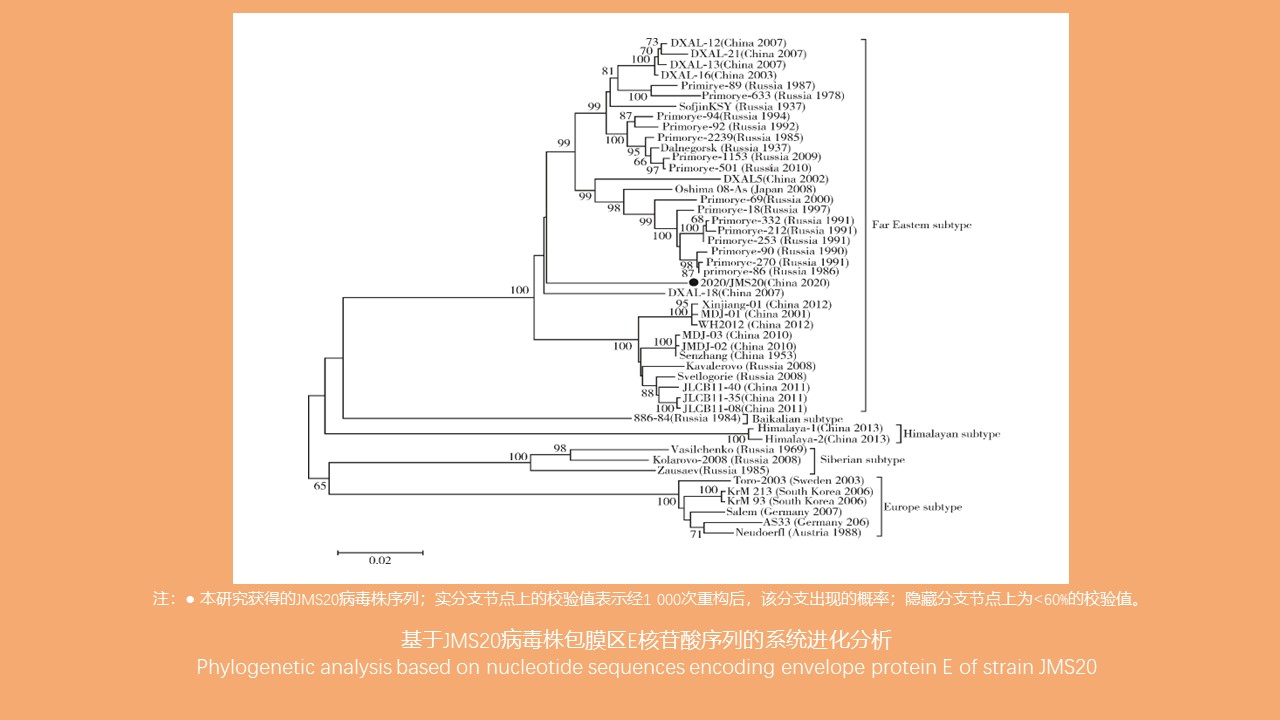
Objective To investigate the species of ticks and tick-borne viruses in Huanan county,Jiamusi city,Heilongjiang province,China.Methods Ticks were collected in Huanan in May 2020 and identified according to morphological keys.Real-time PCR was used to detect the RNA of viruses in the collected ticks,i.e.,tick-borne encephalitis virus (TBEV),severe fever with thrombocytopenia syndrome virus (SFTSV),Omsk hemorrhagic fever virus (OHFV),Langat virus (LGTV),Powassan virus (POWV),and Alongshan virus (ALSV).High-throughput sequencing was used to obtain the genome sequences of detected viruses.Results A total of 890 ticks were collected,including 475 Ixodes persulcatus(210 males and 265 females),360 Dermacentor silvarum(260 males and 100 females),and 55 Haemaphysalis concinna(5 males and 50 females).One batch of tick specimens (n=10;JMS20) was positive for TBEV,which was carried by female I. persulcatus.Other viruses were not detectable.Phylogenetic analysis showed that this TBEV strain was closely related to the Far Eastern subtype of TBEV.Conclusion Ticks in Jiamusi city still carry TBEV,and our results provide basic data for the prevention and control of tick-borne virus diseases in the region.
LI Fan, LIU Feng-ming, FENG Pan-pan, WANG Dong-qiang, FU Shi-hong, NIE Kai, YIN Qi-kai, HE Ying, YIN Jia-yu, XU Song-tao, BAO Ming-jia, WANG Huan-yu
. Investigation of tick-borne viruses in Huanan county,Heilongjiang province,China,2020[J]. Chinese Journal of Vector Biology and Control, 2022
, 33(5)
: 637
-641
.
DOI: 10.11853/j.issn.1003.8280.2022.05.005
[1] Boulanger N,Boyer P,Talagrand-Reboul E,et al. Ticks and tick-borne diseases[J]. Méd Mal Infect,2019,49(2):87-97. DOI:10.1016/j.medmal.2019.01.007.
[2] Shi JM,Hu ZH,Deng F,et al. Tick-borne viruses[J]. Virol Sin,2018,33(1):21-43. DOI:10.1007/s12250-018-0019-0.
[3] 石华,王玥,韩华,等.蜱媒疾病风险评估中标本采集方法的探讨[J].中华卫生杀虫药械,2013,19(4):308-310. DOI:10.19821/j.1671-2781.2013.04.010. Shi H,Wang Y,Han H,et al. Discussion of methods for specimen collection in the tick-borne risk evaluation[J]. Chin J Hyg Insect Equip,2013,19(4):308-310. DOI:10.19821/j.1671-2781.2013. 04.010.(in Chinese)
[4] 王倩莹,刘凤明,付士红,等.黑龙江边境地区蜱虫携带病原体调查[J].中华实验和临床病毒学杂志,2019,33(5):504-508. DOI:10.3760/cma.j.issn.1003-9279.2019.05.013. Wang QY,Liu FM,Fu SH,et al. Investigation of tick-borne pathogens in Heilongjiang border area[J]. Chin J Exp Clin Viral,2019,33(5):504-508. DOI:10.3760/cma.j.issn.1003-9279. 2019.05.013.(in Chinese)
[5] Langmead B,Salzberg SL. Fast gapped-read alignment with Bowtie 2[J]. Nat Methods,2012,9(4):357-359. DOI:10.1038/nmeth.1923.
[6] Rozewicki J,Li SL,Amada KM,et al. MAFFT-DASH:Integrated protein sequence and structural alignment[J]. Nucleic Acids Res,2019,47(W1):W5-W10. DOI:10.1093/nar/gkz342.
[7] Jia N,Wang JF,Shi WQ,et al. Large-scale comparative analyses of tick genomes elucidate their genetic diversity and vector capacities[J]. Cell,2020,182(5):1328-1340.e13. DOI:10. 1016/j.cell.2020.07.023.
[8] Varlacher JF,Hägglund S,Juremalm M,et al. Tick-borne encephalitis[J]. Rev Sci Tech,2015,34(2):453-466. DOI:10.20506/rst.34.2.2371.
[9] Chen XJ,Li F,Yin QK,et al. Epidemiology of tick-borne encephalitis in China,2007-2018[J]. PLoS One,2019,14(12):e0226712. DOI:10.1371/journal.pone.0226712.
[10] 吕志,梁国栋.中国蜱传脑炎研究进展[J].中华流行病学杂志,2009,30(6):641-643. DOI:10.3760/cma.j.issn.0254-6450. 2009.06.026. Lyu Z,Liang GD. Advances in research on tick-borne encephalitis in China[J]. Chin J Epidemiol,2009,30(6):641-643. DOI:10.3760/cma.j.issn.0254-6450.2009.06.026.(in Chinese)
[11] Dumpis U,Crook D,Oksi J. Tick-borne encephalitis[J]. Clin Infect Dis,1999,28(4):882-890. DOI:10.1086/515195.
[12] Süss J. Tick-borne encephalitis 2010:Epidemiology,risk areas,and virus strains in Europe and Asia-an overview[J]. Ticks Tick Borne Dis,2011,2(1):2-15. DOI:10.1016/j.ttbdis.2010.10.007.
[13] Xing Y,Schmitt HJ,Arguedas A,et al. Tick-borne encephalitis in China:A review of epidemiology and vaccines[J]. Vaccine,2017,35(9):1227-1237. DOI:10.1016/j.vaccine.2017.01.015.
[14] Subbotina EL,Loktev VB. Molecular evolution of the tick-borne encephalitis and Powassan viruses[J]. Mol Biol,2012,46(1):75-84. DOI:10.1134/S0026893311060148.
[15] Deviatkin AA,Karganova GG,Vakulenko YA,et al. TBEV subtyping in terms of genetic distance[J]. Viruses,2020,12(11):1240. DOI:10.3390/v12111240.
[16] Zhan JB,Wang Q,Cheng J,et al. Current status of severe fever with thrombocytopenia syndrome in China[J]. Virol Sin,2017,32(1):51-62. DOI:10.1007/s12250-016-3931-1.
[17] Wang ZD,Wang B,Wei F,et al. A new segmented virus associated with human febrile illness in China[J]. N Engl J Med,2019,380(22):2116-2125. DOI:10.1056/NEJMoa1805068.
[18] Kuivanen S,Levanov L,Kareinen L,et al. Detection of novel tick-borne pathogen,Alongshan virus,in Ixodes ricinus ticks,south-eastern Finland,2019[J]. Euro Surveill,2019,24(27):1900394. DOI:10.2807/1560-7917.ES.2019.24.27.1900394.
[19] Kholodilov IS,Litov AG,Klimentov AS,et al. Isolation and characterisation of Alongshan virus in Russia[J]. Viruses,2020,12(4):362. DOI:10.3390/v12040362.

