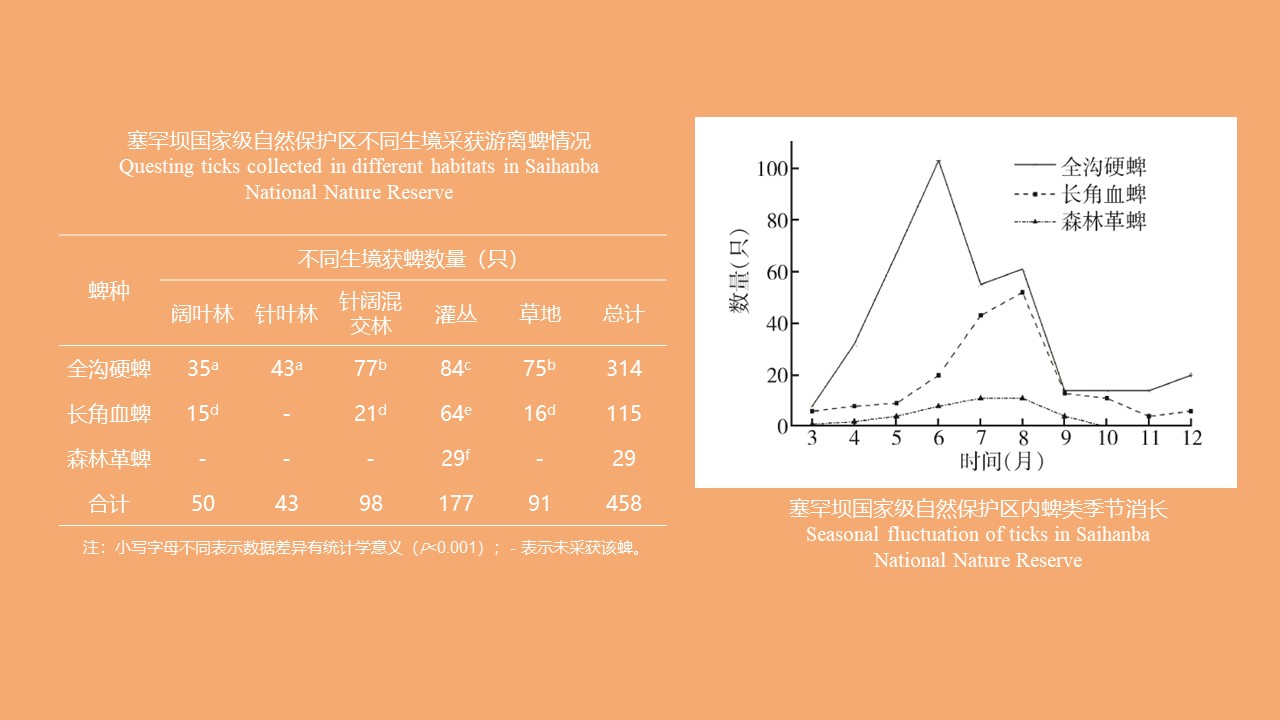
Objective To investigate the species composition,geographical distribution,and seasonal fluctuation of ticks in Saihanba National Nature Reserve (Saihanba Reserve) of Hebei Province,China,and to provide a basis for tick prevention and control.Methods From March to December 2018,questing ticks were collected by flag-dragging in different habitats in Saihanba Reserve,and parasitic ticks were captured from host animals'body surface.The species composition,distribution,and seasonal fluctuation of ticks were investigated.Excel 2010 and SPSS 21.0 softwares were used for data statistics and analysis.The number and parasitic intensity of ticks were compared between different habitats and hosts by the Chi-square test.Results A total of 601 ticks of 1 family,3 genera,and 3 species were collected;the number of Ixodes persulcatus was the most numeous,accounting for 64.56%(388/601) of the total number;Haemaphysalis longicornis accounted for 28.62%(172/601);Dermacentor silvarum was the fewest,accounting for 6.82%(41/601).A total of 458 questing ticks were collected;the number of questing ticks showed a significant difference between different habitats (χ2=96.506,P<0.001),with the most ticks collected in shrubs and grasslands,accounting for 58.52%(268/458),and the fewest ticks in needle-leaved forests,accounting for 9.39%(43/458).A total of 143 parasitic ticks were collected,with an overall infestation rate of 41.38% and a parasitic intensity of 3.97 in host animals.The number of parasitic ticks showed a significant difference between different hosts (χ2=16.106,P<0.001);the infestation rate was 46.00% in sheep and 35.14% in rodents.In Saihanba Reserve,ticks were encountered in March,and the number of ticks maintained at a high level from May to August.From October to December,the number of ticks declined sharply until disappearing.Adults of I. persulcatus showed a peak in early June,and nymphs and larvae were at their peaks in early August.Additionally,D. silvarum and H. longicornis increased to their peaks in August.There was a significant difference between different tick species (χ2=31.437,P<0.001).Conclusion There are diverse species of ticks in Saihanba Reserve,and I. persulcatus is the dominant species in this region.The distribution of ticks varies significantly in different habitats,and the questing ticks are more prevalent in shrubs and grasslands.The population of ticks reaches to its peak in summer,a tourist season of Saihanba Reserve.
[1] Dantas-Torres F. Climate change,biodiversity,ticks and tick-borne diseases:The butterfly effect[J]. Int J Parasitol:Parasit Wildl,2015,4(3):452-461. DOI:10.1016/j.ijppaw. 2015.07.001.
[2] Ramezani Z,Chavshin AR,Telmadarraiy Z,et al. Ticks (Acari:Ixodidae) of livestock and their seasonal activities,northwest of Iran[J]. Asian Pac J Trop Dis,2014,4(2):S754-757. DOI:10.1016/S2222-1808(14)60721-0.
[3] 于志军,刘书广,董娜,等.蜱类基础生物学研究进展[J].中国媒介生物学及控制杂志,2018,29(2):205-208. DOI:10.11853/j.issn.1003.8280.2018.02.025. Yu ZJ,Liu SG,Dong N,et al. Research progress on fundamental biology of ticks[J]. Chin J Vector Biol Control,2018,29(2):205-208. DOI:10.11853/j.issn.1003.8280.2018.02.025.(in Chinese)
[4] 刘吉起,赵奇,许汴利.蜱类研究进展[J].中国媒介生物学及控制杂志,2013,24(2):186-188. Liu JQ,Zhao Q,Xu BL. Progress in research on ticks[J]. Chin J Vector Biol Control,2013,24(2):186-188.(in Chinese)
[5] 周明浩,陈红娜.我国新发蜱媒病原体研究概述[J].中华卫生杀虫药械,2019,25(3):193-198. DOI:10.19821/j.1671-2781.2019.03.001. Zhou MH,Chen HN. A review on emerging tick-borne pathogens in China[J]. Chin J Hyg Insect Equip,2019,25(3):193-198. DOI:10.19821/j.1671-2781.2019.03.001.(in Chinese)
[6] Yu ZJ,Wang H,Wang TH,et al. Tick-borne pathogens and the vector potential of ticks in China[J]. Parasit Vectors,2015,8(1):24. DOI:10.1186/s13071-014-0628-x.
[7] 崔岩.塞罕坝国家森林公园观赏性树木调查与分析[J].安徽农学通报,2019,25(10):59,73. DOI:10.16377/j.cnki.issn1007-7731.2019.10.026. Cui Y. Investigation and analysis of ornamental trees in Saihanba National Forest Park[J]. Anhui Agric Sci Bull,2019,25(10):59,73. DOI:10.16377/j.cnki.issn1007-7731.2019.10.026.(in Chinese)
[8] 周磊,汤芳,栾进,等.内蒙古奇乾地区蜱携带斑点热立克次体的调查[J].中国国境卫生检疫杂志,2017,40(2):96-99. DOI:10.16408/j.1004-9770.2017.02.006. Zhou L,Tang F,Luan J,et al. Investigation on spotted fever group Rickettsiae in ticks collected from Qiqian areas of Inner Mongolia[J]. Chin J Front Health Quar,2017,40(2):96-99. DOI:10.16408/j.1004-9770.2017.02.006.(in Chinese)
[9] 王利宏,刘纪建.塞罕坝森林公园发展条件分析[J].安徽农学通报,2018,24(20):118-119. DOI:10.16377/j.cnki.issn1007-7731.2018.20.046. Wang LH,Liu JJ. Analysis on development conditions of Saihanba Forest Park[J]. Anhui Agric Sci Bull,2018,24(20):118-119. DOI:10.16377/j.cnki.issn1007-7731.2018.20.046.(in Chinese)
[10] 陆宝麟,吴厚永.中国重要医学昆虫分类与鉴别[M].郑州:河南科学技术出版社,2003:652-713. Lu BL,Wu HY. Classification and identification of important medical insects of China[M]. Zhengzhou:Henan Science and Technology Press,2003:652-713.(in Chinese)
[11] Zheng HY,Yu ZJ,Zhou LF,et al. Seasonal abundance and activity of the hard tick Haemaphysalis longicornis(Acari:Ixodidae) in North China[J]. Exp Appl Acarol,2012,56(2):133-141. DOI:10.1007/s10493-011-9505-x.
[12] 吴海霞,刘小波,岳玉娟,等. 2019年全国蜱类监测报告[J].中国媒介生物学及控制杂志,2020,31(4):417-422. DOI:10.11853/j.issn.1003.8280.2020.04.007. Wu HX,Liu XB,Yue YJ,et al. National surveillance report on ticks in China,2019[J]. Chin J Vector Biol Control,2020,31(4):417-422. DOI:10.11853/j.issn.1003.8280.2020.04.007.(in Chinese)
[13] 朱金国,徐连贵,陈美超,等. 2015年额尔古纳口岸及毗邻林区蜱类调查[J].中国国境卫生检疫杂志,2016,39(5):336-338. DOI:10.16408/j.1004-9770.2016.05.009. Zhu JG,Xu LG,Chen MC,et al. Surveillance on ticks in the Argun port and adjacent forest zones,2015[J]. Chin J Front Health Quar,2016,39(5):336-338. DOI:10.16408/j.1004-9770.2016.05.009.(in Chinese)
[14] 马奔,马晓羽,张仪,等.我国全沟硬蜱适生区预测[J].中国血吸虫病防治杂志,2021,33(2):169-176. DOI:10.16250/j.32. 1374.2020244. Ma B,Ma XY,Zhang Y,et al. Prediction of suitable habitats of Ixodes persulcatus in China[J]. Chin J Schisto Control,2021,33(2):169-176. DOI:10.16250/j.32.1374.2020244.(in Chinese)
[15] Meng H,Xu SQ,Yu ZJ,et al. Abundance and seasonal activity of Haemaphysalis concinna(Acari:Ixodidae) at the border between China and Russia in Northern Inner Mongolia,China[J]. Parasit Vectors,2016,9(1):1. DOI:10.1186/s13071-015-1291-6.
[16] Di Luca M,Toma L,Bianchi R,et al. Seasonal dynamics of tick species in an urban park of Rome[J]. Ticks Tick-Borne Dis,2013,4(6):513-517. DOI:10.1016/j.ttbdis.2013.06.008.
[17] 师佳佳,吕明洁,袁中良.郑州市蜱类地理分布、寄生宿主及季节消长调查[J].中国媒介生物学及控制杂志,2021,32(3):361-364. DOI:10.11853/j.issn.1003.8280.2021.03.020. Shi JJ,Lyu MJ,Yuan ZL. An investigation of geographical distribution,host,and seasonality of ticks in Zhengzhou,China[J]. Chin J Vector Biol Control,2021,32(3):361-364. DOI:10.11853/j.issn.1003.8280.2021.03.020.(in Chinese)

