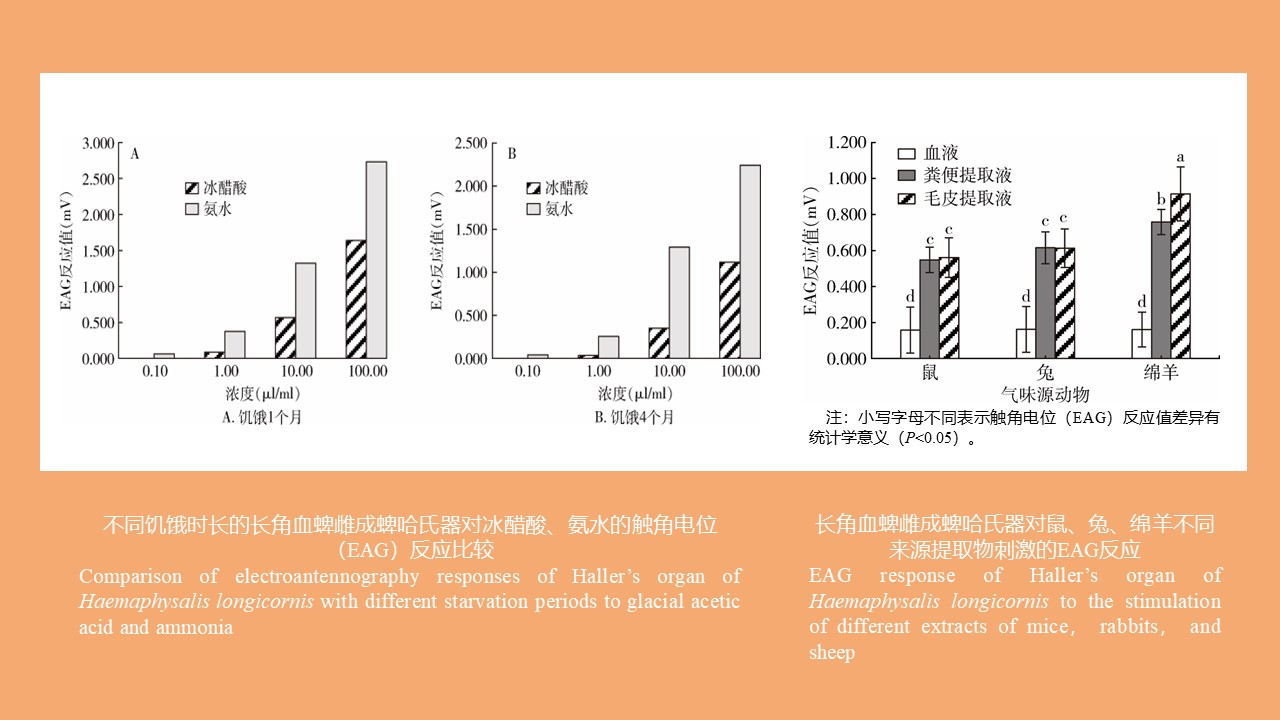
Objective To measure the electrophysiological response of the Haller's organ of starving adult female Haemaphysalis longicornis ticks to several odor volatiles,and to provide a basis for further research on the host selection mechanism of ticks.Methods Electroantennogram with glass electrodes was used to measure the electroantennography (EAG) values of the Haller's organ of adult female H.longicornis ticks to glacial acetic acid,ammonia,and the blood,fecal,and fur extracts of Kunming mice,New Zealand rabbits,and sheep after 1 or 4 months of starvation,and the differences in data were analyzed for t test and analysis of variance using SPSS 22.0 software.Results Except for a relatively low EAG response value (0.000 mV) to glacial acetic acid with a concentration of 0.10 μl/ml,the Haller's organ of starving adult female H.longicornis showed varying degrees of electrophysiological reactions to glacial acetic acid and ammonia at concentrations of 1.00,10.00,and 100.00 μl/ml,and the degree of electrophysiological reactions increased with the increasing concentrations;The EAG values at different concentrations of glacial acetic acid and ammonia of Haller's organ of ticks in 1 month of starvation were higher than those of ticks in 4 months of starvation,but only EAG values at 1.00,10.00,and 100.00 μl/ml of glacial acetic acid,and 1.00 and 100.00 μl/ml of ammonia were significantly different between ticks with different times of starvation (all P<0.05).The ticks with starvation for 1 and 4 months showed the highest EAG response value to 100 μl/ml ammonia,i.e.,(2.729±0.129) mV and (2.239±0.285) mV,respectively,and the EAG response values to each concentration of ammonia were significantly higher than those to each concentration of glacial acetic acid (all P<0.05).The H.longicornis ticks after starvation for 1 month had similar EAG response values to the blood of Kunming mice,New Zealand rabbits,and sheep (F=0.002,P=0.998),and as for the three kinds of animals,the ticks had relatively high EAG response values to the fecal and fur extracts of sheep,i.e.,(0.758±0.070) mV and (0.914±0.150) mV,respectively,which were significantly higher than the EAG response values to the fecal and fur extracts of the other two kinds of animals (fecal extract:F=11.587,P=0.001;fur extract:F=14.237,P<0.001).Conclusion At the same concentration,The Haller's organs of the adult female ticks of H.longicornis are more sensitive to ammonia than to glacial acetic acid,and the ticks after starvation for 1 month have stronger EAG response to ammonia and glacial acetic acid than those after starvation for 4 months.The EAG response of ticks to the fecal and fur extracts of sheep are stronger than those to the fecal and fur extracts of Kunming mice and New Zealand rabbits.
CUI Ying-ying, WANG Jun-gang, SUN Wan-wan, WANG Jun, WU Hai-xia, LIU Qi-yong
. Electroantennographic response of the Haller's organ of Haemaphysalis longicornis(Acari:Ixodidae) to several odor volatiles[J]. Chinese Journal of Vector Biology and Control, 2022
, 33(5)
: 622
-626
.
DOI: 10.11853/j.issn.1003.8280.2022.05.002
[1] 陈泽,杨晓军.蜱的系统分类学[M].北京:科学出版社,2021:2. Chen Z,Yang XJ. Systematic taxonomy of ticks[M]. Beijing:Science Press,2021:2.(in Chinese)
[2] Yu ZJ,Wang H,Wang TH,et al. Tick-borne pathogens and the vector potential of ticks in China[J]. Parasit Vectors. 2015,8:24. DOI:10.1186/s13071-014-0628-x.
[3] 刘起勇. 2005-2020年我国媒介生物传染病报告病例:流行趋势、防控挑战及应对策略[J].中国媒介生物学及控制杂志,2022,33(1):1-7. DOI:10.11853/j.issn.1003.8280.2022.01.001. Liu QY. Reported cases of vector-borne diseases in China,2005-2020:Epidemic trend,challenges in prevention and control,and related coping strategies[J]. Chin J Vector Biol Control,2022,33(1):1-7. DOI:10.11853/j.issn.1003.8280.2022.01.001.(in Chinese)
[4] 邓国藩,姜在阶.中国经济昆虫志.第三十九册.蜱螨亚纲:硬蜱科[M].北京:科学出版社,1991:34-43. Deng GF,Jiang ZJ. Economic insect fauna of China. Fasc. 39(Acari:Ixodidae)[M]. Beijing:Science Press,1991:34-43.(in Chinese)
[5] Liu TT,Feng XJ,Zhang YD,et al. Genetic diversity of Haemaphysalis longicornis from China and molecular detection of Rickettsia[J]. Exp Appl Acarol,2019,79(2):221-231. DOI:10.1007/s10493-019-00423-y.
[6] Qin XR,Han FJ,Luo LM,et al. Anaplasma species detected in Haemaphysalis longicornis tick from China[J]. Ticks Tick Borne Dis,2018,9(4):840-843. DOI:10.1016/j.ttbdis.2018.03.014.
[7] Stanley HM,Ford SL,Snellgrove AN,et al. The ability of the invasive Asian longhorned tick Haemaphysalis longicornis(Acari:Ixodidae) to acquire and transmit Rickettsia rickettsii(Rickettsiales:Rickettsiaceae),the agent of Rocky Mountain spotted fever,under laboratory conditions[J]. J Med Entomol,2020,57(5):1635-1639. DOI:10.1093/jme/tjaa076.
[8] Zhang X,Zhao CY,Cheng CY,et al. Rapid spread of severe fever with thrombocytopenia syndrome virus by parthenogenetic Asian longhorned ticks[J]. Emerg Infect Dis,2022,28(2):363-372. DOI:10.3201/eid2802.211532.
[9] Josek T,Walden KKO,Allan BF,et al. A foreleg transcriptome for Ixodes scapularis ticks:Candidates for chemoreceptors and binding proteins that might be expressed in the sensory Haller's organ[J]. Ticks Tick Borne Dis,2018,9(5):1317-1327. DOI:10.1016/j.ttbdis.2018.05.013.
[10] Renthal R,Manghnani L,Bernal S,et al. The chemosensory appendage proteome of Amblyomma americanum(Acari:Ixodidae) reveals putative odorant-binding and other chemoreception-related proteins[J]. Insect Sci,2017,24(5):730-742. DOI:10.1111/1744-7917.12368.
[11] 陆军,张绍红,张强,等.红火蚁对几种饵剂的EAG试验[J].植物检疫,2007,21增刊1:37-39. Lu J,Zhang SH,Zhang Q,et al. EAG testing of several baits by red fire ants[J]. Plant Quarantine,2007,21 Suppl 1:S37-39.(in Chinese)
[12] 孟浩.嗜群血蜱种群生态及美洲花蜱防治的研究[D].石家庄:河北师范大学,2015. Meng H. Studies on population ecology of Haemaphysalis concinna and prevention and control of Amblyomma americanum[D]. Shijiazhuang:Hebei Normal University,2015.(in Chinese)
[13] 蓝明扬,孟阳春,唐贤汉,等.两种硬蜱哈氏器的嗅觉功能[J].昆虫学报,1985,28(2):231-232. DOI:10.16380/j.kcxb.1985. 02.025. Lan MY,Meng YC,Tang XH,et al. Olfactory function of Haller's organs in two species of ticks (Acari:Ixodidae)[J]. Acta Entomol Sin,1985,28(2):231-232. DOI:10.16380/j.kcxb.1985. 02.025.(in Chinese)
[14] 龚建,陈立,王少山.白星花金龟对醇和醛类植物挥发物的触角电位反应[J].新疆农业科学,2017,54(6):1085-1092. DOI:10.6048/j.issn.1001-4330.2017.06.015. Gong J,Chen L,Wang SS. Electroantennogram responses of female and male adults of Potosia brevitasis Lewis to volatile alcohols and aldehydes[J]. Xinjiang Agric Sci,2017,54(6):1085-1092. DOI:10.6048/j.issn.1001-4330.2017.06.015.(in Chinese)
[15] Haggart DA,Davis EE. Electrophysiological responses of two types of ammonia-sensitive receptors on the first tarsi of ticks[J]. Rec Adv Acarol,1979,1:421-426. DOI:10.1016/B978-0-12-592201-2.50057-9.
[16] Phillips JS,Adeyeye O,Bruni D. Respiratory metabolism of the soft tick,Ornithodoros turicata(Dugès)[J]. Exp Appl Acarol,1995,19(2):103-115. DOI:10.1007/BF00052550.
[17] Rosendale AJ,Dunlevy ME,Fieler AM,et al. Dehydration and starvation yield energetic consequences that affect survival of the American dog tick[J]. J Insect Physiol,2017,101:39-46. DOI:10.1016/j.jinsphys.2017.06.012.
[18] Fujimoto K. Effect of the prolonged time after molting on the induction of the behavioral diapause of Ixodes nipponensis nymphs (Acari:Ixodidae) by exposure to a short-day photoperiod[J]. J Acarol Soc Jpn,2002,11(2):101-103. DOI:10.2300/ACARI.11.101.

