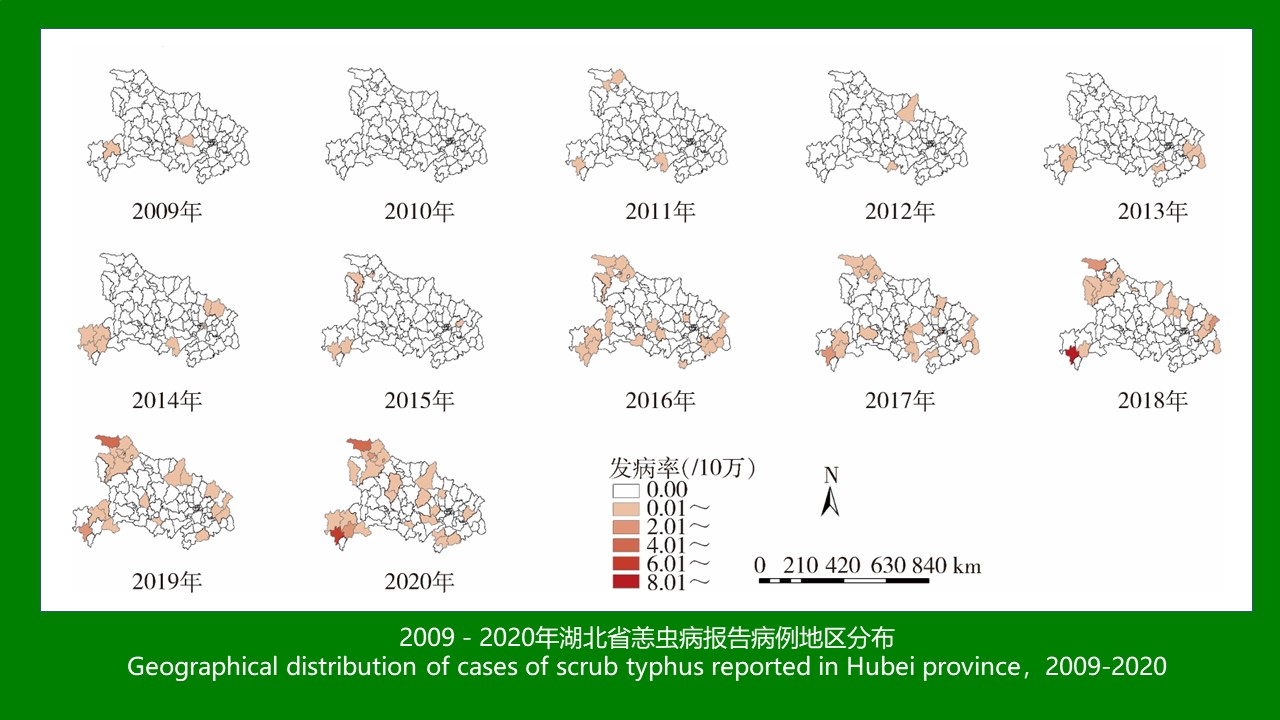
Objective To analyze the epidemiological characteristics of scrub typhus cases reported in Hubei province, China from 2009 to 2020, and provide scientific evidence for formulating control strategies and measures. Methods The data about cases of scrub typhus reported in Hubei province from 2009 to 2020 were collected from the National Disease Reporting Information System in China. Descriptive epidemiological methods were used to analyze the incidence, mortality, and regional, temporal, and population distributions of scrub typhus with the use of Excel 2010, SPSS 19.0, and ArcGIS 10.3 softwares. Results A total of 364 cases of scrub typhus were reported in Hubei province from 2009 to 2020, including 220 clinically diagnosed cases, 18 confirmed cases, and 126 suspected cases, in which one death was reported. The annual incidence rate was at a mean level of 0.01/100 000 during 2009 to 2015, and has been on the rise since 2016, reaching 0.17/100 000 in 2020 (42.50 times the incidence of 0.004/100 000 in 2009). Over the past 12 years, scrub typhus occurred in a total of 61 counties/districts in 15 cities/prefectures across the province, and 85.71% patients were distributed in Enshi Tujia and Miao Autonomous Prefecture, Shiyan, and Huanggang. It occurred mainly in April to October. Most cases (70.88%) were aged between 40 and 69 years. The male-to-female ratio was 1:1.78. Farmers accounted for 69.50% of the total reported cases. The median time from onset to diagnosis was 5 days. Clinically diagnosed cases accounted for the highest proportion (60.44%). The cases were mainly reported from county-level general hospitals. Conclusion Scrub typhus has been on the rise since 2016 in Hubei province, with rapid spreading in the affected areas, characterized by obvious regionality and seasonality and farmers being the most involved population. High-incidence areas should strengthen rodent and mite surveillance, primary-level laboratories' scrub typhus diagnostic capacity, and key populations' health education, so as to reduce the infection risk and control the epidemic of scrub typhus.
[1] 李兰娟, 任红. 传染病学[M]. 8版. 北京:人民卫生出版社, 2013:141-142. Li LJ, Ren H. Infectious diseases[M]. 8th ed. Beijing:People's Medical Publishing House, 2013:141-142. (in Chinese)
[2] 李贵昌, 刘起勇. 恙虫病的流行现状[J]. 疾病监测, 2018, 33(2):129-138. DOI:10.3784/j.issn.1003-9961.2018.02.006. Li GC, Liu QY. Epidemic trend of scrub typhus in the world[J]. Dis Surveill, 2018, 33(2):129-138. DOI:10.3784/j.issn.1003-9961.2018.02.006.(in Chinese)
[3] 岳玉娟, 王玉姣, 李贵昌, 等. 2006-2018年中国大陆恙虫病高发区流行病学特征分析[J]. 疾病监测, 2020, 35(4):301-306. DOI:10.3784/j.issn.1003-9961.2020.04.007. Yue YJ, Wang YJ, Li GC, et al. Epidemiological characteristics of scrub typhus in high-incidence areas in the mainland of China, 2006-2018[J]. Dis Surveill, 2020, 35(4):301-306. DOI:10.3784/j.issn.1003-9961.2020.04.007.(in Chinese)
[4] 龚健仁. 我国恙虫病的分布状况与研究概况[J]. 中华疾病控制杂志, 2016, 20(11):1176-1181. DOI:10.16462/j.cnki.zhjbkz. 2016.11.025. Gong JR. The distribution and general situation on epidemiology studies of tsutsugamushi disease in China[J]. Chin J Dis Control Prev, 2016, 20(11):1176-1181. DOI:10.16462/j.cnki.zhjbkz. 2016.11.025.(in Chinese)
[5] 中国疾病预防控制中心. 恙虫病预防控制技术指南(试行)[Z]. 北京:中国疾病预防控制中心, 2009. Chinese Center for Disease Control and Prevention. Technical guidelines for the prevention and control of tsutsugamushi disease (trial)[Z]. Beijing:Chinese Center for Disease Control and Prevention, 2009. (in Chinese)
[6] 李贵昌, 王玉姣, 岳玉娟, 等. 我国恙虫病夏季型和秋季型疫区划分研究[J]. 中国媒介生物学及控制杂志, 2019, 30(3):233-236. DOI:10.11853/j.issn.1003.8280.2019.03.001. Li GC, Wang YJ, Yue YJ, et al. Division of epidemic areas for summer-and autumn-type scrub typhus in China[J]. Chin J Vector Biol Control, 2019, 30(3):233-236. DOI:10.11853/j.issn.1003.8280.2019.03.001.(in Chinese)
[7] 王玉姣, 闫冬明, 李贵昌, 等. 北京市平谷区2008-2018年恙虫病流行特征分析[J]. 中国媒介生物学及控制杂志, 2019, 30(3):244-247. DOI:10.11853/j.issn.1003.8280.2019.03.003. Wang YJ, Yan DM, Li GC, et al. Epidemiological characteristics of scrub typhus in Pinggu district of Beijing, China, in 2008-2018[J]. Chin J Vector Biol Control, 2019, 30(3):244-247. DOI:10.11853/j.issn.1003.8280.2019.03.003.(in Chinese)
[8] 苏静静, 王莹, 周娟, 等. 近年来我国恙虫病流行病学研究进展[J]. 中华卫生杀虫药械, 2012, 18(2):160-163. DOI:10.19821/j.1671-2781.2012.02.026. Su JJ, Wang Y, Zhou J, et al. Advances in research of tsutsugamushi disease epidemiology in China in recent years[J]. Chin J Hyg Insect Equip, 2012, 18(2):160-163. DOI:10.19821/j.1671-2781.2012.02.026.(in Chinese)
[9] 吴义城. 我国大陆地区恙虫病时空特征分析及风险预测研究[D]. 北京:中国人民解放军军事医学科学院, 2016. Wu YC. Study on spatiotemporal dynamics and risk prediction of scrub typhus in China's mainland[D]. Beijing:Academy of Military Medical Sciences, 2016. (in Chinese)
[10] 张萌, 王显军, 赵仲堂. 中国恙虫病流行态势及预防控制[J]. 中华流行病学杂志, 2011, 32(4):419-423. DOI:10.3760/cma.j.issn.0254-6450.2011.04.021. Zhang M, Wang XJ, Zhao ZT. Current epidemic status and issues on prevention and control of scrub typhus[J]. Chin J Epidemiol, 2011, 32(4):419-423. DOI:10.3760/cma.j.issn.0254-6450. 2011.04.021.(in Chinese)
[11] 邹波, 郭永旺, 侯玉, 等. 平顺县北社乡晚秋农田鼠类分布和数量配置[J]. 山西农业科学, 2012, 40(9):976-978, 982. DOI:10.3969/j.issn.1002-2481.2012.09.15. Zou B, Guo YW, Hou Y, et al. Distribution investigation and the number of configuration of the farmland rodents in late autumn of Beishe town, Pingshun county[J]. J Shanxi Agric Sci, 2012, 40(9):976-978, 982. DOI:10.3969/j.issn.1002-2481.2012.09.15.(in Chinese)
[12] 李贵昌, 王玉姣, 母群征, 等. 北京市平谷区恙虫病自然疫源地宿主、媒介和病原体调查[J]. 中国媒介生物学及控制杂志, 2021, 32(3):291-297. DOI:10.11853/j.issn.1003.8280.2021. 03.007. Li GC, Wang YJ, Mu QZ, et al. An investigation of the hosts, vectors, and pathogens of scrub typhus in Pinggu natural focus of Beijing, China[J]. Chin J Vector Biol Control, 2021, 32(3):291-297. DOI:10.11853/j.issn.1003.8280.2021.03.007.(in Chinese)
[13] 谭梁飞, 熊进峰, 张令要, 等. 湖北省发热伴血小板减少综合征发病地区鼠形动物种群构成调查[J]. 中国媒介生物学及控制杂志, 2013, 24(4):348-349, 352. DOI:10.11853/j.issn.1003.4692.2013.04.021. Tan LF, Xiong JF, Zhang LY, et al. Species composition of murine-like animals in epidemic areas of severe fever with thrombocytopenia syndrome in Hubei province, China[J]. Chin J Vector Biol Control, 2013, 24(4):348-349, 352. DOI:10.11853/j.issn.1003.4692.2013.04.021.(in Chinese)
[14] 吴光华, 王长军, 李丙军, 等. 我国恙虫病宿主动物的研究概况[J]. 中华卫生杀虫药械, 2013, 19(5):370-373. DOI:10.19821/j.1671-2781.2013.05.002. Wu GH, Wang CJ, Li BJ, et al. General situation on studies of animal hosts of tsutsugamushi disease in China[J]. Chin J Hyg Insect Equip, 2013, 19(5):370-373. DOI:10.19821/j.1671-2781.2013.05.002.(in Chinese)
[15] 姜志宽, 吴光华, 李丙军, 等. 我国秋冬型恙虫病媒介恙螨的研究概况[J]. 中华卫生杀虫药械, 2013, 19(6):473-477. DOI:10.19821/j.1671-2781.2013.06.004. Jiang ZK, Wu GH, LI BJ, et al. General situation of studies on vector chigger mite of tsutsugamushi disease of autumn-winter type in China[J]. Chin J Hyg Insect Equip, 2013, 19(6):473-477. DOI:10.19821/j.1671-2781.2013.06.004.(in Chinese)
[16] Kuo CC, Huang JL, Ko CY, et al. Spatial analysis of scrub typhus infection and its association with environmental and socioeconomic factors in Taiwan[J]. Acta Trop, 2011, 120(1/2):52-58. DOI:10.1016/j.actatropica.2011.05.018.
[17] 袁庆虹, 陈敏, 杨向东. 云南省2006-2017年恙虫病流行病学分析[J]. 中国媒介生物学及控制杂志, 2018, 29(6):613-616. DOI:10.11853/j.issn.1003.8280.2018.06.015. Yuan QH, Chen M, Yang XD. Epidemiological analysis of scrub typhus in Yunnan province during 2006-2017[J]. Chin J Vector Biol Control, 2018, 29(6):613-616. DOI:10.11853/j.issn.1003. 8280.2018.06.015.(in Chinese)
[18] 李贵昌, 栗冬梅, 李焱, 等. 2006-2016年我国恙虫病流行特征分析[J]. 疾病监测, 2018, 33(2):139-143. DOI:10.3784/j.issn.1003-9961.2018.02.007. Li GC, Li DM, Li Y, et al. Epidemiology of scrub typhus in China, 2006-2016[J]. Dis Surveill, 2018, 33(2):139-143. DOI:10.3784/j.issn.1003-9961.2018.02.007.(in Chinese)
[19] 李贵昌, 李永香, 陈传伟, 等. 河南省永城市恙虫病自然疫源地调查研究[J]. 中国媒介生物学及控制杂志, 2019, 30(3):255-258. DOI:10.11853/j.issn.1003.8280.2019.03.006. Li GC, Li YX, Chen CW, et al. An investigation of natural focus of scrub typhus in Yongcheng, Henan province, China[J]. Chin J Vector Biol Control, 2019, 30(3):255-258. DOI:10.11853/j.issn.1003.8280.2019.03.006.(in Chinese)
[20] 李文, 马德龙, 赵嘉欣, 等. 广东省恙虫病流行特征及发病风险预测[J]. 中国媒介生物学及控制杂志, 2021, 32(3):334-338. DOI:10.11853/j.issn.1003.8280.2021.03.015. Li W, Ma DL, Zhao JX, et al. Epidemiological characteristics and risk prediction of scrub typhus in Guangdong province, China[J]. Chin J Vector Biol Control, 2021, 32(3):334-338. DOI:10.11853/j.issn.1003.8280.2021.03.015.(in Chinese)

