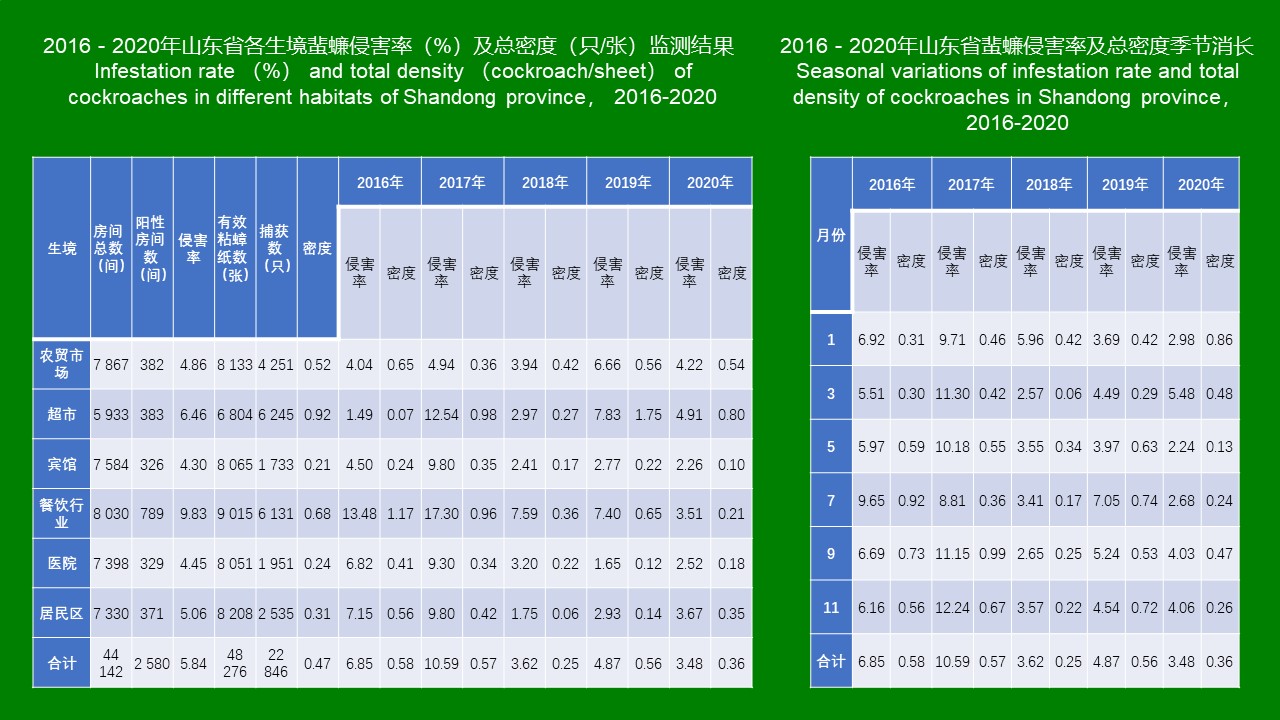
Objective To investigate the species composition, density, infestation rate, and seasonal variation of cockroaches in Shandong province, China, 2016-2020, to analyze the surveillance data of cockroaches captured by the sticky trap method, and to provide a scientific basis for cockroach prevention and control. Methods The surveillance data of cockroaches in Shandong province, 2016-2020 were collected and analyzed using Excel 2010 and R 3.6.0 softwares, and the distribution of monitoring sites was mapped using ArcGIS 10.3 software. Results From 2016 to 2020, a total of 22 846 cockroaches were captured in Shandong province, with Blattella germanica (99.49%) as the dominant species. The average total density was 0.47 cockroaches/sheet and the average infestation rate was 5.84%. The Cochran-Armitage trend test showed that the infestation rate of cockroaches statistically decreased over the years (Z=-13.011, P<0.001), but a small peak appeared in 2017. The infestation rate was highest in catering industry (9.83%), and the density was highest in supermarkets (0.92 cockroaches/sheet). Hotels showed the lowest cockroach infestation rate (4.30%) and density (0.21 cockroaches/sheet). The total cockroach density was high in July to September and peaked in July. The peak periods of infestation rate and density varied in different habitats. Conclusion B. germanica was the dominant species of cockroaches in Shandong province. Supermarkets and catering facilities are the prioritized places for cockroach control. Based on the seasonal variations of cockroach infestation rate and density in different habitats, integrated control measures should be taken before the peak periods to reduce cockroach density and its related diseases.
[1] 侯银续, 水岩, 吴磊, 等. 蜚蠊的危害及防制技术研究进展[J]. 安徽预防医学杂志, 2021, 27(6):487-491, 496. DOI:10.19837/j.cnki.ahyf.2021.06.017. Hou YX, Shui Y, Wu L, et al. Research progress on cockroach damage and control technology[J]. Anhui J Prev Med, 2021, 27(6):487-491, 496. DOI:10.19837/j.cnki.ahyf.2021.06.017.(in Chinese)
[2] 刘峰, 刘亚楠, 景晓, 等. 2010-2015年山东省居民区蟑螂监测分析[J]. 中华卫生杀虫药械, 2019, 25(2):135-137. DOI:10.19821/j.1671-2781.2019.02.013. Liu F, Liu YN, Jing X, et al. Analysis on monitoring of cockroaches in residential areas in Shandong province from 2010 to 2015[J]. Chin J Hyg Insect Equip, 2019, 25(2):135-137. DOI:10.19821/j.1671-2781.2019.02.013.(in Chinese)
[3] 刘峰, 刘亚楠, 孙钦同, 等. 2015-2019年山东省综合超市蜚蠊侵害调查[J]. 预防医学论坛, 2020, 26(6):401-402. DOI:10.16406/j.pmt.issn.1672-9153.2020.06.001. Liu F, Liu YN, Sun QT, et al. Survey on cockroaches invasion in large supermarkets, Shandong province, 2015-2019[J]. Prev Med Trib, 2020, 26(6):401-402. DOI:10.16406/j.pmt.issn.1672-9153.2020.06.001.(in Chinese)
[4] 刘峰, 孙钦同, 刘亚楠, 等. 2014-2020年山东省大型综合医院蜚蠊侵害率调查[J]. 预防医学论坛, 2021, 27(9):644-646. DOI:10.16406/j.pmt.issn.1672-9153.2021.09.004. Liu F, Sun QT, Liu YN, et al. Survey on cockroach infestation rate in large general hospitals, Shandong province, 2014-2020[J]. Prev Med Trib, 2021, 27(9):644-646. DOI:10.16406/j.pmt.issn.1672-9153.2021.09.004.(in Chinese)
[5] 中国疾病预防控制中心. 全国病媒生物监测实施方案[Z]. 北京:中国疾病预防控制中心, 2016. Chinese Center for Disease Control and Prevention. National vector surveillance implementation plan[Z]. Beijing:Chinese Center for Disease Control and Prevention, 2016. (in Chinese)
[6] 王德征, 王冲, 沈成凤, 等. Cochran-Armitage趋势检验和线性回归在流行病学率的趋势分析中的比较研究[J]. 中华流行病学杂志, 2017, 38(5):684-687. DOI:10.3760/cma.j.issn.0254-6450.2017.05.026. Wang DZ, Wang C, Shen CF, et al. Comparison of application of Cochran-Armitage trend test and linear regression analysis for rate trend analysis in epidemiology study[J]. Chin J Epidemiol, 2017, 38(5):684-687. DOI:10.3760/cma.j.issn.0254-6450.2017. 05.026.(in Chinese)
[7] 张家林, 侯银续. 安徽省2017-2019年蜚蠊监测结果分析[J]. 中国媒介生物学及控制杂志, 2021, 32(4):464-467. DOI:10.11853/j.issn.1003.8280.2021.04.016. Zhang JL, Hou YX. An analysis of surveillance results for cockroaches in Anhui province, China, 2017-2019[J]. Chin J Vector Biol Control, 2021, 32(4):464-467. DOI:10.11853/j.issn.1003.8280.2021.04.016.(in Chinese)
[8] 胡远峰, 谭梁飞. 湖北省鄂州市2016-2020年蜚蠊密度及抗药性监测结果分析[J]. 中国媒介生物学及控制杂志, 2021, 32(5):599-603. DOI:10.11853/j.issn.1003.8280.2021.05.018. Hu YF, Tan LF. Surveillance results of cockroach density and insecticide resistance in Ezhou of Hubei province, China, 2016-2020[J]. Chin J Vector Biol Control, 2021, 32(5):599-603. DOI:10.11853/j.issn.1003.8280.2021.05.018.(in Chinese)
[9] 岳玉娟, 任东升, 吴海霞, 等. 2019年全国蜚蠊监测报告[J]. 中国媒介生物学及控制杂志, 2020, 31(4):412-416. DOI:10.11853/j.issn.1003.8280.2020.04.006. Yue YJ, Ren DS, Wu HX, et al. National surveillance report on cockroaches in China, 2019[J]. Chin J Vector Biol Control, 2020, 31(4):412-416. DOI:10.11853/j.issn.1003.8280.2020. 04. 006.(in Chinese)
[10] 王陇德. 病媒生物防制实用指南[M]. 北京:人民卫生出版社, 2010:77-78. Wang LD. Practical guide to vector control[M]. Beijing:People's Health Publishing House, 2010:77-78. (in Chinese)
[11] 刘东华, 曹官时, 霍新北, 等. 日本大蠊与德国小蠊种群间演替因素探讨[J]. 中国媒介生物学及控制杂志, 2005, 16(6):463-464. DOI:10.3969/j.issn.1003-4692.2005.06.020. Liu DH, Cao GS, Huo XB, et al. Discussion on succession factors between Periplaneta japonica and P. germanica populations[J]. Chin J Vector Biol Control, 2005, 16(6):463-464. DOI:10.3969/j.issn.1003-4692.2005.06.020.(in Chinese)
[12] 霍新北. 我国城市德国小蠊的入侵及预防控制[J]. 中国媒介生物学及控制杂志, 2015, 26(2):114-116. DOI:10.11853/j.issn.1003.4692.2015.02.002. Huo XB. Invasion of Blattella germanica and its infestation management in urban environment in China[J]. Chin J Vector Biol Control, 2015, 26(2):114-116. DOI:10.11853/j.issn.1003. 4692.2015.02.002.(in Chinese)
[13] 李广帅, 庞松涛, 雷晓岗, 等. 2019年西安市蜚蠊监测结果分析[J]. 医学动物防制, 2021, 37(10):1016-1019. DOI:10.7629/yxdwfz202110026. Li GS, Pang ST, Lei XG, et al. Analysis on monitoring results of cockroach in Xi'an, 2019[J]. J Med Pest Control, 2021, 37(10):1016-1019. DOI:10.7629/yxdwfz202110026.(in Chinese)
[14] 姜志宽, 吴光华. 蟑螂防治(二):蟑螂的生态习性与常见种类[J]. 中华卫生杀虫药械, 2009, 15(2):169-172. DOI:10.19821/j.1671-2781.2009.02.032. Jiang ZK, Wu GH. Cockroach control (Ⅱ):Ecological habits and common species of cockroaches[J]. Chin J Hyg Insect Equip, 2009, 15(2):169-172. DOI:10.19821/j.1671-2781.2009. 02.032.(in Chinese)
[15] 张家勇, 王纯玉, 丁俊, 等. 2014-2016年辽宁省蟑螂监测分析[J]. 中华卫生杀虫药械, 2019, 25(4):338-342. DOI:10.19821/j.1671-2781.2019.04.011. Zhang JY, Wang CY, Ding J, et al. Surveillance on cockroaches in Liaoning province from 2014 to 2016[J]. Chin J Hyg Insect Equip, 2019, 25(4):338-342. DOI:10.19821/j.1671-2781.2019.04.011.(in Chinese)
[16] 蒋璐, 王飞, 王丹华, 等. 上海市虹口区德国小蠊对5种杀虫剂的抗性调查[J]. 中华卫生杀虫药械, 2016, 22(6):622-623. DOI:10.19821/j.1671-2781.2016.06.032. Jiang L, Wang F, Wang DH, et al. Resistance of Blattella germanica to five insecticides in Hongkou district of Shanghai[J]. Chin J Hyg Insect Equip, 2016, 22(6):622-623. DOI:10.19821/j.1671-2781.2016.06.032.(in Chinese)
[17] 都二霞, 李胜. 蟑螂为"小强"的分子奥秘[J]. 中国媒介生物学及控制杂志, 2021, 32(4):385-389. DOI:10.11853/j.issn.1003. 8280.2021.04.001. Du EX, Li S. Molecular mystery of the "little mighty" cockroach[J]. Chin J Vector Biol Control, 2021, 32(4):385-389. DOI:10.11853/j.issn.1003.8280.2021.04.001.(in Chinese)

