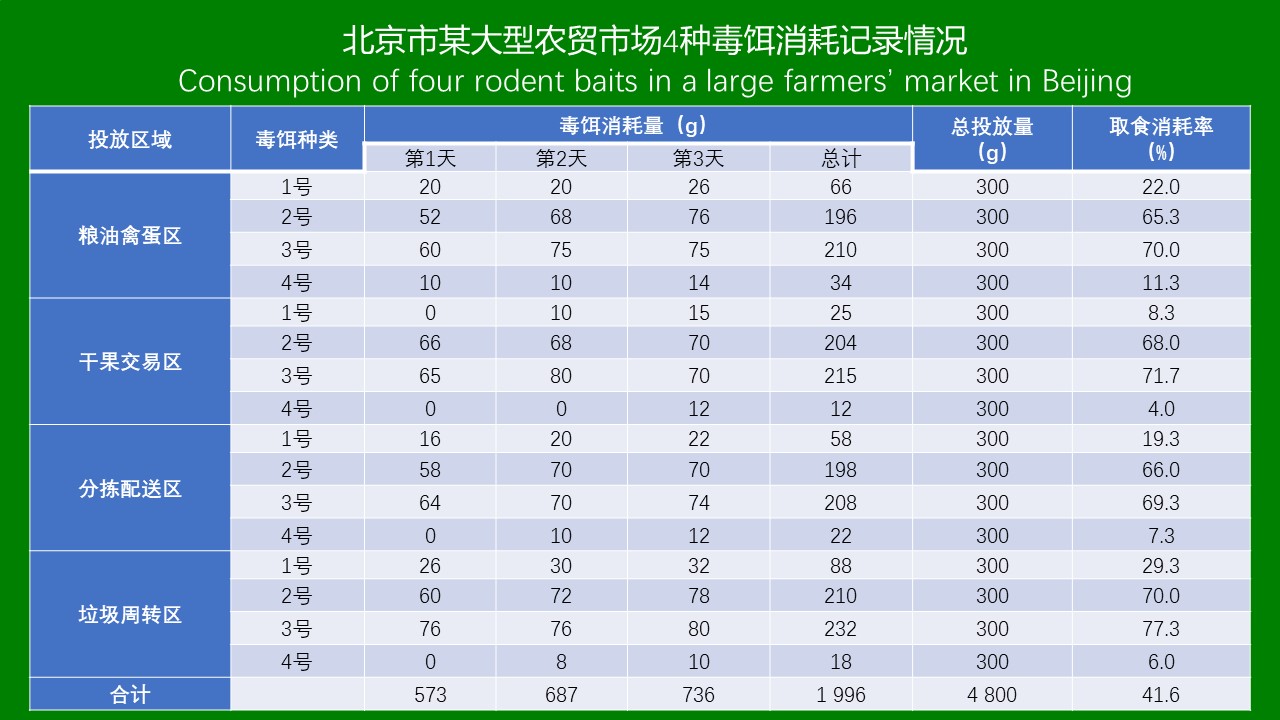
Objective To evaluate the palatability and effectiveness of several rodent baits for deratization in a large farmers' market in Beijing, China. Methods The rodent density and population distribution in this market were monitored and investigated before and after deratization by using the rodent trace method and night trapping method in May 2021. An on-site investigation of the palatability of several rodent bromadiolone baits was conducted. A rank sum test was used to analyze the difference in palatability to select the best bait for deratization. Results Before deratization, the mean positive infestation rate and the capture rate of rodents were 32.6% and 25.3% in the farmers' market. The places with relatively high rodent densities included the garbage collection area, dry fruit area, and grain, oil, and eggs area, where the capture rates were 69.0%, 43.0%, and 30.0%, respectively. The intakes of No. 2 and No. 3 baits (combination formulations of 0.5% bromadiolone mother liquor with different proportions of corn kernels, raw peanuts, sweet potatoes and apples) were significantly higher than those of No 1 (combination formulations of 0.5% brodiolone mother liquor with corn kernels, raw peanuts) and No 4 (commodity, 0.005% bromadiolone bait pellets) (Z1,2=-4.159, Z1,3=-4.158, Z2,4=-4.168,Z3,4=-4.167, all P<0.001). There was a statistical difference in the intakes of No. 1 and No. 4 baits (Z=-3.367, P=0.001). No statistical difference was observed in the intakes of No. 2 and No. 3 baits (Z=-0.110, P=0.272). No. 3 bait showed statistically better consumption rates than No. 2 bait in various areas. After deratization with No. 3 bait, the rodent capture rate in the farmers' market was statistically decreased to 0.9%. Conclusion The density of rodents in the farmers' market was high before deratization, and was statistically reduced after eliminating rodent habitats and deratization with the selected No.3 rodent baits. Improving the palatability of baits can enhance rodent control.
GUO Yu, WU Qing-rui, LIU Mei-de, LIU Yuan, YAN Shuai, LI Ruo-xi
. Palatability and deratization effectiveness evaluation of rodent baits in a large farmers' market in Beijing, China[J]. Chinese Journal of Vector Biology and Control, 2022
, 33(4)
: 521
-524
.
DOI: 10.11853/j.issn.1003.8280.2022.04.015
[1] 高文, 黄钢, 马丽华, 等. 差分自回归移动平均模型在河北省鼠密度监测信息系统中的应用研究[J]. 中国媒介生物学及控制杂志, 2017, 28(3):265-268. DOI:10.11853/j.issn.1003. 8280.2017.03.018. Gao W, Huang G, Ma LH, et al. Application of autoregressive integrated moving average (ARIMA) model in information system for rodent surveillance in Hebei province[J]. Chin J Vector Biol Control, 2017, 28(3):265-268. DOI:10.11853/j.issn.1003.8280.2017.03.018.(in Chinese)
[2] Meerburg BG, Singleton GR, Kijlstra A. Rodent-borne diseases and their risks for public health[J]. Crit Rev Microbiol, 2009, 35(3):221-270. DOI:10.1080/10408410902989837.
[3] Liu QY, Gao Y. Vital surveillance:Reported vector-borne diseases-China, 2018[J]. China CDC Wkly, 2020, 2(14):219-224. DOI:10.46234/ccdcw2020.057.
[4] 刘起勇. 气候变化对中国媒介生物传染病的影响及应对:重大研究发现及未来研究建议[J]. 中国媒介生物学及控制杂志, 2021, 32(1):1-11. DOI:10.11853/j.issn.1003.8280.2021. 01.001. Liu QY. Impact of climate change on vector-borne diseases and related response strategies in China:Major research findings and recommendations for future research[J]. Chin J Vector Biol Control, 2021, 32(1):1-11. DOI:10.11853/j.issn.1003.8280. 2021.01.001.(in Chinese)
[5] 白雪薇, 陈永明, 牛艳芬, 等. 河北省鼠疫自然疫源地动物鼠疫流行分布特征分析[J]. 中国媒介生物学及控制杂志, 2021, 32(3):324-328. DOI:10.11853/j.issn.1003.8280.2021.03.013. Bai XW, Chen YM, Niu YF, et al. Distribution characteristics of plague epidemics in animals in natural plague foci of Hebei province, China[J]. Chin J Vector Biol Control, 2021, 32(3):324-328. DOI:10.11853/j.issn.1003.8280.2021.03.013.(in Chinese)
[6] Wang YM, Zhou L, Fan MG, et al. Outbreak reports:Isolated cases of plague-Inner Mongolia-Beijing, 2019[J]. China CDC Wkly, 2019, 1(1):13-16. DOI:10.46234/ccdcw2019.005.
[7] 中华人民共和国国家质量监督检验检疫总局, 中国国家标准化管理委员会. GB/T 27770-2011病媒生物密度控制水平鼠类[S]. 北京:中国标准出版社, 2012. General Administration of Quality Supervision, Inspection and Quarantine of the People's Republic of China, Standardization Administration of China. GB/T 27770-2011 Criteria for vector density control-Rodent[S]. Beijing:Standards Press of China, 2012. (in Chinese)
[8] 黄金波, 柳付明, 潘孝猛, 等. 模拟现场快速评价家栖鼠毒饵适口性的应用研究[J]. 中国媒介生物学及控制杂志, 2017, 28(5):505-507. DOI:10.11853/j.issn.1003.8280.2017.05.027. Huang JB, Liu FM, Pan XM, et al. The application research of a rapid evaluation on the palatability of poison baits to domestic rodents in a stimulated field[J]. Chin J Vector Biol Control, 2017, 28(5):505-507. DOI:10.11853/j.issn.1003.8280.2017. 05.027.(in Chinese)
[9] 刘阳, 张韶华, 梁焯南, 等. 广东省深圳市2017年褐家鼠对抗凝血杀鼠剂抗药性研究[J]. 中国媒介生物学及控制杂志, 2018, 29(6):617-620. DOI:10.11853/j.issn.1003.8280.2018. 06.016. Liu Y, Zhang SH, Liang ZN, et al. Study on resistance of commensal rats (Rattus norvegicus) to anticoagulant rodenticides in Shenzhen[J]. Chin J Vector Biol Control, 2018, 29(6):617-620. DOI:10.11853/j.issn.1003.8280.2018.06.016.(in Chinese)
[10] 司晓艳, 白国辉, 宋利桃, 等. 内蒙古自治区人居环境2017-2019年鼠类监测数据分析[J]. 中国媒介生物学及控制杂志, 2021, 32(5):586-589. DOI:10.11853/j.issn.1003.8280.2021. 05.015. Si XY, Bai GH, Song LT, et al. An analysis of rodent surveillance data in human settlements of Inner Mongolia, China, in 2017-2019[J]. Chin J Vector Biol Control, 2021, 32(5):586-589. DOI:10.11853/j.issn.1003.8280.2021.05.015.(in Chinese)
[11] 刘起勇. 2005-2020年我国媒介生物传染病报告病例:流行趋势、防控挑战及应对策略[J]. 中国媒介生物学及控制杂志, 2022, 33(1):1-7. DOI:10.11853/j.issn.1003.8280.2022.01.001. Liu QY. Reported cases of vector-borne diseases in China, 2005-2020:Epidemic trend, challenges in prevention and control, and related coping strategies[J]. Chin J Vector Biol Control, 2022, 33(1):1-7. DOI:10.11853/j.issn.1003.8280.2022.01.001.(in Chinese)

