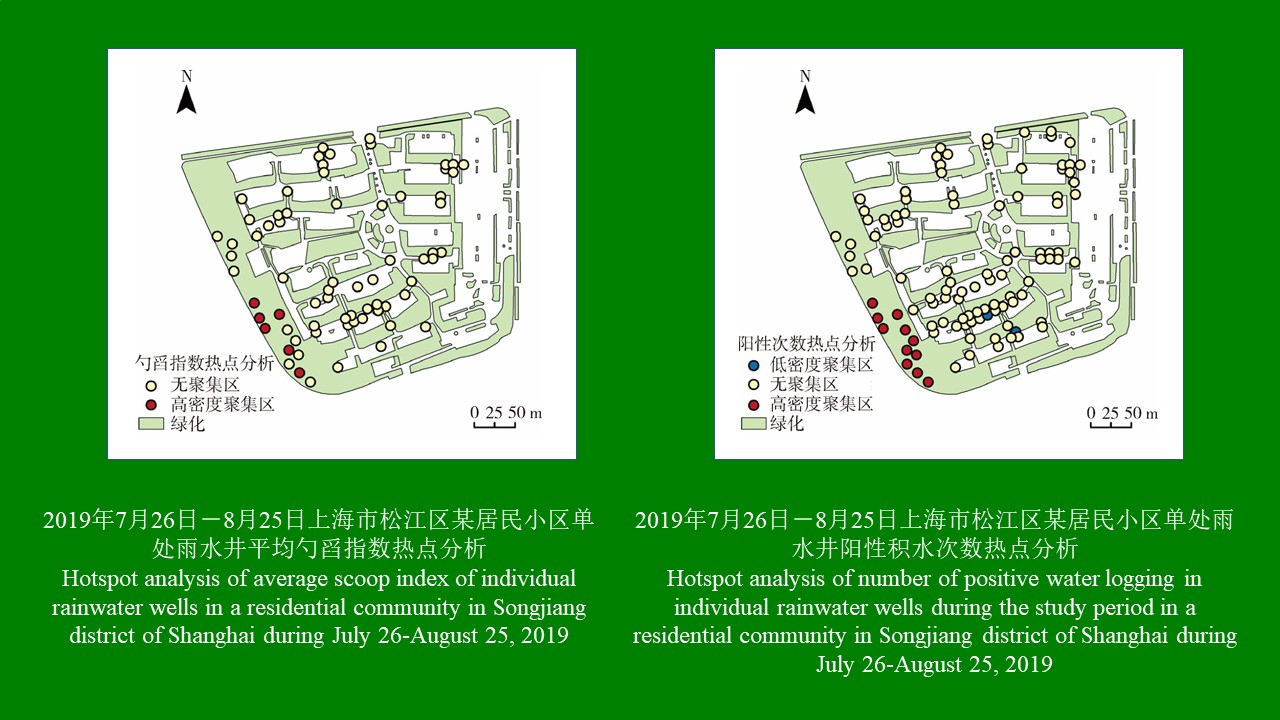
Objective To investigate the effect of rainfall on the accumulation of water in rainwater wells and the breeding of Aedes albopictus, and to provide a basis for dengue fever prevention and control. Methods From July 26 to August 25, 2019, 105 rainwater wells in a residential community of Songjiang district, Shanghai, China were selected to investigate the water accumulation and mosquito breeding on days 1, 3, 6, 9, 12, 15, 20, and 30. ArcGIS 10.8 was used for spatial analysis and Stata 14.0 was used for negative binomial regression analysis. Results Of the 105 rainwater wells, 22 were flooded 8 times, 77 were flooded 1-7 times, and 6 were not flooded. Of the 99 flooded wells investigated using the juvenile mosquito spoon trap method, 69 were positive for Ae. albopictus breeding (one or more records of Aedes breeding), and 36 were negative for Ae. albopictus breeding. Negative binomial regression analysis showed that mosquito breeding was statistically associated with turbidity of water in rainwater wells (Z=-4.423, P<0.001) and total rainfall during the first seven days (Z=-7.874, P<0.001) and from day 8 to day 14 (Z=6.166, P<0.001) before the survey day of the eight surveys. There was no statistical correlation between mosquito breeding and the number of water logging (Z=1.342, P=0.179). Conclusion The rainwater wells were generally flooded in Shanghai, and mosquito breeding in rainwater wells was related to turbidity of water, total rainfall from day 1 to day 7 prior to the survey, and total rainfall from day 8 to day 14 prior to the survey. Investigation and control of juvenile mosquito density in rainwater wells should be carried out to reduce the risk of dengue fever transmission.
[1] 蔡文锋, 景钦隆, 刘文辉, 等. 2015-2019年广州市登革热本地病例流行病学特征分析[J]. 华南预防医学, 2020, 46(2):138-140. DOI:10.12183/j.scjpm.2020.0138. Cai WF, Jing QL, Liu WH, et al. Epidemiological characteristics of local cases of dengue fever in Guangzhou, 2015-2019[J]. South Chin J Prev Med, 2020, 46(2):138-140. DOI:10.12183/j.scjpm.2020.0138.(in Chinese)
[2] 须俊明, 杨迎宇, 孙春卫, 等. 上海市宝山区2018年3例本地感染登革热病例疫点伊蚊控制及效果评价[J]. 中华卫生杀虫药械, 2019, 25(3):204-208. DOI:10.19821/j.1671-2781.2019. 03.003. Xu JM, Yang YY, Sun CW, et al. Evaluation on control measures and effects to Aedes albopictus at the epidemic sites of three local occurred dengue fever inflection cases in Baoshan district of Shanghai in 2018[J]. Chin J Hyg Insect Equip, 2019, 25(3):204-208. DOI:10.19821/j.1671-2781.2019.03.003.(in Chinese)
[3] 陆宝麟. 中国登革热媒介及其防制[M]. 贵阳:贵州人民出版社, 1990:163. Lu BL. Chinese dengue vector and its control[M]. Guiyang:Guizhou People's Publishing House, 1990:163. (in Chinese)
[4] 徐仁权, 蔡恩茂, 徐友祥, 等. 上海地区白纹伊蚊监测与药物防制研究[J]. 中国媒介生物学及控制杂志, 2003, 14(4):256-260. DOI:10.3969/j.issn.1003-4692.2003.04.005. Xu RQ, Cai EM, Xu YX, et al. Surveillance on larva and adult of Aedes albopictus and the study of insecticide in Shanghai[J]. Chin J Vector Biol Control, 2003, 14(4):256-260. DOI:10.3969/j.issn.1003-4692.2003.04.005.(in Chinese)
[5] 徐仁权, 徐宏, 李洪宝, 等. 居民区控制登革热媒介蚊虫的方法与效果探索[J]. 中国媒介生物学及控制杂志, 2008, 19(4):287-290. DOI:10.3969/j.issn.1003-4692.2008.04.004. Xu RQ, Xu H, Li HB, et al. Study on the control methods and control effect of the vector of dengue fever in residential area in Shanghai[J]. Chin J Vector Biol Control, 2008, 19(4):287-290. DOI:10.3969/j.issn.1003-4692.2008.04.004.(in Chinese)
[6] 张振东, 高强, 曹晖, 等. 上海市中心城区住区成蚊种群动态及分布特征分析[J]. 中国媒介生物学及控制杂志, 2015, 26(5):486-490. DOI:10.11853/j.issn.1003.4692.2015.05.014. Zhang ZD, Gao Q, Cao H, et al. Mosquito population dynamics and distribution of residential areas in downtown Shanghai[J]. Chin J Vector Biol Control, 2015, 26(5):486-490. DOI:10. 11853/j.issn.1003.4692.2015.05.014.(in Chinese)
[7] 王飞, 高强, 吕锡宏, 等. 上海市地面排水系统2017年蚊虫孳生状况调查研究[J]. 中国媒介生物学及控制杂志, 2018, 29(3):259-262. DOI:10.11853/j.issn.1003.8280.2018.03.010. Wang F, Gao Q, Lyu XH, et al. Breeding status of mosquitoes in municipal drainage system of Shanghai, China in 2017[J]. Chin J Vector Biol Control, 2018, 29(3):259-262. DOI:10.11853/j.issn.1003.8280.2018.03.010.(in Chinese)
[8] 高强, 曹晖, 张振东, 等. 白纹伊蚊在上海城区地面雨水井的孳生状况分析[J]. 中华卫生杀虫药械, 2016, 22(6):563-568. DOI:10.19821/j.1671-2781.2016.06.013. Gao Q, Cao H, Zhang ZD, et al. Breeding status of Aedes albopictus in rain-water catch basins in downtown of Shanghai[J]. Chin J Hyg Insect Equip, 2016, 22(6):563-568. DOI:10.19821/j.1671-2781.2016.06.013.(in Chinese)
[9] Harbison JE, Runde AB, Henry M, et al. An operational evaluation of 3 methoprene larvicide formulations for use against mosquitoes in catch basins[J]. Environ Health Insights, 2018, 12:1178630218760539. DOI:10.1177/1178630218760539.
[10] Nasci RS, Runde AB, Henry M, et al. Effectiveness of five products to control Culex pipiens larvae in urban stormwater catch basins[J]. J Am Mosq Control Assoc, 2017, 33(4):309-317. DOI:10.2987/17-6686.1.
[11] Harbison JE, Hulsebosch B, Buczek J, et al. Reduced productivity of Culex pipiens and Cx. restuans (Diptera:Culicidae) mosquitoes in parking area catch basins in the northeast Chicago metropolitan area[J]. J Vector Ecol, 1948, 42(1):148-154. DOI:10.1111/jvec.12249.
[12] 张佳一, 周毅彬, 李彦玲, 等. 网格化诱蚊诱卵器监测方法研究[J]. 中国媒介生物学及控制杂志, 2021, 32(2):208-212. DOI:10.11853/j.issn.1003.8280.2021.02.017. Zhang JY, Zhou YB, Li YL, et al. A study of grid monitoring method for mosquito ovitraps[J]. Chin J Vector Biol Control, 2021, 32(2):208-212. DOI:10.11853/j.issn.1003.8280.2021. 02.017.(in Chinese)
[13] 冷培恩, 高强, 刘洪霞. 公共环境治理与蚊媒控制[J]. 上海预防医学, 2016, 28(10):687-692. DOI:10.19428/j.cnki.sjpm. 2016.10.005. Leng PE, Gao Q, Liu HX. Environmental management and mosquito control[J]. Shanghai J Prev Med, 2016, 28(10):687-692. DOI:10.19428/j.cnki.sjpm.2016.10.005.(in Chinese)
[14] 朱伟, 戈斌, 李澜, 等. 空间分析在诱蚊诱卵器监测中的应用研究[J]. 寄生虫与医学昆虫学报, 2020, 27(3):158-163. DOI:10.3969/j.issn.1005-0507.2020.03.004. Zhu W, Ge B, Li L, et al. The study of the monitoring by mosq-ovitraps with spatial analysis[J]. Acta Parasitol Med Entomol Sin, 2020, 27(3):158-163. DOI:10.3969/j.issn.1005-0507.2020. 03.004.(in Chinese)
[15] 许峰, 王唐, 宋灿磊, 等. 诱蚊诱卵器捕获白纹伊蚊成蚊聚集趋势及分布型的研究[J]. 中国媒介生物学及控制杂志, 2021, 32(4):481-486. DOI:10.11853/j.issn.1003.8280.2021.04.020. Xu F, Wang T, Song CL, et al. Aggregation tendency and distribution pattern of adult Aedes albopictus mosquitoes captured by mosquito ovitraps[J]. Chin J Vector Biol Control, 2021, 32(4):481-486. DOI:10.11853/j.issn.1003.8280.2021.04.020.(in Chinese)

