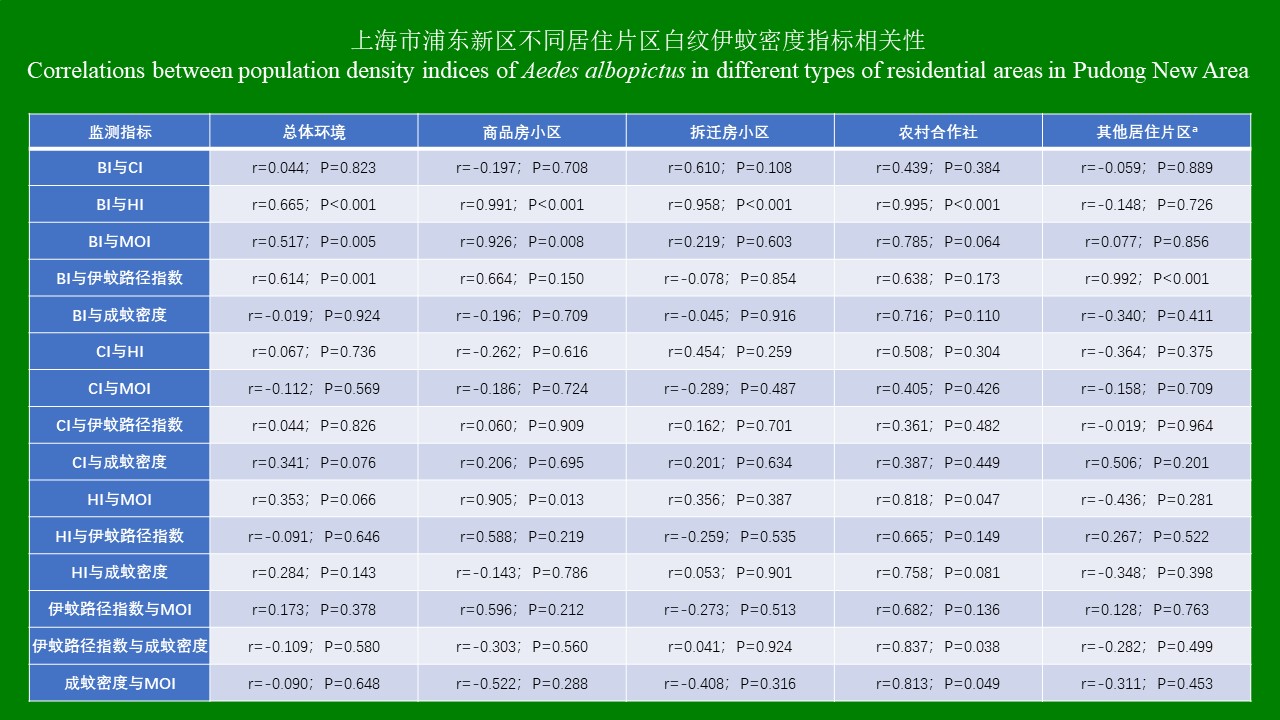
Objective To study the correlations between population density indices of Aedes albopictus monitored in different types of residential areas, and to provide a basis for the rational use of Aedes mosquito monitoring indices. Methods The density monitoring indices of Ae. albopictus were investigated in 28 residential areas of four types in Pudong New Area, Shanghai, China, and their correlations were analyzed by Pearson correlation analysis. Results From May to October, the highest container index (CI) of 28 residential areas was found in enterprise dormitories (35.78%), the highest housing index (HI) was in rural cooperatives (6.74%), the highest mosquito ovitrap index (MOI) was in commercial housing communities (11.11), the highest Breteau index (BI) was in construction sites (21.14), the highest Aedes route index (RI) was in construction sites (8.33 places/km), and the highest adult mosquito density (AMD) was recorded in a construction site[0.97/(lamp·night)]. There were positive correlations between BI and HI, between BI and MOI, and between BI and RI in the general environment (r=0.665, 0.517, and 0.614, all P<0.05). In commercial housing residential areas, a positive correlation was found between BI and HI, between BI and MOI, and between HI and MOI (r=0.991, 0.926, and 0.905, all P<0.05). In resettlement residential areas, BI and HI were positively correlated (r=0.958, P=0.001). In rural cooperatives, a positive correlation was found between BI and HI, between HI and MOI, between RI and AMD, and between AMD and MOI (r=0.995, 0.818, 0.837, and 0.813, all P<0.05). In other residential areas (urban villages, enterprise dormitories, construction sites, and school dormitories), BI was positively correlated with RI (r=0.992, P=0.001).Conclusion Duplicated monitoring with both BI and HI should be avoided in residential areas such as commercial housing residential areas, resettlement residential areas, and rural cooperatives. Duplicated mosquito monitoring with both BI and RI should be avoided in urban villages, enterprise dormitories, construction sites, school dormitories, and other residential areas with large external environment. Duplicated monitoring with both BI and MOI should be avoided in commercial housing residential areas. Both BI and MOI should be selected to complement each other for monitoring Aedes mosquito the resettlement residential areas, rural cooperatives, and other residential types.
[1] 王丕玉, 周红宁. 白纹伊蚊(Aedes albopictus)实验室饲养研究[J]. 医学动物防制, 2002, 18(9):497-498. Wang PY, Zhou HN. Studies on the rearing of Aedes albopictus at laboratory[J]. Chin J Pest Control, 2002, 18(9):497-498. (in Chinese)
[2] 江毅民, 严子锵. 我国亚热带地区登革热发生机制[J]. 中国媒介生物学及控制杂志, 2008, 19(1):80-81. DOI:10.3969/j.issn.1003-4692.2008.01.038. Jiang YM, Yan ZQ. Occurrence mechanism of dengue fever in subtropical areas of China[J]. Chin J Vector Biol Control, 2008, 19(1):80-81. DOI:10.3969/j.issn.1003-4692.2008.01.038.(in Chinese)
[3] 杨舒然, 刘起勇. 白纹伊蚊的全球分布及扩散趋势[J]. 中国媒介生物学及控制杂志, 2013, 24(1):1-4. Yang SR, Liu QY. Trend in global distribution and spread of Aedes albopictus[J]. Chin J Vector Biol Control, 2013, 24(1):1-4. (in Chinese)
[4] Grard G, Caron M, Mombo IM, et al. Zika virus in Gabon (Central Africa)-2007:A new threat from Aedes albopictus[J]. PLoS Negl Trop Dis, 2014, 8(2):e2681. DOI:10.1371/journal.pntd.0002681.
[5] 文艳苹, 汪皓秋, 于新芬, 等. 2018年杭州市登革热流行病学及病原特征研究[J]. 中华微生物学和免疫学杂志, 2021, 41(2):119-125. DOI:10.3760/cma.j.cn112309-20200914-00430. Wen YP, Wang HQ, Yu XF, et al. Epidemiological and etiological characteristics of dengue fever in Hangzhou in 2018[J]. Chin J Microbiol Immunol, 2021, 41(2):119-125. DOI:10.3760/cma.j.cn112309-20200914-00430.(in Chinese)
[6] 罗超, 陈琼, 谭仕碧, 等. 重庆市万州区2019年登革热暴发疫情流行特征及相关因素[J]. 中国热带医学, 2021, 21(7):654-657, 662. DOI:10.13604/j.cnki.46-1064/r.2021.07.08. Luo C, Chen Q, Tan SB, et al. Epidemic characteristics and influential factors of dengue fever in Wanzhou, Chongqing, 2019[J]. China Trop Med, 2021, 21(7):654-657, 662. DOI:10. 13604/j.cnki.46-1064/r.2021.07.08.(in Chinese)
[7] 蒋力云, 刘远, 苏文哲, 等. 广州市2019年登革热确诊病例空间聚集性及登革病毒E基因进化特征分析[J]. 中华流行病学杂志, 2021, 42(5):878-885. DOI:10.3760/cma.j.cn112338-20201015-01238. Jiang LY, Liu Y, Su WZ, et al. Spatial autocorrelation of dengue cases and molecular biological characteristics of envelope gene of dengue virus in Guangzhou, 2019[J]. Chin J Epidemiol, 2021, 42(5):878-885. DOI:10.3760/cma.j.cn112338-20201015-01238.(in Chinese)
[8] 孟凤霞, 王义冠, 冯磊, 等. 我国登革热疫情防控与媒介伊蚊的综合治理[J]. 中国媒介生物学及控制杂志, 2015, 26(1):4-10. DOI:10.11853/j.issn.1003.4692.2015.01.002. Meng FX, Wang YG, Feng L, et al. Review on dengue prevention and control and integrated mosquito management in China[J]. Chin J Vector Biol Control, 2015, 26(1):4-10. DOI:10.11853/j.issn.1003.4692.2015.01.002.(in Chinese)
[9] 刘小波, 郭玉红, 吴海霞, 等. 2015-2017年我国媒介伊蚊幼蚊监测结果分析[J]. 中国媒介生物学及控制杂志, 2018, 29(4):325-330. DOI:10.11853/j.issn.1003.8280.2018.04.001. Liu XB, Guo YH, Wu HX, et al. National surveillance on larval Aedes mosquito in China, 2015-2017[J]. Chin J Vector Biol Control, 2018, 29(4):325-330. DOI:10.11853/j.issn.1003. 8280.2018.04.001.(in Chinese)
[10] 刘小波, 吴海霞, 郭玉红, 等. 2016年中国媒介伊蚊密度监测结果分析[J]. 疾病监测, 2018, 33(2):144-149. DOI:10.3784/j.issn.1003-9961.2018.02.008. Liu XB, Wu HX, Guo YH, et al. Surveillance on the density of Aedes mosquitoes in China, 2016[J]. Dis Surveill, 2018, 33(2):144-149. DOI:10.3784/j.issn.1003-9961.2018.02.008.(in Chinese)
[11] 中华人民共和国国家质量监督检验检疫总局, 中国国家标准化管理委员会. GB/T 23797-2009病媒生物密度监测方法蚊虫[S]. 北京:中国标准出版社, 2009. General Administration of Quality Supervision, Inspection and Quarantine of the People's Republic of China, Standardization Administration of China. GB/T 23797-2009 Surveillance methods for vector density-Mosquito[S]. Beijing:China Standard Press, 2009.
[12] 高强, 周毅彬, 曹晖, 等. 住区与绿地环境成蚊侵害状况及公共卫生影响分析[J]. 中华卫生杀虫药械, 2016, 22(1):40-45. DOI:10.19821/j.1671-2781.2016.01.013. Gao Q, Zhou YB, Cao H, et al. Status and public health impact of mosquito infestation in residential and green areas in Shanghai downtown[J]. Chin J Hyg Insect Equip, 2016, 22(1):40-45. DOI:10.19821/j.1671-2781.2016.01.013.(in Chinese)
[13] Romero-Vivas CME, Falconar AKI. Investigation of relationships between Aedes aegypti egg, larvae, pupae, and adult density indices where their main breeding sites were located indoors[J]. J Am Mosq Control Assoc, 2005, 21(1):15-21. DOI:10.2987/8756-971X(2005)21[15:IORBAA] 2.0.CO;2.
[14] 黄坤, 郭玉红, 吴海霞, 等. 我国重点省份媒介伊蚊幼蚊密度指数相关性研究[J]. 中国媒介生物学及控制杂志, 2019, 30(4):395-399. DOI:10.11853/j.issn.1003.8280.2019.04.009. Huang K, Guo YH, Wu HX, et al. A study of the correlation between density indices of Aedes vector larvae in key provinces of China[J]. Chin J Vector Biol Control, 2019, 30(4):395-399. DOI:10.11853/j.issn.1003.8280.2019.04.009.(in Chinese)
[15] 江毅民, 严子锵, 胡志刚, 等. 诱蚊诱卵指数作为蚊虫密度监测指标适用性的探讨[J]. 热带医学杂志, 2015, 15(11):1555-1557. Jiang YM, Yan ZQ, Hu ZG, et al. Applicability of MOI as a density index in surveillance of mosquitoes[J]. J Tropic Med, 2015, 15(11):1555-1557. (in Chinese)
[16] 茌静, 古文媚, 陈戊申, 等. 3种媒介伊蚊监测方法在登革热疫点中的应用及相关性研究[J]. 中国媒介生物学及控制杂志, 2015, 26(5):495-497, 508. DOI:10.11853/j.issn.1003.4692. 2015.05.016. Chi J, Gu WM, Chen WS, et al. Application and correlation of three vector Aedes monitoring methods in dengue epidemic spots[J]. Chin J Vector Biol Control, 2015, 26(5):495-497, 508. DOI:10.11853/j.issn.1003.4692.2015.05.016.(in Chinese)

