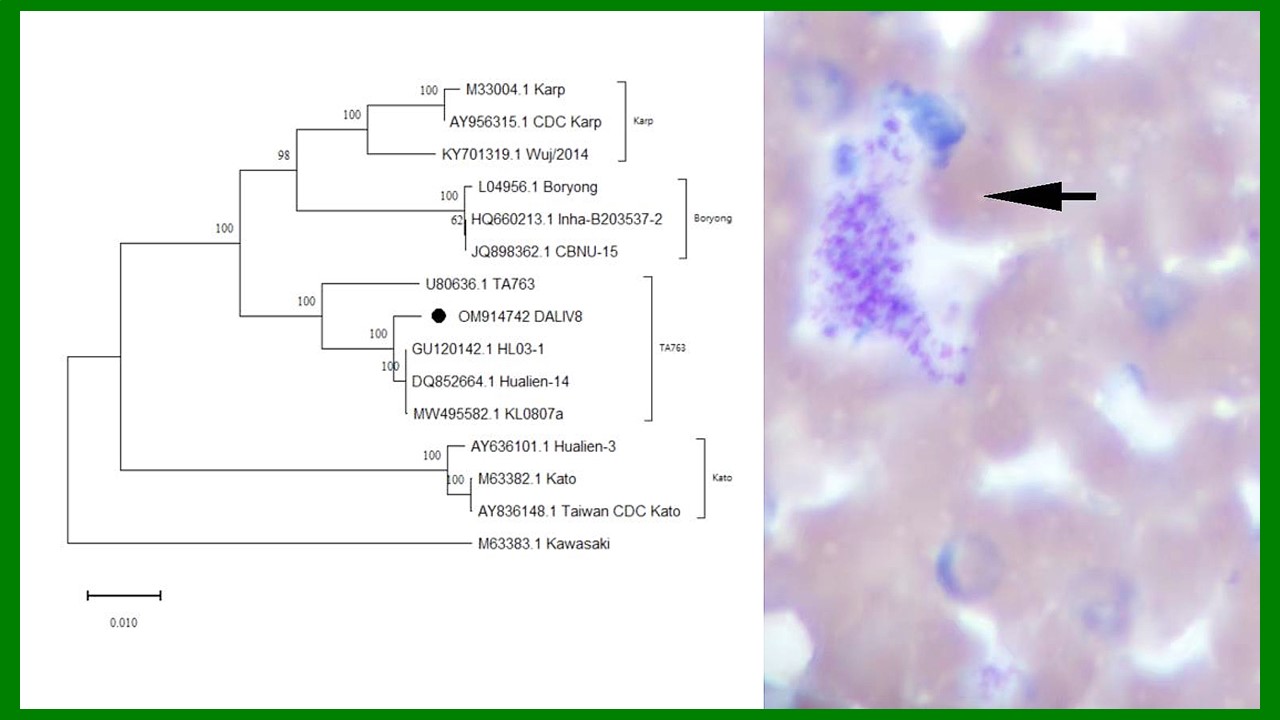
Objective To isolate and identify Orientia tsutsugamushi from rodents in Dali city, Yunnan province, China, and to amplify and analyze its full-length 56 kDa type-specific antigen (TSA) gene. Methods From August 2020 to August 2021, rodents were collected from four townships in Dali city using the night trapping method. Nested polymerase chain reaction (PCR) was used to amplify the conserved sequence of O. tsutsugamushi. PCR-positive samples were taken to intraperitoneally inoculate mice to isolate O. tsutsugamushi. The isolated O. tsutsugamushi was identified by observation with Giemsa staining and indirect immunoassay. Primers were designed to amplify the full-length 56 kDa TSA gene of O. tsutsugamushi. Bioinformatics software (MEGA Ⅹ, DNAStar 7.1, and SeqMan) was used for homology and phylogenetic analyses. Results A total of 76 rodents were captured, including 6 species under 5 genera. PCR detected the sequence of O. tsutsugamushi from the liver and spleen tissue homogenate of a Rattus tanezumi, with a positive rate of 2.38% (1/42). One strain named DALIV8 was isolated and identified as O. tsutsugamushi. The full-length 56 kDa TSA gene of this isolate was 1 566 bp, encoding 521 amino acids (GenBank:OM914742). The 56 kDa TSA gene of the DALIV8 strain showed similarities of 82.30%-98.85% at the nucleotide level and 74.04%-98.28% at the amino acid level to the Kawasaki, Boryong, Karp, Kato, and TA763 genotypes. So, the isolate was identified as the TA763 genotype. Conclusion The DALIV8 strain isolated from R. tanezumi in Dali city is firstly recorded as the TA763 genotype of O. tsutsugamushi in Yunnan province, China.
KONG Yi-chen, TIAN Jia-wei, YANG Zi, YIN Hong-min, HUANG Hao, CHEN Li, ZHANG Yun-zhi
. Isolation, identification, and 56 kDa type-specific antigen gene characterization of Orientia tsutsugamushi from Rattus tanezumi in Dali, Yunnan province, China[J]. Chinese Journal of Vector Biology and Control, 2022
, 33(4)
: 503
-509
.
DOI: 10.11853/j.issn.1003.8280.2022.04.012
[1] Giengkam S, Blakes A, Utsahajit P, et al. Improved quantification, propagation, purification and storage of the obligate intracellular human pathogen Orientia tsutsugamushi[J]. PLoS Negl Trop Dis, 2015, 9(8):e0004009. DOI:10.1371/journal.pntd.0004009.
[2] Dittrich S, Card E, Phuklia W, et al. Survival and growth of Orientia tsutsugamushi in conventional hemocultures[J]. Emerg Infect Dis, 2016, 22(8):1460-1463. DOI:10.3201/eid2208. 151259.
[3] Ming DK, Phommadeechack V, Panyanivong P, et al. The isolation of Orientia tsutsugamushi and Rickettsia typhi from human blood through mammalian cell culture:A descriptive series of 3, 227 samples and outcomes in the Lao people's democratic republic[J]. J Clin Microbiol, 2020, 58(12):e01553-20. DOI:10.1128/JCM.01553-20.
[4] Guo WP, Lin XD, Wang W, et al. Phylogeny and origins of hantaviruses harbored by bats, insectivores, and rodents[J]. PLoS Pathog, 2013, 9(2):e1003159. DOI:10.1371/journal.ppat. 1003159.
[5] Zhang SY, Song HB, Liu Y, et al. Scrub typhus in previously unrecognized areas of endemicity in China[J]. J Clin Microbiol, 2010, 48(4):1241-4. DOI:10.1128/JCM.01784-09.
[6] 岳玉娟, 王玉姣, 李贵昌, 等. 2006-2018年中国大陆恙虫病高发区流行病学特征分析[J]. 疾病监测, 2020, 35(4):301-306. DOI:10.3784/j.issn.1003-9961.2020.04.007. Yue YJ, Wang YJ, Li GC, et al. Epidemiological characteristics of scrub typhus in high-incidence areas in the mainland of China, 2006-2018[J]. Dis Surveill, 2020, 35(4):301-306. DOI:10.3784/j.issn.1003-9961.2020.04.007.(in Chinese)
[7] 李贵昌, 栗冬梅, 李焱, 等. 2006-2016年我国恙虫病流行特征分析[J]. 疾病监测, 2018, 33(2):139-143. DOI:10.3784/j.issn.1003-9961.2018.02.007. Li GC, Li DM, Li Y, et al. Epidemiology of scrub typhus in China, 2006-2016[J]. Dis Surveill, 2018, 33(2):139-143. DOI:10.3784/j.issn.1003-9961.2018.02.007.(in Chinese)
[8] 罗云燕, 尹家祥. 恙虫病东方体及其宿主和媒介的研究概况[J]. 疾病监测, 2019, 34(10):920-923. DOI:10.3784/j.issn.1003-9961.2019.10.013. Luo YY, Yin JX. Progress in research of Orientia tsutsugamushi and its host and vector[J]. Dis Surveill, 2019, 34(10):920-923. DOI:10.3784/j.issn.1003-9961.2019.10.013.(in Chinese)
[9] Chung JH, Lim SC, Yun NR, et al. Scrub typhus hepatitis confirmed by immunohistochemical staining[J]. World J Gastroenterol, 2012, 18(36):5138-5141. DOI:10.3748/wjg.v18.i36.5138.
[10] Keller CA, Hauptmann M, Kolbaum J, et al. Dissemination of Orientia tsutsugamushi and inflammatory responses in a murine model of scrub typhus[J]. PLoS Negl Trop Dis, 2014, 8(8):e3064. DOI:10.1371/journal.pntd.0003064.
[11] Tilak R, Kunte ACR. Scrub typhus strikes back:Are we ready?[J]. Med J Armed Forces India, 2019, 75(1):8-17. DOI:10.1016/j.mjafi.2018.12.018.
[12] Varghese GM, Janardhanan J, Mahajan SK, et al. Molecular epidemiology and genetic diversity of Orientia tsutsugamushi from patients with scrub typhus in 3 regions of India[J]. Emerg Infect Dis, 2015, 21(1):64-69. DOI:10.3201/eid2101.140580.
[13] Kannan K, John R, Kundu D, et al. Performance of molecular and serologic tests for the diagnosis of scrub typhus[J]. PLoS Negl Trop Dis, 2020, 14(11):e0008747. DOI:10.1371/journal.pntd.0008747.
[14] Phuklia W, Panyanivong P, Sengdetka D, et al. Novel high-throughput screening method using quantitative PCR to determine the antimicrobial susceptibility of Orientia tsutsugamushi clinical isolates[J]. J Antimicrob Chemother, 2019, 74(1):74-81. DOI:10.1093/jac/dky402.
[15] Cao M, Guo HB, Tang T, et al. Spring scrub typhus, people's republic of China[J]. Emerg Infect Dis, 2006, 12(9):1463-1465. DOI:10.3201/eid1209.060257.
[16] 胡挺松, 李应, 胡秋凌, 等. 云南省楚雄州恙虫病流行特征及其病原体东方体基因分型研究[J]. 中国媒介生物学及控制杂志, 2020, 31(3):282-288. DOI:10.11853/j.issn.1003.8280. 2020.03.008. Hu TS, Li Y, Hu QL, et al. Epidemiological characteristics of scrub typhus and genotyping of the pathogen Orientia tsutsugamushi in Chuxiong prefecture, Yunnan province, China[J]. Chin J Vector Biol Control, 2020, 31(3):282-288. DOI:10.11853/j.issn.1003.8280.2020.03.008.(in Chinese)
[17] Xu G, Walker DH, Jupiter D, et al. A review of the global epidemiology of scrub typhus[J]. PLoS Negl Trop Dis, 2017, 11(11):e0006062. DOI:10.1371/journal.pntd.0006062.
[18] 龚健仁. 我国恙虫病的分布状况与研究概况[J]. 中华疾病控制杂志, 2016, 20(11):1176-1181. DOI:10.16462/j.cnki.zhjbkz. 2016.11.025. Gong JR. The distribution and general situation on epidemiology studies of tsutsugamushi disease in China[J]. Chin J Dis Control Prev, 2016, 20(11):1176-1181. DOI:10.16462/j.cnki.zhjbkz. 2016.11.025.(in Chinese)
[19] Valbuena G, Walker DH. Approaches to vaccines against Orientia tsutsugamushi[J]. Front Cell Infect Microbiol, 2013, 2:170. DOI:10.3389/fcimb.2012.00170.
[20] Musa TH, Ahmad T, Wana MN, et al. The epidemiology, diagnosis and management of scrub typhus disease in China[J]. Hum Vaccin Immunother, 2021, 17(10):3795-3805. DOI:10.1080/21645515.2021.1934355.

