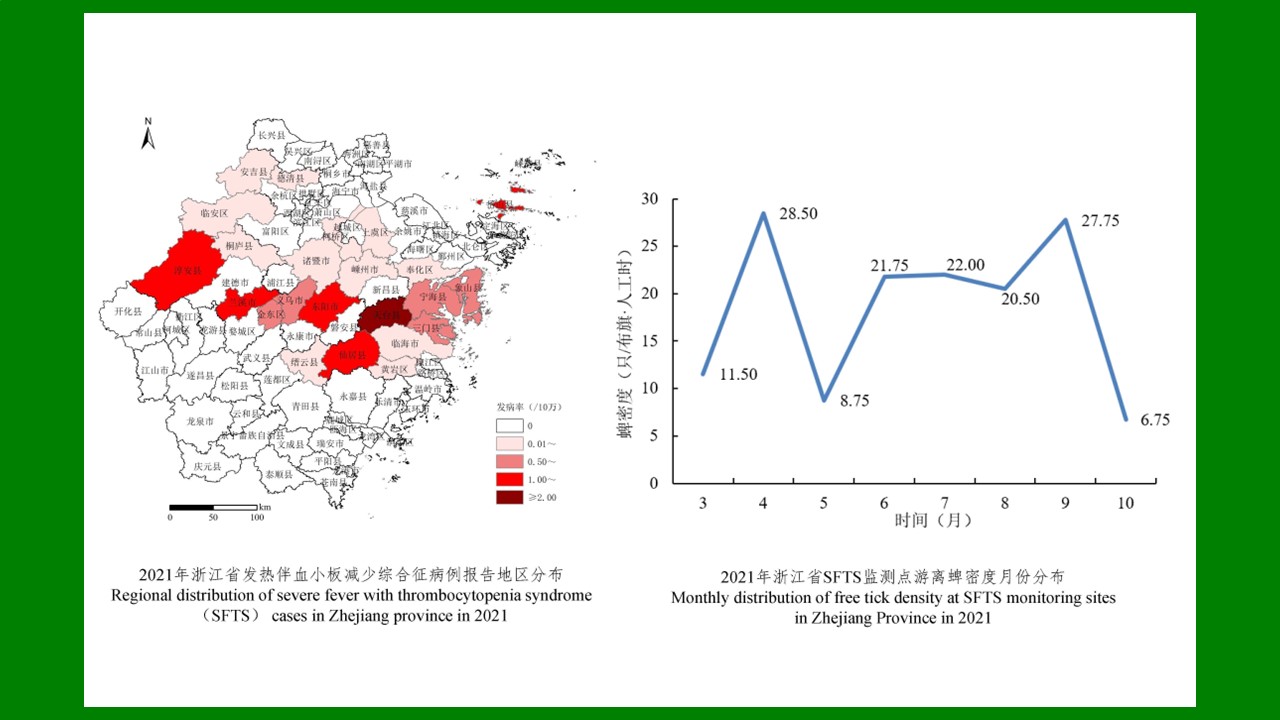
Objective To understand the epidemiological characteristics of severe fever with thrombocytopenia syndrome (SFTS) and tick vectors in Zhejiang province of China in 2021. Methods The data on SFTS cases in Zhejiang province in 2021 were obtained from China Information System for Disease Control and Prevention, and descriptive epidemiological methods were used to describe the temporal, population, and regional distributions of SFTS cases. Tick surveillance sites were set up in 8 counties (cities/districts) of Zhejiang province from March to October 2021, and the drag-flag method was used to collect free-living ticks and the body surface examination method for on-host ticks. Excel 2013 and SPSS17.0 softwares were used to perform a statistical analysis of the data on SFTS cases and vector surveillance data, and ArcGIS 10.0 software was used to draw the map of SFTS incidence rate in districts and counties. Results A total of 85 SFTS cases were reported in Zhejiang province in 2021, with a reported incidence rate of 0.15/100 000 and a fatality rate of 8.24% (7/85). The cases were distributed in 23 counties (cities/districts) in 8 prefectures, and the top 3 prefectures in terms of the number of cases were Jinhua (27 cases), Taizhou (27 cases), and Ningbo (11 cases) cities. The cases mainly occurred in April to October, with a peak in May to July. There was no significant difference in incidence rate between the male patients and the female patients (χ2=1.347, P=0.246); as for the age of onset of SFTS, most cases were middle-aged and elderly patients, with a median age of 67 years; most of the patients were farmers, accounting for 80.00% (68/85). The patients with a clear history of tick bites within 2 weeks before SFTS onset accounted for 17.65% (15/85). A total of 590 free-living ticks were collected in the unpopulated rural area, and the mean density of free-living ticks was 18.44 ticks/flag·h. A total of 688 animals were monitored and 2 406 on-host ticks were collected, with a mean density of 3.50 ticks per host. Conclusion Sporadic cases of SFTS are mainly observed in Zhejiang province, with obvious regional and seasonal characteristics. The middle-aged and elderly people and farmers were the main affected populations. Free-living ticks and on-host ticks show a relatively high density as the vector for SFTS.
ZHANG Qian-tong, SUN Ji-min, LING Feng, SHI Xu-guang, REN Jiang-ping, GUO Song, ZHANG Rong, LIU Ying
. Analysis of reported cases of fever with thrombocytopenia syndrome and tick vectors surveillance results in Zhejiang province of China in 2021[J]. Chinese Journal of Vector Biology and Control, 2022
, 33(4)
: 485
-488
.
DOI: 10.11853/j.issn.1003.8280.2022.04.008
[1] Yu XJ, Liang MF, Zhang SY, et al. Fever with thrombocytopenia associated with a novel bunyavirus in China[J]. N Engl J Med, 2011, 364(16):1523-1532. DOI:10.1056/NEJMoa1010095.
[2] Casel MA, Park SJ, Choi YK. Severe fever with thrombocytopenia syndrome virus:Emerging novel phlebovirus and their control strategy[J]. Exp Mol Med, 2021, 53(5):713-722. DOI:10.1038/s12276-021-00610-1.
[3] 李佳宸, 王玉娜, 赵静, 等. 发热伴血小板减少综合征流行病学研究进展[J]. 中华流行病学杂志, 2021, 42(12):2226-2233. DOI:10.3760/cma.j.cn112338-20210529-00439. Li JC, Wang YN, Zhao J, et al. A review on the epidemiology of severe fever with thrombocytopenia syndrome[J]. Chin J Epidemiol, 2021, 42(12):2226-2233. DOI:10.3760/cma.j.cn112338-20210529-00439.(in Chinese)
[4] 李青. 发热伴血小板减少综合征研究进展[J]. 中国热带医学, 2019, 19(10):1004-1008. DOI:10.13604/j.cnki.46-1064/r. 2019.10.23. Li Q. Advances in severe fever with thrombocytopenia syndrome[J]. China Trop Med, 2019, 19(10):1004-1008. DOI:10.13604/j.cnki.46-1064/r.2019.10.23.(in Chinese)
[5] 马婷, 孙继民, 施旭光, 等. 发热伴血小板减少综合征流行病学研究进展[J]. 中国媒介生物学及控制杂志, 2015, 26(3):327-329. DOI:10.11853/j.issn.1003.4692.2015.03.031. Ma T, Sun JM, Shi XG, et al. Research advances on epidemiology of severe fever with thrombocytopenia syndrome[J]. Chin J Vector Biol Control, 2015, 26(3):327-329. DOI:10.11853/j.issn.1003.4692.2015.03.031.(in Chinese)
[6] 中华人民共和国卫生部. 发热伴血小板减少综合征防治指南(2010版)[EB/OL]. (2010-09-29)[2022-02-14]. http://www.nhc.gov.cn/zwgkzt/pwsyj1/201010/49272.shtml. Ministry of Health of the People's Republic of China. Guidelines for the prevention and treatment of severe fever with thrombocytopenia syndrome (2010)[EB/OL]. (2010-09-29)[2022-02-14]. http://www.nhc.gov.cn/zwgkzt/pwsyj1/201010/49272.shtml.(in Chinese)
[7] 汪金生, 龚磊, 李贤相, 等. 安庆市137例发热伴血小板减少综合征流行病学调查及传播媒介蜱虫监测结果[J]. 职业与健康, 2019, 35(4):516-520. DOI:10.13329/j.cnki.zyyjk.2019. 0141. Wang JS, Gong L, Li XX, et al. Epidemiological investigation of 137 cases of severe fever with thrombocytopenia syndrome and monitoring results of vehicle ticks in Anqing city[J]. Occup Health, 2019, 35(4):516-520. DOI:10.13329/j.cnki.zyyjk. 2019.0141.(in Chinese)
[8] 李昱, 杨明, 牟笛, 等. 2010-2017年全国发热伴血小板减少综合征流行特征分析[J]. 中国急救复苏与灾害医学杂志, 2018, 13(11):1076-1079. DOI:10.3969/j.issn.1673-6966.2018. 11.011. Li Y, Yang M, Mou D, et al. Epidemiological analysis of severe fever with thrombocytopenia syndrome from 2010 to 2017, China[J]. China J Emerg Resusc Dis Med, 2018, 13(11):1076-1079. DOI:10.3969/j.issn.1673-6966.2018.11.011.(in Chinese)
[9] 黄晓霞, 李阿茜, 李德新, 等. 2018年中国发热伴血小板减少综合征流行特征分析[J]. 中国病毒病杂志, 2020, 10(6):417-420. DOI:10.16505/j.2095-0136.2020.0059. Huang XX, Li AQ, Li DX, et al. Epidemiological analysis of severe fever with thrombocytopenia syndrome in 2018, China[J]. Chin J Viral Dis, 2020, 10(6):417-420. DOI:10.16505/j.2095-0136.2020.0059.(in Chinese)
[10] 施旭光, 孙继民, 刘营, 等. 2015-2019年浙江省发热伴血小板减少综合征流行特征分析[J]. 疾病监测, 2021, 36(5):431-435. DOI:10.3784/jbjc.202101070014. Shi XG, Sun JM, Liu Y, et al. Epidemiological characteristics of fever with thrombocytopenia syndrome in Zhejiang, 2015-2019[J]. Dis Surveill, 2021, 36(5):431-435. DOI:10.3784/jbjc. 202101070014.(in Chinese)
[11] 李江麟, 胡雅飞, 翁坚, 等. 台州市发热伴血小板减少综合征流行特征分析[J]. 预防医学, 2019, 31(12):1267-1268. DOI:10.19485/j.cnki.issn2096-5087.2019.12.019. Li JL, Hu YF, Weng J, et al. Epidemiological characteristics of severe fever with thrombocytopenia syndrome in Taizhou[J]. Prev Med, 2019, 31(12):1267-1268. DOI:10.19485/j.cnki.issn 2096-5087.2019.12.019.(in Chinese)
[12] 孙继民. 发热伴血小板减少综合征时空预测研究[D]. 北京:中国疾病预防控制中心, 2018. Sun JM. Study on spatial and temporal prediction of severe fever with thrombocytopenia syndrome[D]. Beijing:Chinese Center for Disease Control and Prevention, 2018. (in Chinese)
[13] Chmelar J, Calvo E, Pedra JH, et al. Tick salivary secretion as a source of antihemostatics[J]. J Proteomics, 2012, 75(13):3842-3854. DOI:10.1016/j.jprot.2012.04.026.

