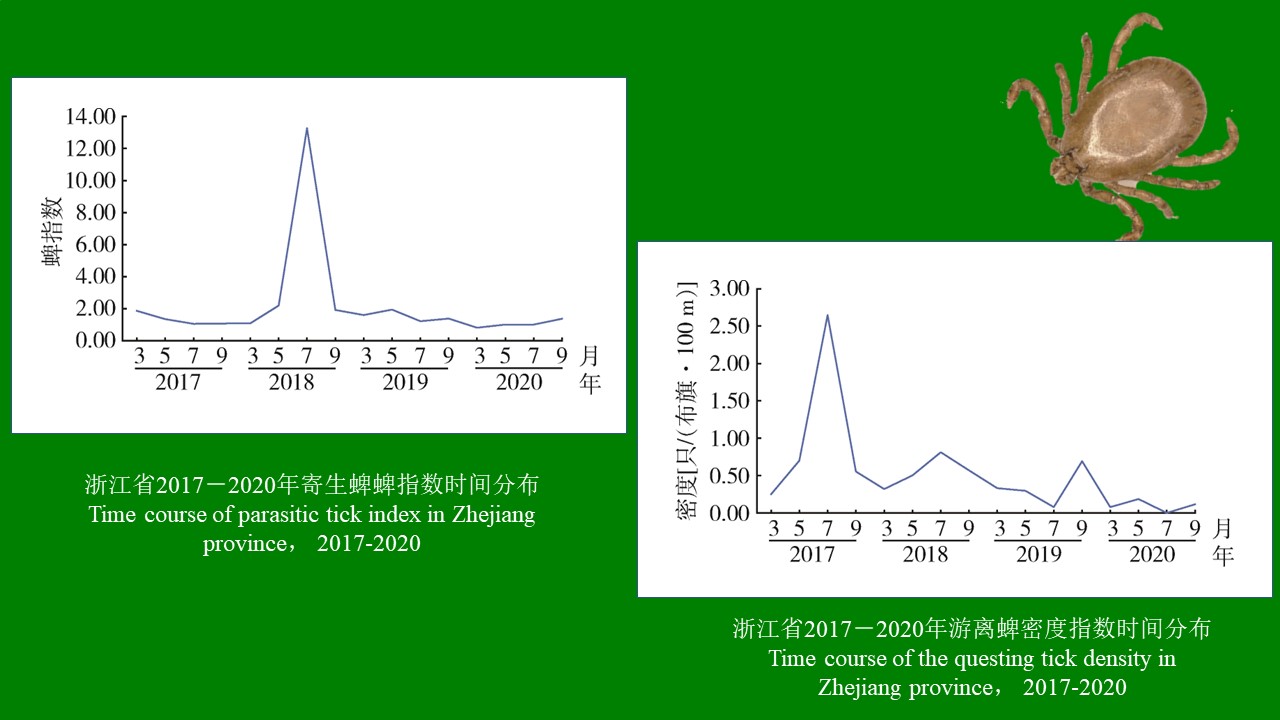
Objective To analyze the results of tick ecological surveillance in Zhejiang province, China, 2017-2020, to understand species composition, density and seasonal fluctuation of ticks in Zhejiang province, and to provide a basis for the development of control measures. Methods Twelve surveillance sites for ticks were set up in Zhejiang province. Parasitic ticks were monitored by tick inspection on the body surface of animal and the questing ticks were monitored using drag-flag method. Ticks collected from the same sampling sites or animals were numbered uniformly or placed in the same tube and brought back to the laboratory for classification, identification, and counting. The monitoring data were processed and analyzed using Excel 2010 software. Results The parasitic tick index was 2.25 and the questing tick density was 0.48 ticks/flag·100 m in Zhejiang province, 2017-2020. Haemaphysalis longicornis was the dominant parasitic and questing tick. Among host animals, sheep had the highest tick index (4.29), followed by cattle (1.33). The dominant tick species were H. longicornis on sheep, Rhipicephalus microplus on cattle, H. longicornis on rural dogs, and R. sanguineus on urban dogs. The questing tick density was 0.94 ticks/flag·100 m in rural environment and 0.04 ticks/flag·100 m in scenic area. The tick density in Zhejiang province showed no obvious seasonal fluctuation. Conclusion In 2017-2020, the dominant tick species in Zhejiang province was H. longicornis. The dominant parasitic tick species varied across host animals, and sheep had the highest tick infestation rate. The questing tick density in rural environment was significantly higher than that in scenic area. The results can provide a reference for the public health institutions of Zhejiang province to formulate targeted tick and tick control measures.
WANG Jin-na, LI Tian-qi, LUO Ming-yu, WU Yu-yan, LIU Qin-mei, GONG Zhen-yu
. Analysis of the tick ecological surveillance results in Zhejiang province from 2017 to 2020[J]. Chinese Journal of Vector Biology and Control, 2022
, 33(4)
: 466
-470
.
DOI: 10.11853/j.issn.1003.8280.2022.04.004
[1] Li ZF, Bao CJ, Hu JL, et al. Ecology of the tick-borne phlebovirus causing severe fever with thrombocytopenia syndrome in an endemic area of China[J]. PLoS Negl Trop Dis, 2016, 10(4):e0004574. DOI:10.1371/journal.pntd.0004574.
[2] Yu XJ, Liang MF, Zhang SY, et al. Fever with thrombocytopenia associated with a novel bunyavirus in China[J]. N Engl J Med, 2011, 364(16):1523-1532. DOI:10.1056/NEJMoa1010095.
[3] Hu JL, Li ZF, Hong L, et al. Preliminary fast diagnosis of severe fever with thrombocytopenia syndrome with clinical and epidemiological parameters[J]. PLoS One, 2017, 12(7):e0180256. DOI:10.1371/journal.pone.0180256.
[4] 马婷, 龚震宇, 张严峻, 等. 浙江省发热伴血小板减少综合征布尼亚病毒的宿主媒介调查[J]. 中国媒介生物学及控制杂志, 2015, 26(4):353-356. DOI:10.11853/j.issn.1003.4692. 2015.04.006. Ma T, Gong ZY, Zhang YJ, et al. Survey of vectors and hosts of severe fever with thrombocytopenia syndrome virus in Zhejiang province, China[J]. Chin J Vector Biol Control, 2015, 26(4):353-356. DOI:10.11853/j.issn.1003.4692.2015.04.006.(in Chinese)
[5] Wang SW, Li JD, Niu GY, et al. SFTS virus in ticks in an endemic area of China[J]. Am J Trop Med Hyg, 2015, 92(4):684-689. DOI:10.4269/ajtmh.14-0008.
[6] 吴海霞, 刘小波, 岳玉娟, 等. 2018年全国蜱类监测报告[J]. 中国媒介生物学及控制杂志, 2019, 30(2):146-150. DOI:10.11853/j.issn.1003.8280.2019.02.007. Wu HX, Liu XB, Yue YJ, et al. National vectors surveillance report on ticks in China, 2018[J]. Chin J Vector Biol Control, 2019, 30(2):146-150. DOI:10.11853/j.issn.1003.8280.2019. 02.007.(in Chinese)
[7] 辛正, 王东, 杨国樑, 等. 济南市蜱分布及带病毒状况调查[J]. 中国媒介生物学及控制杂志, 2015, 26(2):179-181. DOI:10.11853/j.issn.1003.4692.2015.02.018. Xin Z, Wang D, Yang GL, et al. Status of tick distribution and tick-borne pathogens in Ji'nan city[J]. Chin J Vector Biol Control, 2015, 26(2):179-181. DOI:10.11853/j.issn.1003. 4692.2015.02.018.(in Chinese)
[8] 韦娜娜, 张厚双, 周金林. 宠物蜱传疾病流行概况和防控技术研究进展[J]. 中国媒介生物学及控制杂志, 2021, 32(3):257-264. DOI:10.11853/j.issn.1003.8280.2021.03.001. Wei NN, Zhang HS, Zhou JL. Research progress in epidemic situation and control techniques of tick-borne diseases in pets[J]. Chin J Vector Biol Control, 2021, 32(3):257-264. DOI:10.11853/j.issn.1003.8280.2021.03.001.(in Chinese)
[9] Chen C, Li P, Li KF, et al. Animals as amplification hosts in the spread of severe fever with thrombocytopenia syndrome virus:A systematic review and meta-analysis[J]. Int J Infect Dis, 2019, 79:77-84. DOI:10.1016/j.ijid.2018.11.017.
[10] 李冰, 木合塔, 王启果, 等. 药物驱蜱对新疆出血热流行抑制作用的现场实验研究[J]. 中国媒介生物学及控制杂志, 2011, 22(1):5-7. Li B, Muheta, Wang QG, et al. A field experimentation on the inhibitory effects of tick management with avermectin on the prevalence of Xinjiang hemorrhagic fever[J]. Chin J Vector Biol Control, 2011, 22(1):5-7. (in Chinese)
[11] Sun JM, Lu L, Wu HX, et al. The changing epidemiological characteristics of severe fever with thrombocytopenia syndrome in China, 2011-2016[J]. Sci Rep, 2017, 7(1):9236. DOI:10.1038/s41598-017-08042-6.
[12] 赵奇, 高丽君, 唐振强, 等. 河南省蜱种类和地理分布及季节消长调查[J]. 中国媒介生物学及控制杂志, 2015, 26(1):75-77. DOI:10.11853/j.issn.1003.4692.2015.01.020. Zhao Q, Gao LJ, Tang ZQ, et al. Investigation of species, temporal and spatial distribution of ticks in Henan province, China[J]. Chin J Vector Biol Control, 2015, 26(1):75-77. DOI:10.11853/j.issn.1003.4692.2015.01.020.(in Chinese)
[13] 吴海霞, 刘小波, 岳玉娟, 等. 2019年全国蜱类监测报告[J]. 中国媒介生物学及控制杂志, 2020, 31(4):417-422. DOI:10.11853/j.issn.1003.8280.2020.04.007. Wu HX, Liu XB, Yue YJ, et al. National surveillance report on ticks in China, 2019[J]. Chin J Vector Biol Control, 2020, 31(4):417-422. DOI:10.11853/j.issn.1003.8280.2020.04.007.(in Chinese)
[14] 于志军, 董娜, 刘书广, 等. 蜱类生态学研究现状与进展[J]. 中国媒介生物学及控制杂志, 2015, 26(2):211-213. DOI:10.11853/j.issn.1003.4692.2015.02.029. Yu ZJ, Dong N, Liu SG, et al. Progress and current situation in the studies of tick ecology[J]. Chin J Vector Biol Control, 2015, 26(2):211-213. DOI:10.11853/j.issn.1003.4692.2015.02.029.(in Chinese)

