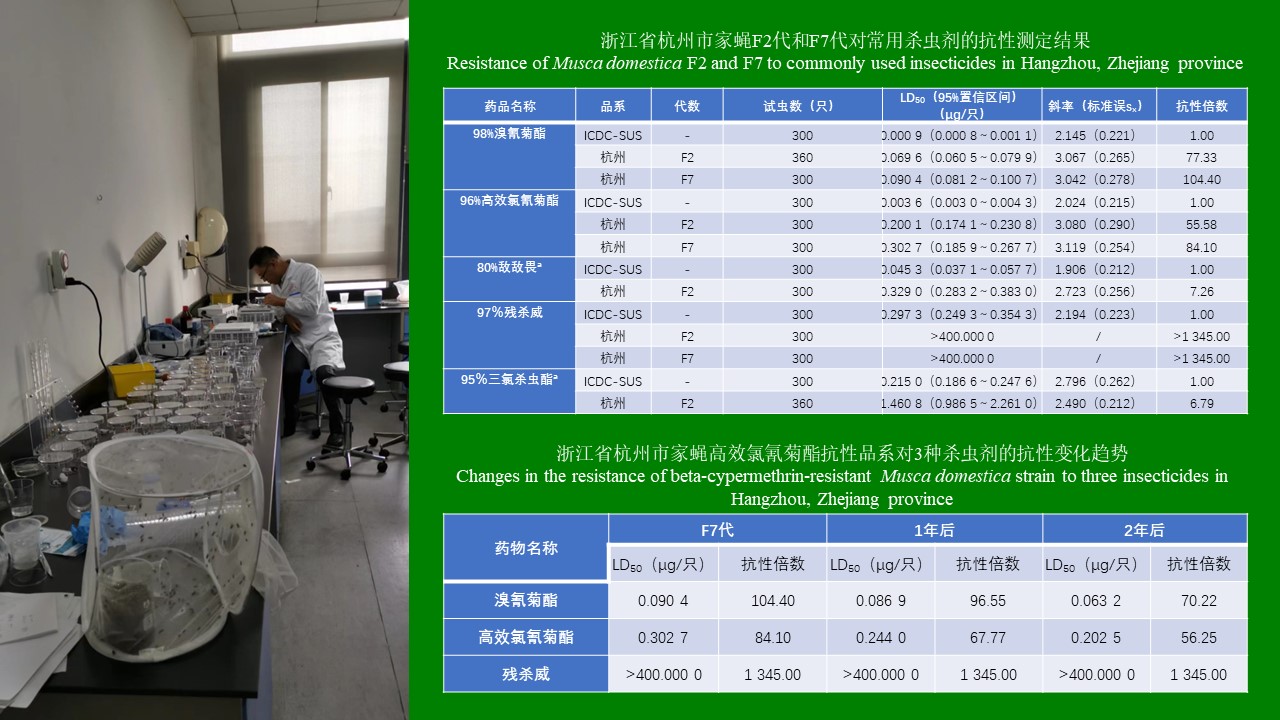
Objective To screen and purify stable strains highly resistant to beta-cypermethrin using the field samples of Musca domestica in Hangzhou, China. Methods Houseflies were collected from different locations in Hangzhou, and adult houseflies were screened by direct spray with beta-cypermethrin. After screening for 5 generations, the houseflies were maintained for two years. Resistance was determined using topical application method for F2 against deltamethrin, beta-cypermethrin, dichlorvos, triclosan, and propoxur, for F7 against deltamethrin and beta-cypermethrin, and for houseflies maintained for 1 and 2 years against deltamethrin and beta-cypermethrin. The resistance data of sensitive strains were provided by the department of infectious diseases, Zhejiang provincial center for disease control and prevention. Results The F2 generation of M. domestica in Hangzhou developed resistance to the five commonly used insecticides. The LD50of propoxur was >400.000 0 μg/♀, with the highest resistance and R/S >1 345.00. Resistance to other insecticide showed R/S between 6.79 and 77.33. The R/Sfor deltamethrin was 77.33 (LD50=0.069 6μg/♀) and the R/S for beta-cypermethrin was 55.58 (LD50=0.200 1 μg/♀). After being screened with beta-cypermethrin for 5 consecutive generations, compared with F2, F7 showed 29.89% and 51.27% increases in resistance to deltamethrin and beta-cypermethrin, respectively. After 2 years of normal rearing, the beta-cypermethrin-resistant strain showed decreased resistance as compared with the F7 generation; however, compared with sensitive strains, the R/S values for deltamethrin and beta-cypermethrin were 70.22 and 56.25, respectively, and the resistance remained at high levels. The LD50 for propoxur remained above 400.000 0 μg/♀. Conclusion After being screened with beta-cypermethrin for 5 generations and maintaining for two years, relatively stable beta-cypermethrin-resistant strains of M. domestica in Hangzhou were obtained, which lays a foundation for further research on the resistance mechanism of M. domestica.
[1] Zhu F, Lavine L, O'Neal S, et al. Insecticide resistance and management strategies in urban ecosystems[J]. Insects, 2016, 7(1):2. DOI:10.3390/insects7010002.
[2] 中华人民共和国国家质量监督检验检疫总局, 中国国家标准化管理委员会. GB/T 26350-2010蝇类抗药性检测方法家蝇生物测定法[S]. 北京:中国标准出版社, 2011. General Administration of Quality Supervision, Inspection and Quarantine of the People's Republic of China, Standardization Administration of China. GB/T 26350-2010 Test methods of fly resistance to insecticides-The bioassay methods for Musca domestica[S]. Beijing:Standards Press of China, 2011. (in Chinese)
[3] 耿晓飞, 李超, 高志鹏, 等. 北京市怀柔区2014和2016年家蝇对常用化学杀虫剂的抗药性调查[J]. 中国媒介生物学及控制杂志, 2018, 29(4):388-390. DOI:10.11853/j.issn.1003.8280. 2018.04.017. Geng XF, Li C, Gao ZP, et al. Resistance of Musca domestica to commonly used insecticides in Huairou district in Beijing, during 2014 and 2016[J]. Chin J Vector Biol Control, 2018, 29(4):388-390. DOI:10.11853/j.issn.1003.8280.2018.04.017.(in Chinese)
[4] 涂涛田, 何亚明, 冯绍全, 等. 贵州省盘县家蝇抗药性调查及防制策略分析[J]. 中国热带医学, 2019, 19(5):492-493. DOI:10.13604/j.cnki.46-1064/r.2019.05.22. Tu TT, He YM, Feng SQ, et al. Resistance of Musca domestica to commonly used insecticides and its countermeasures in Pan county of Guizhou[J]. China Trop Med, 2019, 19(5):492-493. DOI:10.13604/j.cnki.46-1064/r.2019.05.22.(in Chinese)
[5] 施红喜, 李培珍, 何健. 金华市家蝇抗药性水平趋势分析[J]. 实用预防医学, 2020, 27(1):115-116. DOI:10.3969/j.issn. 1006-3110.2020.01.034. Shi HX, Li PZ, He J. Trend analysis of insecticide resistance of Musca domestica in Jinhua city[J]. Pract Prev Med, 2020, 27(1):115-116. DOI:10.3969/j.issn.1006-3110.2020.01.034.(in Chinese)
[6] 戈斌, 李星成, 刘清, 等. 上海市奉贤区家蝇对5种常用杀虫剂的抗性调查[J]. 中华卫生杀虫药械, 2020, 26(3):292-293. DOI:10.19821/j.1671-2781.2020.03.029. Ge B, Li XC, Liu Q, et al. Resistance of Musca domestica to five commonly used insecticides in Fengxian district of Shanghai[J]. Chin J Hyg Insect Equip, 2020, 26(3):292-293. DOI:10.19821/j.1671-2781.2020.03.029.(in Chinese)
[7] 王唐, 宋灿磊, 李淑华, 等. 上海市金山区家蝇对5种杀虫剂的抗性调查[J]. 中华卫生杀虫药械, 2021, 27(4):382-383. DOI:10.19821/j.1671-2781.2021.04.024. Wang T, Song CL, Li SH, et al. Resistance of Musca domestica to five insecticides in Jinshan district of Shanghai[J]. Chin J Hyg Insect Equip, 2021, 27(4):382-383. DOI:10.19821/j.1671-2781.2021.04.024.(in Chinese)
[8] 张咏梅, 王源, 王姝, 等. 天津市家蝇对4种常用杀虫剂的抗性调查[J]. 职业与健康, 2021, 37(13):1811-1814. DOI:10.13329/j.cnki.zyyjk.2021.0431. Zhang YM, Wang Y, Wang S, et al. An investigation of resistance of Musca domestica to four commonly used insecticides in Tianjin[J]. Occup Health, 2021, 37(13):1811-1814. DOI:10.13329/j.cnki.zyyjk.2021.0431.(in Chinese)
[9] 陈晓敏, 刘芹, 周良才, 等. 武汉市2009-2015年家蝇对常用杀虫剂的抗药性调查[J]. 中国媒介生物学及控制杂志, 2021, 32(4):468-471. DOI:10.11853/j.issn.1003.8280.2021.04.017. Chen XM, Liu Q, Zhou LC, et al. An investigation of resistance of Musca domestica to commonly used insecticides in Wuhan, China, 2009-2015[J]. Chin J Vector Biol Control, 2021, 32(4):468-471. DOI:10.11853/j.issn.1003.8280.2021.04.017.(in Chinese)
[10] 阎利敏, 师佳佳, 张月泉, 等. 郑州市区淡色库蚊和家蝇对常用杀虫剂的抗性调查[J]. 中华卫生杀虫药械, 2020, 26(3):220-222. DOI:10.19821/j.1671-2781.2020.03.009. Yan LM, Shi JJ, Zhang YQ, et al. Resistance of Culex pipiens pallens and Musca domestica in Zhengzhou to commonly used insecticides[J]. Chin J Hyg Insect Equip, 2020, 26(3):220-222. DOI:10.19821/j.1671-2781.2020.03.009.(in Chinese)
[11] 曹辉, 霍新北, 王学军. 家蝇对高效氯氰菊酯抗药性的选育研究[J]. 中国媒介生物学及控制杂志, 2010, 21(1):56-58. Cao H, Huo XB, Wang XJ. Study of the resistance of Musca domestica against beta-cypermethrin through selective breeding[J]. Chin J Vector Biol Control, 2010, 21(1):56-58. (in Chinese)
[12] 张莹, 唐勇, 孙炳欣. 家蝇对高效氯氰菊酯抗药性的选育研究[J]. 中华卫生杀虫药械, 2018, 24(1):27-28. DOI:10.19821/j.1671-2781.2018.01.009. Zhang Y, Tang Y, Sun BX. Selection of resistant strain of Musca domestica against beta-cypermethrin[J]. Chin J Hyg Insect Equip, 2018, 24(1):27-28. DOI:10.19821/j.1671-2781.2018. 01.009.(in Chinese)
[13] 王志钢, 海秀平, 许永红, 等. 家蝇对两种拟除虫菊酯类杀虫剂抗性的稳定性[J]. 中国媒介生物学及控制杂志, 2006, 17(4):286-287. DOI:10.3969/j.issn.1003-4692.2006.04.009. Wang ZG, Hai XP, Xu YH, et al. Stability of two kinds of pyrethroids resistance in housefly (Diptera:Muscidae)[J]. Chin J Vector Biol Control, 2006, 17(4):286-287. DOI:10.3969/j.issn.1003-4692.2006.04.009.(in Chinese)
[14] 王学军, 霍新北, 宫学诗, 等. 家蝇对化学杀虫剂抗药性及抗性自然衰减趋势[J]. 中国公共卫生, 2008, 24(11):1330-1331. DOI:10.3321/j.issn:1001-0580.2008.11.033. Wang XJ, Huo XB, Gong XS, et al. The resistance of housefly to chemical insecticides and their natural attenuation trend[J]. Chin J Public Health, 2008, 24(11):1330-1331. DOI:10.3321/j.issn:1001-0580.2008.11.033.(in Chinese)

