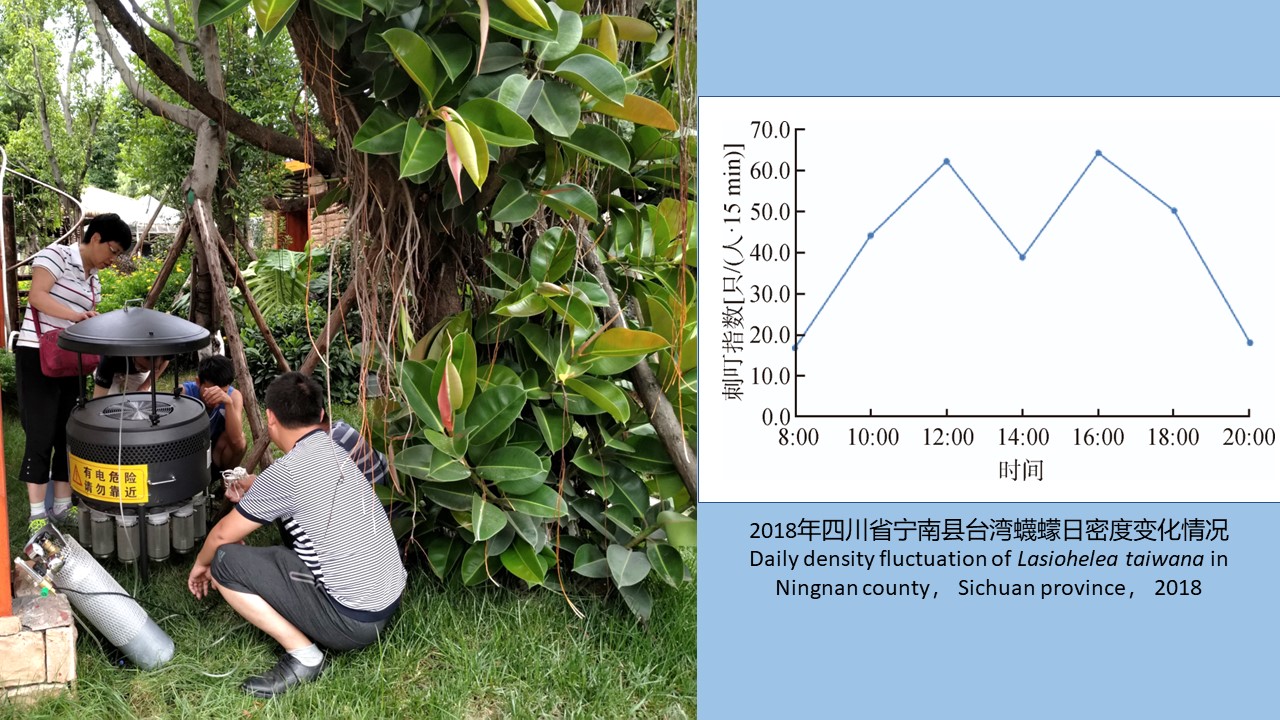
Objective To investigate the population density and seasonal fluctuation of Lasiohelea taiwana in Ningnan county, Sichuan province, China. Methods Three types of habitats (urban, suburban, and rural areas) were selected as monitoring sites. Using the human trap method, researchers exposed their legs to L. taiwana to induce biting in a fixed time period. The biting data of L. taiwana were recorded, and the biting index was calculated. Furthermore, the meteorological data of Ningnan county were collected and analyzed. Results The daily density of L. taiwana in Ningnan county showed two peaks at 12:00[62.0 midges/(person·15 min)] and 16:00[64.0 midges/(person·15 min)]. In terms of seasonal fluctuation from 2018 to 2019, L. taiwana had not been detected from January to May, and began to appear in late June. Its density reached the first peak in September and the second peak at the end of October. Then it decreased rapidly in November until it was undetectable in December. The overall mean density index from June to November were 85.6 midges/(person·15 min) in 2018 and 52.4 midges/(person·15 min) in 2019. The densities of L. taiwana in different habitats were 183.9 midges/(person·15 min) in rural areas, 117.7 midges/(person·15 min) in suburban areas, and 20.0 midges/(person·15 min) in urban areas; 90.9 midges/(person·15 min) in bushes, 52.4 midges/(person·15 min) on lawns; 18.4 midges/(person·15 min) in the bushes on plains, and 5.8 midges/(person·15 min) in the bushes in hilly areas. Conclusion The daily density variation, seasonal fluctuation, and densities in different habitats of L. taiwana in Ningnan county have been preliminarily mastered, which provides a scientific basis for the control of L. taiwana.
HAN Shi-kang, LIU Yu, WANG Song-lin, CHEN Jian-ping, DENG Yong, WANG Pei-zhang, LUO Fa-mei, YU Yi-xin, QIAN Wei-ping
. An investigation and analysis of population density of Lasiohelea taiwana in Ningnan county, Sichuan province, China, 2018-2019[J]. Chinese Journal of Vector Biology and Control, 2022
, 33(3)
: 426
-429
.
DOI: 10.11853/j.issn.1003.8280.2022.03.021
[1] 虞以新. 中国蠓科昆虫[M]. 北京:军事医学科学出版社, 2006:1-39, 1647-1667. Yu YX. Ceratopogonidae of China (Insecta, diptera)[M]. Beijing:Military Medical Science Press, 2006:1-39, 1647-1667. (in Chinese)
[2] 陈亢川. 台湾蠛蠓:一种骚扰人吸血与传播疾病的微小飞虫[J]. 海峡预防医学杂志, 2012, 18(3):18-20. Chen KC. Lasiohelea taiwana Shiraki:A kind of tiny flying insects that harass people to suck blood and spread diseases Strait[J]. Strait J Prev Med, 2012, 18(3):18-20. (in Chinese)
[3] 韩世康, 边绍勇, 王松林, 等. 四川省蠓类一新种和一新纪录(双翅目:蠓科)[J]. 中国媒介生物学及控制杂志, 2020, 31(4):462-464. DOI:10.11853/j.issn.1003.8280.2020.04.017. Han SK, Bian SY, Wang SL, et al. A new species and a new record of midges in Sichuan province, China (Diptera:Ceratopogonidae)[J]. Chin J Vector Biol Control, 2020, 31(4):462-464. DOI:10.11853/j.issn.1003.8280.2020.04.017.(in Chinese)
[4] 郭文泽, 刘国平, 薛万琦. 虎林林区吸血蠓种组成调查及防治对策[J]. 中华卫生杀虫药械, 2008, 14(5):380-381. DOI:10.3969/j.issn.1671-2781.2008.05.020. Guo WZ, Liu GP, Xue WQ. Studies on species composition and control countermeasures of bloodsucking midges in Hulin forest[J]. Chin J Hyg Insect Equip, 2008, 14(5):380-381. DOI:10.3969/j.issn.1671-2781.2008.05.020.(in Chinese)
[5] 刘国平, 李东力, 王继群, 等. 我国东北3省吸血蠓的区系分布[J]. 中国媒介生物学及控制杂志, 2004, 15(1):40-42. DOI:10.3969/j.issn.1003-4692.2004.01.016. Liu GP, Li DL, Wang JQ, et al. Faunal distribution on bloodsucking midges in three provinces of Northeast China[J]. Chin J Vector Biol Control, 2004, 15(1):40-42. DOI:10.3969/j.issn.1003-4692.2004.01.016.(in Chinese)
[6] 刘国平, 徐政府, 陶增珖, 等. 东北边境地带吸血蠓的区系和生态研究[J]. 生态学杂志, 1992, 11(4):18-21, 40. Liu GP, Xu ZF, Tao ZG, et al. Faunal and ecological studies on blood-sucking midges along the border line of Northeast China[J]. Chin J Ecol, 1992, 11(4):18-21, 40. (in Chinese)
[7] 曾若雪, 何永强, 莫虹斐, 等. 浙江省舟山市金塘地区库蠓种群调查研究[J]. 中国媒介生物学及控制杂志, 2018, 29(5):476-478. DOI:10.11853/j.issn.1003.8280.2018.05.014. Zeng RX, He YQ, Mo HF, et al. Investigation on the populations of Culicoides midges in Jintang district of Zhoushan in Zhejiang province[J]. Chin J Vector Biol Control, 2018, 29(5):476-478. DOI:10.11853/j.issn.1003.8280.2018.05.014.(in Chinese)

