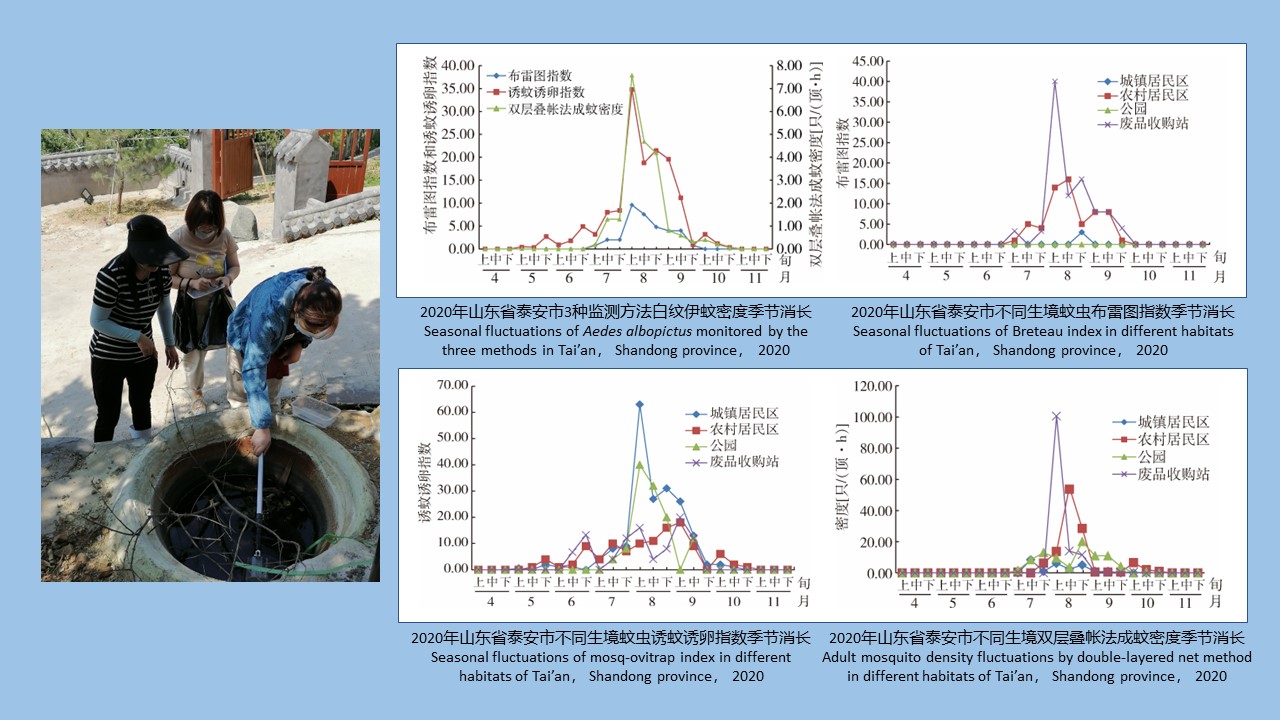
Objective To study the effects of three Aedes albopictus density monitoring methods. Methods One monitoring site each was selected in four types of habitats (urban residential areas, rural residential areas, waste collection stations, and parks) of Tai'an, Shandong province, China. The Breteau index (BI) method, Mosq-ovitrap (MOT) method, and double-layered mosquito net method were used to separately monitor the density of Ae. albopictus once each in the early, middle, and late periods of every month from April to November 2020. Differences in mosquito density were examined using Chi-squared test, and a Pearson correlation analysis was used to analyze the correlation between BI and mosq-ovitrap index (MOI). Results The average BI was 1.57, the average MOI was 6.22, and the average adult mosquitoes density by double-layer net method was 0.05 mosquito/net·h from April to November in 2020. The seasonal fluctuation trend of the three monitoring methods was basically the same, and the peak density was all in early August. Adult Ae. albopictus was detected by MOT method in early May, and Ae. albopictus was detected by BI method and double-layer net method in early July. There was a positive correlation between the BI and the MOI (r=0.957, P<0.001), and there was a positive correlation between the MOI and the adult mosquitoes density by double-layer (r=0.914, P<0.001), and there was a positive correlation between the BI and the adult mosquitoes density using double-layer net method (r=0.934, P<0.001). the BI in waste collection station (5.16)>in rural residential area (3.10)>in urban residential area (0.11)>in park (0.00). the MOI of park (6.90)>urban residential area (6.82)>rural residential area (5.55)>waste collection station (4.84). The adult mosquitoes density by double-layer net method in waste collection station (mosquito/net·h) (0.32)>rural residential area (0.30)>park (0.22)>urban residential area (0.06). Conclusion The density index of Ae. albopictus monitored by the MOT method is relatively high, which can reflect the density level of Ae. albopictus at an earlier time to provide an earlier warning of mosquito-borne diseases in Tai'an city. The BI method and double-layer net method are suitable for density surveillance during the peak period of Ae. albopictus.
MA De-zhen, SONG Wei, XU Yan, LIU Huan-yan
. Comparison of three Aedes albopictus density monitoring methods[J]. Chinese Journal of Vector Biology and Control, 2022
, 33(3)
: 336
-339
.
DOI: 10.11853/j.issn.1003.8280.2022.03.004
[1] 刘起勇. 寨卡病毒媒介伊蚊控制策略和措施展望[J]. 中国媒介生物学及控制杂志, 2016, 27(2):93-98. DOI:10.11853/j.issn.1003.8280.2016.02.001. Liu QY. Prospects on Zika virus vector control measures and strategy[J]. Chin J Vector Biol Control, 2016, 27(2):93-98. DOI:10.11853/j.issn.1003.8280.2016.02.001.(in Chinese)
[2] 景晓, 康殿民, 王学军. 蚊媒传染病监测技术及应用[M]. 济南:山东人民出版社, 2017:702-763. Jing X, Kang DM, Wang XJ. Monitoring technologies and their application of mosquito borne infectious diseases[M]. Ji'nan:Shandong People's Publishing House, 2017:702-763. (in Chinese)
[3] 李天奇, 刘钦梅, 吴瑜燕, 等. 浙江省登革热重点地区2020年白纹伊蚊幼蚊种群密度监测分析[J]. 中国媒介生物学及控制杂志, 2022, 33(1):21-24, 37. DOI:10.11853/j.issn.1003.8280. 2022.01.004. Li TQ, Liu QM, Wu YY, et al. Surveillance of the population density of Aedes albopictus larvae in dengue prone and risk areas of Zhejiang province, China, 2020[J]. Chin J Vector Biol Control, 2022, 33(1):21-24, 37. DOI:10.11853/j.issn.1003. 8280.2022.01.004.(in Chinese)
[4] 田野, 吴治明, 张恒端, 等. 3种监测方法对白纹伊蚊成蚊密度监测效果比较研究[J]. 中国媒介生物学及控制杂志, 2018, 29(6):586-589. DOI:10.11853/j.issn.1003.8280.2018.06.008. Tian Y, Wu ZM, Zhang HD, et al. Efficiency of three monitoring methods for the density of adult Aedes albopictus:A comparative analysis[J]. Chin J Vector Biol Control, 2018, 29(6):586-589. DOI:10.11853/j.issn.1003.8280.2018.06.008.(in Chinese)
[5] 刘彬彬, 王家豪, 位广帅, 等. 诱蚊诱卵器与BGS-trap捕蚊器应用效果研究[J]. 河南大学学报(医学版), 2018, 37(4):254-256, 264. DOI:10.15991/j.cnki.41-1361/r.2018.04.007. Liu BB, Wang JH, Wei GS, et al. Study on the efficiency between ovitrap and BG-sentinel trap[J]. J Henan Univ:Med Sci, 2018, 37(4):254-256, 264. DOI:10.15991/j.cnki.41-1361/r.2018. 04.007.(in Chinese)
[6] Gao Q, Wang F, Lyu XH, et al. Comparison of the human-baited double net trap with the human landing catch for Aedes albopictus monitoring in Shanghai, China[J]. Parasit Vectors, 2018, 11(1):483. DOI:10.1186/s13071-018-3053-8.
[7] 郭玉红, 吴海霞, 刘小波, 等. 2018年全国媒介蚊虫监测报告[J]. 中国媒介生物学及控制杂志, 2019, 30(2):128-133. DOI:10.11853/j.issn.1003.8280.2019.02.003. Guo YH, Wu HX, Liu XB, et al. National vectors surveillance report on mosquitoes in China, 2018[J]. Chin J Vector Biol Control, 2019, 30(2):128-133. DOI:10.11853/j.issn.1003. 8280.2019.02.003.(in Chinese)

