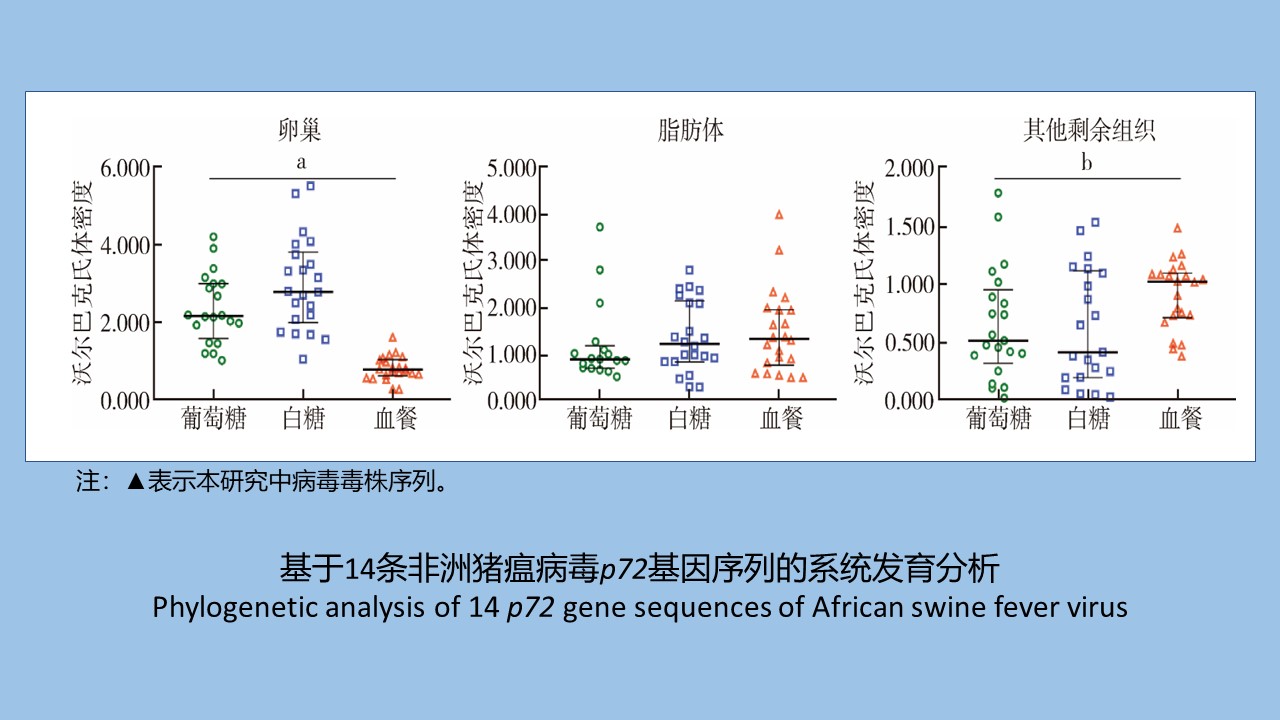
Objective To investigate the effects of different diets on the density of Wolbachia in the ovary, fat body, and the other tissues in female Aedes aegypti of the WB strain. Methods After eclosion, Ae. aegypti mosquitoes of the WB strain were divided into glucose group (fed with glucose), white sugar group (fed with white sugar), and blood group (fed with blood for 2 hours on the 3rd day). Mosquitoes in each group were collected on days 4, 4.5, 5, and 6 to harvest the ovary, fat body, and the other tissues. DNA was extracted to determine the density of Wolbachia in all tissues using quantitative real-time PCR. SPSS 20.0 software was used for data analysis. The Kruskal-Wallis H test was used to compare the density of Wolbachia under different diets and at different days of age.Results On day 4.5, Wolbachia densities in the ovary in the glucose, white sugar, and blood groups were 2.149, 2.773, and 0.761, respectively, with a statistically lower density in the blood group (H=40.754, P<0.001); Wolbachia densities in the fat body in the three groups were 0.859, 1.189, 1.298, respectively, and the differences were not statistically significant (H=1.631, P=0.442). Wolbachia densities in the other tissues were 0.505, 0.405, 1.012, respectively, and the differences were not statistically significant (H=6.306, P=0.043). Under different diets but at the same days of age, Wolbachia densities in the ovary were lowest in the blood group on days 4, 5, and 6, and highest in the white sugar group on days 4 and 6 (H=14.335, P=0.001; H=22.049, P<0.001; H=4.266, P=0.084); for the fat body on days 4 and 6 and the other tissues on days 4, 5, and 6, Wolbachia densities were highest in the blood group, followed by the white sugar group, and lowest in the glucose group (H=7.186, P=0.028; H=10.504, P=0.005; H=16.338, P<0.001; H=14.083, P=0.001; H=4.266, P=0.118). At different days of age but under the same diets, Wolbachia densities in the ovary, fat body, and the other tissues in the glucose group had no statistical differences between different days of age (H=4.683, P=0.096; H=2.451, P=0.294; H=0.293, P=0.864); under the white sugar diet, Wolbachia densities in the ovary and fat body were no statistically increased with days of age (H=4.731, P=0.094; H=0.390, P=0.823); under the blood diet, Wolbachia densities in the ovary and fat body were first decreased and then increased with days of age (H=20.572, P<0.001; H=9.675, P=0.008). Conclusion Feeding blood reduces the density of Wolbachia in the reproductive tissue but increases its density in the non-reproductive tissues of Ae. aegypti mosquitoes of the WB strain. Under laboratory conditions, the mosquitoes can be fed with white sugar to increase the density of Wolbachia in the body.
[1] Pfarr K, Foster J, Slatko B, et al. On the taxonomic status of the intracellular bacterium Wolbachia pipientis:Should this species name include the intracellular bacteria of filarial nematodes?[J]. Int J Syst Evol Microbiol, 2007, 57(Pt 8):1677-1678. DOI:10.1099/ijs.0.65248-0.
[2] 潘晓玲, 刘起勇, 奚志勇. 基于昆虫共生菌沃尔巴克氏体的蚊媒和蚊媒病控制研究进展[J]. 中国媒介生物学及控制杂志, 2014, 25(1):1-7. DOI:10.11853/j.issn.1003.4692.2014.01.001. Pan XL, Liu QY, Xi ZY. Advance in developing Wolbachia as a mean to control mosquito and mosquito-borne diseases[J]. Chin J Vector Biol Control, 2014, 25(1):1-7. DOI:10.11853/j.issn. 1003.4692.2014.01.001.(in Chinese)
[3] Beckmann JF, Ronau JA, Hochstrasser M. A Wolbachia deubiquitylating enzyme induces cytoplasmic incompatibility[J]. Nat Microbiol, 2017, 2(5):17007. DOI:10.1038/nmicrobiol. 2017.7.
[4] Moreira LA, Iturbe-Ormaetxe I, Jeffery JA, et al. A Wolbachia symbiont in Aedes aegypti limits infection with dengue, Chikungunya, andPlasmodium[J]. Cell, 2009, 139(7):1268-1278. DOI:10.1016/j.cell.2009.11.042.
[5] Lu P, Sun Q, Fu P, et al. Wolbachia inhibits binding of dengue and Zika viruses to mosquito cells[J]. Front Microbiol, 2020, 11:1750. DOI:10.3389/fmicb.2020.01750.
[6] Lu P, Bian GW, Pan XL, et al. Wolbachia induces density-dependent inhibition to dengue virus in mosquito cells[J]. PLoS Negl Trop Dis, 2012, 6(7):e1754. DOI:10.1371/journal.pntd. 0001754.
[7] Martinez J, Tolosana I, Ok S, et al. Symbiont strain is the main determinant of variation in Wolbachia-mediated protection against viruses across Drosophila species[J]. Mol Ecol, 2017, 26(15):4072-4084. DOI:10.1111/mec.14164.
[8] Waltz E. US government approves 'killer' mosquitoes to fight disease[J]. Nature, 2017. DOI:10.1038/nature.2017.22959.
[9] Ritchie SA, Van Den Hurk AF, Smout MJ, et al. Mission accomplished? We need a guide to the 'post release' world of Wolbachia for Aedes-borne disease control[J]. Trends Parasitol, 2018, 34(3):217-226. DOI:10.1016/j.pt.2017.11.011.
[10] Zheng XY, Zhang DJ, Li YJ, et al. Incompatible and sterile insect techniques combined eliminate mosquitoes[J]. Nature, 2019, 572(7767):56-61. DOI:10.1038/s41586-019-1407-9.
[11] World Health Organization. Global strategy for dengue prevention and control, 2012-2020[DB/OL]. (2012-08-22)[2021-12-10]. https://www.afro.who.int/publications/global-strategy-dengue-prevention-and-control-2012-2020.
[12] Xi ZY, Khoo CCH, Dobson SL. Wolbachia establishment and invasion in an Aedes aegypti laboratory population[J]. Science, 2005, 310(5746):326-328. DOI:10.1126/science.1117607.
[13] Ahmad NA, Mancini MV, Ant TH, et al. Wolbachia strain wAlbB maintains high density and dengue inhibition following introduction into a field population of Aedes aegypti[J]. Philos Trans Roy Soc B Biol Sci, 2021, 376(1818):20190809. DOI:10.1098/rstb.2019.0809.
[14] 邱洁如, 郑小英, 吴瑜. Wolbachia基因组研究进展[J]. 热带医学杂志, 2017, 17(2):274-277. DOI:10.3969/j.issn.1672-3619.2017.02.037. Qiu JR, Zheng XY, Wu Y. The research progress on Wolbachia genomes[J]. J Trop Med, 2017, 17(2):274-277. DOI:10.3969/j.issn.1672-3619.2017.02.037.(in Chinese)
[15] Caragata EP, Rancès E, O'Neill SL, et al. Competition for amino acids between Wolbachia and the mosquito host, Aedes aegypti[J]. Microb Ecol, 2014, 67(1):205-218. DOI:10.1007/s00248-013-0339-4.
[16] Jiménez NE, Gerdtzen ZP, Olivera-Nappa Á, et al. A systems biology approach for studying Wolbachia metabolism reveals points of interaction with its host in the context of arboviral infection[J]. PLoS Negl Trop Dis, 2019, 13(8):e0007678. DOI:10.1371/journal.pntd.0007678.
[17] Serbus LR, White PM, Silva JP, et al. The impact of host diet on Wolbachia titer in Drosophila[J]. PLoS Pathog, 2015, 11(3):e1004777. DOI:10.1371/journal.ppat.1004777.
[18] 陈玲玲, 王政艳, 胡蓉, 等. 埃及伊蚊体内wAlbB株沃尔巴克氏体感染的时空分布[J]. 中国病原生物学杂志, 2021, 16(1):71-75. DOI:10.13350/j.cjpb.210114. Chen LL, Wang ZY, Hu R, et al. The temporal and spatial distribution of the density of infection with the Wolbachia strain wAlbB in Aedes aegypti[J]. J Pathog Biol, 2021, 16(1):71-75. DOI:10.13350/j.cjpb.210114.(in Chinese)
[19] Monash University. World mosquito program[DB/OL]. (2018-05-30)[2021-10-10]. https://www.worldmosquitoprogram.org/.
[20] Ponton F, Wilson K, Holmes A, et al. Macronutrients mediate the functional relationship between Drosophila and Wolbachia[J]. Proc Roy Soc B Biol Sci, 2015, 282(1800):20142029. DOI:10.1098/rspb.2014.2029.
[21] Cosgrove JB, Wood RJ. Effects of variations in a formulated protein meal on the fecundity and fertility of female mosquitoes[J]. Med Vet Entomol, 1996, 10(3):260-264. DOI:10.1111/j.1365-2915.1996.tb00740.x.
[22] Marques J, Cardoso JCR, Felix RC, et al. Fresh-blood-free diet for rearing malaria mosquito vectors[J]. Sci Rep, 2018, 8(1):17807. DOI:10.1038/s41598-018-35886-3.
[23] Gulia-Nuss M, Elliot A, Brown MR, et al. Multiple factors contribute to anautogenous reproduction by the mosquito Aedes aegypti[J]. J Insect Physiol, 2015, 82:8-16. DOI:10.1016/j.jinsphys.2015.08.001.
[24] Castillo J, Brown MR, Strand MR. Blood feeding and insulin-like peptide 3 stimulate proliferation of hemocytes in the mosquito Aedes aegypti[J]. PLoS Pathog, 2011, 7(10):e1002274. DOI:10.1371/journal.ppat.1002274.
[25] Wen ZM, Gulia M, Clark KD, et al. Two insulin-like peptide family members from the mosquito Aedes aegypti exhibit differential biological and receptor binding activities[J]. Mol Cell Endocrinol, 2010, 328(1/2):47-55. DOI:10.1016/j.mce.2010.07.003.
[26] Teleman AA. Molecular mechanisms of metabolic regulation by insulin in Drosophila[J]. Biochem J, 2010, 425(1):13-26. DOI:10.1042/BJ20091181.
[27] Noda T. Regulation of autophagy through TORC1 and mTORC1[J]. Biomolecules, 2017, 7(3):52. DOI:10.3390/biom7030052.
[28] Deehan M, Lin W, Blum B, et al. Intracellular density of Wolbachia is mediated by host autophagy and the bacterial cytoplasmic incompatibility gene cifB in a cell type-dependent manner inDrosophila melanogaster[J]. mBio, 2021, 12(1):e02205-20. DOI:10.1128/mBio.02205-20.
[29] Hansen IA, Attardo GM, Park JH, et al. Target of rapamycin-mediated amino acid signaling in mosquito anautogeny[J]. Proc Natl Acad Sci USA, 2004, 101(29):10626-10631. DOI:10.1073/pnas.0403460101.
[30] Hansen IA, Attardo GM, Rodriguez SD, et al. Four-way regulation of mosquito yolk protein precursor genes by juvenile hormone-, ecdysone-, nutrient-, and insulin-like peptide signaling pathways[J]. Front Physiol, 2014, 5:103. DOI:10.3389/fphys. 2014.00103.
[31] Weng SC, Shiao SH. The unfolded protein response modulates the autophagy-mediated egg production in the mosquito Aedes aegypti[J]. Insect Mol Biol, 2020, 29(4):404-416. DOI:10.1111/imb.12645.
[32] Kokoza VA, Martin D, Mienaltowski MJ, et al. Transcriptional regulation of the mosquito vitellogenin gene via a blood meal-triggered cascade[J]. Gene, 2001, 274(1/2):47-65. DOI:10.1016/s0378-1119(01)00602-3.
[33] Guo Y, Hoffmann AA, Xu XQ, et al. Vertical transmission of Wolbachia is associated with host vitellogenin in Laodelphax striatellus[J]. Front Microbiol, 2018, 9:2016. DOI:10.3389/fmicb.2018.02016.
[34] Camacho M, Oliva M, Serbus LR. Dietary saccharides and sweet tastants have differential effects on colonization of Drosophila oocytes by Wolbachia endosymbionts[J]. Biol Open, 2017, 6(7):1074-1083. DOI:10.1242/bio.023895.
[35] 孙建新, 谭璟宪. 东乡伊蚊自殖株和非自殖株卵巢发育动态的比较研究[J]. 第二军医大学学报, 1989, 10(2):133-137, 144. DOI:10.16781/j.0258-879x.1989.02.016. Sun JX, Tan JX. Comparative study of the ovary development in autogenous and anautogenous strains of Aedes togoi[J]. Acad J Second Mil Med Univ, 1989, 10(2):133-137, 144. DOI:10.16781/j.0258-879x.1989.02.016.(in Chinese)
[36] Johnson KN. The impact of Wolbachia on virus infection in mosquitoes[J]. Viruses, 2015, 7(11):5705-5717. DOI:10.3390/v7112903.

